Monday, January 30, 2017

Comparing modern irons vs. the Ping Eye 2 with Fried Eggs Golf

Here’s an interesting video from Fried Eggs Golf testing a series of different Ping irons, from a blade style design to a player’s cavity back design to a game improvement and then comparing them to the old Ping Eye 2. All with 7-irons.


Two of the more interesting aspects of the video were:

1. How the launch angle and peak height metrics were almost the same for each of the modern clubs.

2. Obviously, the Ping Eye 2 going further than the players’s CB (i200’s) and just a bit shorter than the modern Game Improvement irons.

I would have thought that the Ping Eye 2 would go shorter due to the advancements in design, the possibility of the steel in the head softening over time and I would presume the higher lofts. Chances are the distance was helped by the more worn down grooves because the grooves being worn down are more likely to produce a higher launch and lower spin than fresh new grooves on the same club. In all likelihood, the Ping Eye 2 likely will still fly as far for this golfer as the modern i200’s if the grooves were new.


***


One of the things I wanted to examine with this is the possibility of the impact that finding irons that one can hit further would have on a golfer’s game. As we can see from the video, the lofts are much stronger on the player’s CB and game improvement irons.

Many golfers feel this is ‘cheating your distances’ because the game improvement iron has 4 degrees lower loft than the i-Blade model. Essentially, the thought is that the player who hits the Game Improvement 7-iron is only hitting the ball longer because the loft of the club is more like a 6-iron than the 7-iron for the iBlade.

Fair enough.

The other thing as noted in the video, is that the spin rate for the game improvement iron is significantly less, so you may have more difficulty holding the green.

However, I feel there is some short sighted logic in that regard. The big thing is that while the game improvement iron may spin less, you’re also using 1 less club. In this scenario, if you have a 170 yard shot, you may use a 7-iron with the iBlade model, but you’re going to use an 8-iron with the game improvement iron. And thus the extra spin you get from going to 1 shorter club may make up for the less spin the game improvement irons provide.


***

In order to test this out, I took the mean for each of the key ball metrics provided in the video:

- Ball Speed
- Launch Angle
- Spin Rate

Fried Eggs golf only provides the data for a 7-iron. So, what I did was take Trackman’s PGA Tour averages

I used this data to determine what the gap’s should roughly be for each club with regards to ball speed, launch angle and spin rate.

From there, I went onto FlightScope’s Trajectory Optimizer (http://flightscope.com/products/trajectory-optimizer/), I set the horizontal launch at 0 degrees (straight shot) and set the altitude at 100 feet and here’s the final numbers I came up with on the iBlade vs. the game improvement iron


The graph shows pretty clearly that the when you adjust for using 1 less club with the game improvement iron, the roll distance is almost exactly the same.  For example, the Game Improvement 6-iron is projected to roll 3.8 yards versus the i-Blade 5-iron which is projected to roll 4.0 yards.  In this scenario, the game improvement iron will travel a *total* of 1.7 yards futher, but actually roll -0.2 yards less.

Of course, there is a lot of assumptions going on here. Furthermore, I’m not saying that a golfer should go to a game improvement iron. But, there is some real value to finding a set of irons you can hit further.

The main one I point to is that hitting irons 1 club length longer is more likely to help you hit them straighter provided the shaft lengths are the same. For starters, you will be using a shorter shafted club which tends to be easier to control. Secondly, you’re likely to increase the Spin Loft with 1 less club (Dynamic Loft – Attack Angle = Spin Loft) and we know that the higher the spin loft, the less the ball’s spin axis will tilt which helps you to hit a straighter shot.

It’s still more important to be fit for the irons that you hit best overall and again, I think finding longer shafted irons that you hit longer is counterproductive. You also have to worry about the how well the weight of the club and the sole grind fits your swing. But, if you can find irons that check off all of those boxes, it could be very well worth getting over the look and feel of the irons for 1 extra club of distance.


3JACK

Sunday, January 29, 2017

Update on 3Jack Golf


I apologize to all of the readers for having not updated you on my status as I haven't updated the blog since last August.  Here's a bit of a rundown on my life.

1.  I was laid-off from my job over the past 6 years back in June and was called back to work 2 weeks from the date I was let go.  By then I had already looked for different jobs and found a new job that paid me substantially more in south Florida.  So for 5 weeks I was feverishly looking for jobs and then moving to south Florida and getting acclimated with the area and quite frankly the entire process would make my head spin.


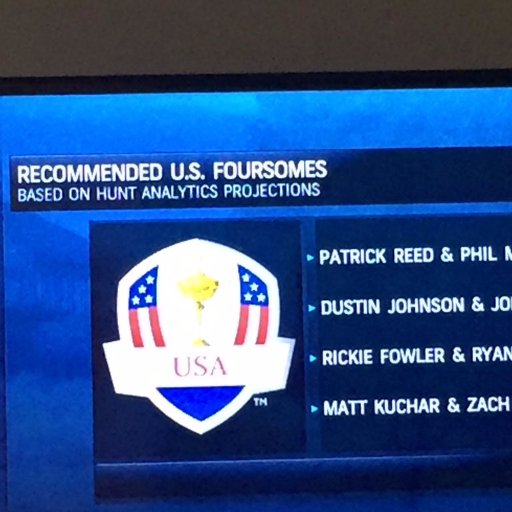
2.  While working on 2016 Pro Golf Synopsis, I had the honor of providing statistical analysis on the Ryder Cup for The Golf Channel as well as doing statistical analytics for numerous Tour players, coaches and their caddies that took away time from being able to finish 2016 Pro Golf Synopsis.


3.  My mother unexpectedly passed away after Thanksgiving.  This has been a very trying time for myself and my family.  I was very close to my mom and she bought me my first Bill James Historical Baseball Abstract when I was 10 years old as well as driving me to the golf course and me and my friends to numerous golf tournaments when I was a junior golfer.  So as hard as it has been to lose my mother, the game of golf always reminds me of her.  That put off 2016 Pro Golf Synopsis.


4.  I then quit my job down in South Florida and relocated back to the central Florida area with a new job which again...took time away from finishing 2016 Pro Golf Synopsis.


Status on 2016 Pro Golf Synopsis - I hope to finish it by the end of February.  It will be an abbreviated version with all of the normal information and the player-by-player analysis.  However, I will only have 2 essays instead of the normal 3 or 4 essays.  I suspect the book will still be about 300+ pages long.  Due to the delay and 'less' information, I will be offering the book at the reduce price of $7.50.


Status on the Blog - I plan on getting the blog going starting tomorrow.  I will likely update it every Monday thru Thursday.  I will try to update on Friday, but there has been a downward trend in the amount of new content on the internet these days.

I plan on making the blog more of a video blog (vlog) come Summer of this year.  That will consist of putting content on my YouTube channel, Instagram and Periscope.  I am also looking into a weekly golf podcast, but that will likely not start until 2018.


Status on my own game - Before I moved to south Florida in July, I was arguably playing the best golf of my life.  I shot 65 on five different occasions from March to June (my lowest score ever is 64).  And I was logging in a lot of sub-70 rounds on 7,000+ yard courses.  I had gotten my club head speed up as high as 117 mph on Trackman and was averaging 114 mph.  

When I moved to south Florida, the transition meant far less time to work on my game and I became very inconsistent and had to work out the kinks which took me a couple of months.  I started to get my game back into decent shape in December, but a step below where it was back in June.  

The past couple of weeks I have been working on a couple of new pieces and I like where it is headed.  My results on 'good swings' are better than my previous 'good swings' which I think is critical when making changes to your swing.  I now have to get more reps in to work out those 3-4 bad swings per round.  

I hope to get some video of my swing here in the next couple of weeks and get a What's In The Bag post sometime this week.

I thank all of you for your following and those that have inquired about the status of the blog and all of the encouragement you have graciously given me.  If you have any questions or comments, feel free to e-mail me at progolfsynopsis@yahoo.com


3JACK


Wednesday, August 10, 2016

Andre Van Staden Analyzes Mr. 58's Swing

Here's a video from instructor, Andre Van Staden, analyzing what makes Jim Furyk's swing so good:


3JACK

Wednesday, August 3, 2016

Dana Dahlquist and the Flat Spot in the Golf Swing

Here's a video from Dana Dahlquist with his student discussing angle of attack and the flat spot.


Some golfers may not understand the importance of the flat spot.  I had first heard the 'flat spot' bandied about by Jim McLean in one of his books (I think it was The 8 Step Swing).  IIRC, all McLean discussed was his belief that a flat spot existed and that you wanted to hit your driver on the flat spot.

It wasn't until recently that Chris Como and Dr. Sasho MacKenzie started to research the flat spot and found that it did exist and the longer the flat spot, the better.  The long the flat spot it creates more speed due to creating more parametric acceleration.  Furthermore, it makes the golfer more consistent and more accurate.

This is what I think was the real secret to Moe Norman's success.  Watch this video of Moe hitting balls.  At this point, Moe's eyesight is becoming an issue and he was grossly overweight and in his 60's.


Moe is still hitting the ball well, but you can see instances where his club head is hitting the turf further back, behind the ball.  Yet...he still hits the ball well.

What we also know about Moe?

He was known for small divots or almost no divot.  As Moe said 'bacon strips, not pork chops.'

Of course, some will dispute that Moe wasn't long.  However, these people usually saw Moe when he was in his 50's and 60's and was out-of-shape.  A few years ago I was told that Moe's driver weighed in at 465 grams.  I've been known to have a heavy driver and at its heaviest mine weighed 337 grams.

That's 128 grams heavier than my driver!

So if you find a way to lengthen that flat spot, I say go for it.


3JACK

Tuesday, August 2, 2016

Golf and Visualization with Eric Jones

Here's a couple of videos from Eric Jones discussing visualization in the golf swing.  I've found that quality visualization has a far larger reaching impact on your performance than consciously thinking about swing mechanics.


It's not that swing mechanics are unimportant, but being able to sense and feel those swing mechanics BEFORE you make your swing is something that I have found enables me to execute those mechanics and perform better than when I consciously think about swing mechanics.

A long time ago I had read an article about Fred Couples.  In the article they asked Fred how he hits a draw.  He says he visualizes a draw in his pre-shot routine and he hits the draw.  The same with a fade.

For years...I thought Couples was either goofing on the interviewer or was some surreal talent (well, he is that) that could make that work, but no ordinary human could reproduce that type of magic.

After understanding visualization better, I started to be able to do the same thing.  Instead of thinking about mechanics to hit a draw on command, I would visualize the shot and sense the swing I needed to make to produce that shot BEFORE I swung the club and I started producing that shot on command.

What I have seen thus far is when I can really visualize the ball's flight trajectory and then visualize myself making the swing I want to make, that's when I hit pay dirt and golf becomes really easy for me.  It's almost like an out-of-body experience of not only visualizing, but actually feeling the muscles, the balance of your body, etc. hitting the shot despite the fact that I'm standing behind the ball in my pre-shot routine.

Hall of Famer and arguably the greatest left hand pitcher of all time, Steve Carlton, was known to visualize himself getting into 'the zone' before a game and obviously it worked quite well for him.  I hope to have more blog posts on this to come.


3JACK

Thursday, July 28, 2016

Scott Hamilton on BodiTrak

Here's a video from Scott Hamilton on how he uses the BodiTrak sytem.


3JACK

Wednesday, July 27, 2016

Kelvin Miyahira Analyzes Henrik Stenson's Golf Swing

Here's Kelvin Miyahira on his analysis of Henrik Stenson's golf swing


3JACK