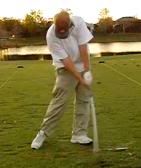
Here's an update swing video filmed today. I said I would film it when I thought it was pretty close. I think from the Face On view it is 'close to being close.' The DTL view still has things to work on, so I didn't post it up here.
Was thinking about this the other day...what path will the future of golf instruction go into?
Here's some of my thoughts:
1. Trackman and Trackman like devices will be the norm.
It seems like the logical step to me. At the 2011 PGA Merchandise show there was an abundance of these type of launch monitors that not only measure the ball, but measure (or calculate) the club dimensions thru impact. Trackman will likely be the ‘top dog’ in the launch monitor industry with FlightScope right on its tail. Hopefully when we get some people like John Graham (www.johngrahamgolf.com) doing side by side comparisons of Trackman vs. the new FlightScope product we’ll see how accurate it is. But the ‘mini-Trackman’ devices were in full force at the PGA Show, much like the Pocket Pro.
I remember getting a lesson with a PGA professional back in 1995 who used a video camera and drew plane lines on the camera. Back then, that was considered RADICAL and many eschewed the idea of using video at all, regardless if you were using line drawing. I had people saying ‘looking at your swing on video will only screw up your game.’ By 2000, everybody and their mother was using video and drawing lines. So my guess is that Trackman, which has been eschewed by many in the golf instruction community, will eventually become all of the rage by 2015.
2. Casio cameras will be more or less mandatory
The main reason for this is today’s Casio line of cameras are not much more expensive than a decent camcorder, plus you can use the Casio for regular picture taking as well. And the technology for Casio keeps getting better and better. My Casio EX-FH20 cost me $240 which included everything (tax and shipping as well) and I will probably purchase another one of the newer models in the next year or 18 months.
3. D-Plane will be readily accepted and teachers will act like they always knew about it, when they didn’t.
I actually didn’t think this would happen until last month when Dr. Gary Wiren (the main dude that directs the PGA with regards to teaching) was supposedly at the PGA Teaching Summit with the Trackman guys saying how great D-Plane was. Then to top it off, Wiren supposedly (I wasn’t there) claimed that his ball flight laws he outlined in the PGA Manuals were not wrong.
Well, whatever.
But you get the idea here, it’s going to be accepted and put into teaching and 9 out of 10 instructors will act like that’s how they always teached the ball flight laws. Still though, I’ve seen plenty of instructors memorize the correct laws of ball flight, but putting them into practice is a different story.
4. Putting Instruction Will Revolve More Around AimPoint Green Reading and Putter Fitting
AimPoint Golf is expanding it’s instruction around the nation and now internationally. I don’t think it will be something that is at every instructional facility or known by every instructor, but it will likely become very popular throughout the US and something that every section will have somebody who has heard of it or has learned it.
The problem they face is probably the golfer’s unwillingness to go against their instincts and most golf instruction revolves around the swing while putting is an afterthought.
Since AimPoint Golf and Edel Golf have formed a partnership, I expect that more instructors and more putter companies will focus harder on proper aim. However, learning touch/speed will still fall way behind.
5. Some Stack and Tilt, Then Some Old School
I think for the next 5-10 years more instruction will favor a Stack and Tilt style swing. I think S&T sorta had a ‘hiccup’ as far as popularity goes as golfers seemed to be willing to try it when the first Golf Digest article came out and then it sunk in popularity a bit and now it seems to be making a rise again, particularly with the noticeable similarities of S&T and what Tiger Woods has done with his golf swing. But, golf instruction is a lot like fashion, a trend takes over and then it goes away only to come back years later. My guess is that the S&T popularity will subside eventually and then the trend will be more like a Jimmy Ballard swing with a big move off the ball and then a big move back to the ball. Throw that in with some D-Plane knowledge and more instructors having Trackman and some getting into the 6* 3D machines.
6. Sadly An Old Friend Fades Away
Sadly I believe that TGM will start to fade away. Not because it’s invalid or won’t help golfers, but there’s been a lot of former AI’s that I’ve talked with that are very unhappy with the company’s direction and other instructors who would typically become an AI, but don’t like what they see either.
The rumor now going around is that they do not give the GSED designation out anymore. If true, it reminds me of going to get a job evaluation at your work and them telling you that on a scale of 1 to 5 ‘nobody is allowed to receive a 5.’ Well, what are we trying to achieve then…sub-excellence?
7. The PGA Loses Membership As Well
I don’t hate the PGA by any means, but I often think they do a poor job by its members. Years ago a friend of mine finally got the Head Pro job at a club and was fired for what was a ridiculous reason. I can’t even say he ‘made an offense’ because he didn’t. But where was the PGA to help mediate this matter? Where they usually are…nowhere. And my friend faced the choice of ‘being sent down to the minors’ going back as an Assistant and seeing his pay cut by 2/3rds or finding a new job. He eventually decided to go back to school and get his law degree and passed the bar. But too many pros don’t have those options.
More and more golf clubs do not care if you are a member of the PGA and very few instruction facilities care at all. I think more and more pros seem to realize this and the costs associated with being a PGA Member and have deemed it a waste of time and money.
Here's a video from S&T instructor, Paul Gorman, going over his thoughts on posture and turning the shoulders in a circle (aka turning the shoulders 90* with relation to the spine).
Like I mentioned in my PGA Merchandise Show journal, I purchased an Edel putter and should be receiving it hopfully later this February or early March. Here's a promotional video for Edel putters going over the process of their fitting as well.
One of the things that has intrigued me and bothered me at the same time was the Slate.com articles on 'MoneyGolf.' Here's an excerpt about how the stat that matters the most on the PGA Tour is the long game.
If you've been reading Moneygolf this week, you're all too aware of the importance of the long game. If you aggregate all shots taken from more than 100 yards from the green, the pros gain 16 shots per round on mid-handicap golfers. They gain 24 shots on the true duffers—those of us (cough) who have trouble breaking 100. Even the scratch-golfing club ace surrenders 9 strokes to the pros in the long game.
So why is putting important?
Well, from talking to Edel, Mark Sweeney and reading stuff from Geoff Mangum I've come up with some theories.
1. I think the putting skill between amateurs typically has a large discrepancy. I think a scratch golfer probably tends to putt much, much better than just a 5 handicapper. And probably worlds better than your average 10 handicapper who probably putts much worse than the 5 handicapper. So being able to improve your putting if you're an amateur will likely directly correlate to making a sizeable improvement to your handicap.
2. The discrepancy in putting between pros is not all that great on average. I think a lot of this has to do with not only the skill level being pretty similar, but outside forces like the caddies understanding the greens and the cups, there usually isn't a surprise there.
3. The typical PGA Tour player has to putt well to win a tournament, but not necessarily lights out. If a PGA Tour player strikes the ball mediocre, their chances of winning are slim because if you're constantly leaving yourself with 40 foot birdie putts, your chances of making birdies and not 3-putting are very slim.
4. The main crux of putting for the PGA Tour player is that the guys considered to be the best putters are more or less still streaky putters.
Why?
Ballstriking and ballstriking placement plays a big part.
In 2009, Steve Stricker surprised people in the MoneyGolf statistic called 'Putts Gained' by finishing 69th. That's actually still well above average (they measured 166 golfers).
The 'Putts Gained' statistic figures out how a golfer putts against the average of the field. So it's like saying that if you gave everybody the same 100 different putts, in '09 Stricker would've had the 69th amount of putts (Luke Donald finished 1st that year).
Still, Stricker is often considered a top 5 putter on Tour. But the reason why he finished 60th was:
Mr. Stricker, who finished No. 1 in putting average last year largely because of his proficiency with approach shots, ranked a surprising 69th in putts gained per round. (Deeper analysis by MIT showed that Mr. Stricker's ranking was also negatively affected because he happened to play on the "easiest" greens of all 166 players sampled
But it's not only how close you are hitting it to the cup, but where you are locating it as well. As David Orr's 'spider studies' have shown, the putt made most by golfers of all levels is the uphill right to left putt. So if somebody like Gary Woodland hits the ball a little better than normal and just happens to leave himself with uphill right to left putts that day, the typical putting stats will maybe show Woodland 'on fire' with his putting, but the reality is that his ballstriking left him with better opportunities to make putts.
Green Types Make a Difference
One thing I've learned is that some golfers not only putt better or worse on different types of grass, but also different types of green designs.
Some golfers eat up flat greens, some eat up hilly greens. But *nobody* on the PGA Tour putts well everywhere.
And to me, that's why putting is still important. If a Tour player can not only putt a little better, but more consistently better, even if it's just slightly, they have gained a noticeable advantage over the rest of the field which is filled with guys who are, at best, streaky putters.
From what I've gathered from these teachers, the big problem with working with PGA Tour players is that even if the instructor is dead right and the Tour player is dead wrong, the Tour player reasons that their instincts are right because they solely used those instincts to achieve their previous success.
For instance, if a Tour player truly believes a putt will break 8 inches left and no matter how many different ways one can scientifically prove that putt will NEVER go in if they play for 8 inches of break...the Tour player will reason that their instincts are right because that's what they used to achieve their prior wins and other successes.
And it doesn't matter if we're talking about green reading, stroke mechanics, how the brain works, putter fitting, etc....if a PGA Tour player doesn't buy into something, they'll go back to their instincts and always defend those instincts.
From what I gather from these teachers, this is why they often prefer working with amateurs over Tour pros because the amateur is usually more willing to do anything they say. The problem is that they don't have the skill to quite execute it all of the time.
With that, I believe a Tour pro who fully trusts these facets of instruction....green reading, putter fitting, putting mechanics, and touch/speed control....they would be on the path to gain an incredible advantage over the rest of the tour and instead of being a great putter who is streaky, they'll be a great putter who can putt anywhere.
Hopefully this year we'll get a bit more into the 6 degree 3D animation technology when it comes to golf instruction. Here's a video showing a golfer coming over the top on the Motion Golf technology.