Homer Kelley states in order to get consistent impact alignments, you have to prepare for those correct impact alignments. In order to prepare for them, you need to establish what the correct impact alignments are.
First, the clubface must be square to the Target Line at seperation (the point just after impact where the ball 'seperates' from the clubface) if you want to hit a straight shot.
Secondly, the clubface alignment at Impact Fix must fit the hinge action selected. Remember, impact fix is the chosen alignments of the hands, clubshaft, clubface at address. Here's a video of Simon Williams performing impact fix (he has his hands at 'impact hands' at address, but you can also use 'mid-body' hands at address as well)
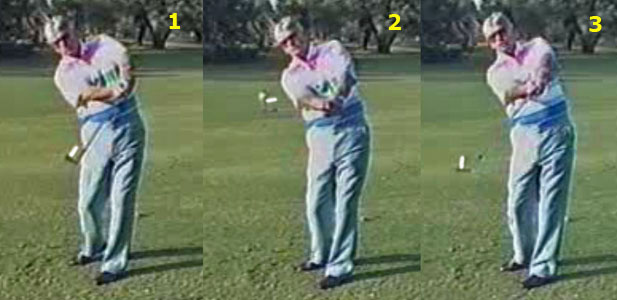
And here's the Tomasello pic again showing the 3 different hinge motions. (1=angled, 2=horizontal, 3=vertical)
Because the toe is pointing at the target with horizontal hinging, which means the clubface is closed quite a bit thru impact, Homer suggests opening the face a little at impact fix to allow for that closing. And yes, GENERALLY speaking the horizontal hinge action produces a draw spin and usually well executed 'swinger' patterns tend to hit draws. Homer also states that with horizontal hinging, it's recommended that the longer the shot, the more open the face should be at impact fix.
With Angled Hinging, Homer recommends an open face on the shorter shots and a closed face on longer shots. And with Vertical Hinging, no clubface alignment adjustments need to be made regardless of the length of the shot.
A couple of other important notes are made. In particular, the clubhead should hit the ball FIRST and THEN take a divot. Here's a KJ Choi SwingVision video showing Choi doing just that.
Lastly, Homer notes that the golfer is likely to see themselves, 'rise' upward when they get to impact...particularly with the driver. What this means is if you sole the club with a driver, you're likely to rise up towards the teed ball so you can hit it properly on the sweetspot. So what Homer Kelley is saying that with a driver you should play the ball more towards the toe of the club. Here's a link to a video by John Graham showing what Homer Kelley was talking about when it came to addressing the ball towards the toe of the club with a driver. Addressing With The Driver Video
Homer states that this method of addressing the ball towards the toe with the driver allows for more precise geometric alignments. With irons it doesn't need to be so much off the toe because you are hitting downward.
2-J-2 (Low Point)
One of the most important parts of TGM is in 2-J-2. Thankfully, it's pretty easy to understand.
Going back to the 'Geometry of the Circle' in the diagram below:
The low point is simply the 'lowest point' of the clubhead as it travels on the Geometry of the Circle. It should also be noted that the 'Low Point' is straight down the line from the left shoulder. It's like that with all golfers (except it's the right shoulder if you're a lefty).
The first KEY is to have the ball position behind the low point. This allows the golfer to hit the ball FIRST, THEN take a divot which means the golfer can properly compress the golf ball. If you get the ball position too far forward up by the low point, then you're more likely to take a divot FIRST and then hit the ball, which results in poor shots. One of the big reasons why 'flipping' (aka a bent left wrist at impact) is a problem is that it moves the low point around. If you 'flip' the low point will move further back in your stance, but it's tough to figure out where the low point will be. If your left wrist is flat, the low point will always be opposite of the left shoulder.
Part 6D of the TGM Translations will only go over Section 2-H (On Plane Acceleration). This is what it sounds like, accelerating while being 'on plane' and the parts and components that play a role in that.
Homer starts of by talking about 'lever assembly.' Lever Assembly is just the alignments of the left shoulder, left arm and clubshaft. When Kelley talks about the 'turning shoulder' (note, it's singular, not plural), he's talking about the left shoulder.
Homer states that the spine is the 'center' of the shoulder turn only. Often times you will hear the spine, from the caddy view, is the 'axis.' S&T guys talk about having a 'centered' or 'reverse' axis tilt. Basically, early on Homer is trying to get into his recommended style of pivot where the head is 'centered.' The centered head abides by one of Homer's '3 Essentials' of the golf swing, the 'stationary head.' This is also a big part of the S&T method. Homer does mention that the Head Centered Pivot is recommended, but not mandatory. Homer also states tha the swing center for all swings has two ends to them. The top end is the top of the head, the bottom end is between the feet.
Homer also talks about the 'on plane' right shoulder. All that is from the DTL view is that the right shoulder goes down the plane. This pic below shows Byron Nelson and Nicklaus having their right shoulder 'on plane.' Golfers who come over the top tend to have the right shoulder above the plane. Golfers who get 'under plane' tend to have the right shoulder under the plane as well.
The important thing to note is that Homer states that 'On Plane Right Shoulder Motion is possible only by titling its axis, the spine.' This of course means that in order to get that right shoulder on plane, from the Caddy View, the 'axis' (aka the spine) has to tilt away from the target on the downswing.
A self explanatory quote from Homer:
Being part of both the Pivot and the Power Package, the Right Shoulder must reconcile them by moving with great precision of thrust, speed, direction and distance. The Right Shoulder does not flap around haphazardly -- it has many responsibilities.
Homer then talks about variations in the location of the right shoulder at impact will vary the right elbow bend at impact which may alter the impact alignment of the clubface.
What Homer is talking about here, and it's VERY IMPORTANT to note, that at impact the right arm should be BENT from the elbow. Here's a dual pic of Moe Norman. On the left, he's at address. On the right, he's at impact.
Notice how at address Moe's right arm is straight and at impact the right arm is clearly bent from the elbow. Now, that's not to say you cannot bend the right arm at address (in fact, Homer Kelley recommended it), but it's to show that the right arm needs to be bent at impact for accurate and consistent clubface alignments at impact. Often you will hear TGM'ers say that they are 'running out of right arm' and all that means is that the right arm is not bent or not bent enough at impact. And to tie this all together, Homer is basically saying that you need 'axis tilt' to get the right shoulder in a good location and on plane at impact so you have enough right elbow bend at impact so you can have very precise clubface alignments. IMO, it's not a coincidence that some of the greatest ballstrikers ever, Trevino, Hogan, Moe, and O'Grady all had a tremendous amount of right elbow bend at impact.
Homer also talks about some other facets of the shoulder alignments, lever assembly radius and low points, but we'll get those later. Homer does state this of importance:
The long Backstroke shoulder turn produces arc of approach procedures. The short shoulder turn produces angle of approach procedures.
Here's what a club using the 'ARC of approach' procedure looks like.
This is obviously a diagram from the bird's eye view. As you can see, the clubhead approaches the ball from an arc. Here's the ANGLE of approach procedure.
This is a diagram for the Stack & Tilt method, but take a look at yellow line labeled 'leaning clubshaft.' Now take a look at the light green line labeled 'Angle of Approach.' Instead of showing a diagram where the clubhead and shaft come into the ball from an arc, this has them coming into the ball at an angle. Thus, the term 'Angle of Approach.' Basically Homer states:
Long Swing with Big Shoulder Turn (usually a 'swinger') = ANGLE of Approach
Short Swing with Short Shoulder Turn (usually a 'hitter') = ARC of Approach
Basically, the main purpose of 2-H (On Plane Acceleration) is to understand the importance of the right shoulder position, the 'centered swing', axis tilt' and what type of golfers should use an Angle vs. Arc Approach.
Part 6C of the TGM translations will only go over Section 2-G.
2-G (Hinge Motion)
Clubface alignment control will control the direction of ball flight. Clubface alignment control is very much dictated by the Hinge Motion in the swing. There are 3 types of hinge motions:
- Horizontal - Angled - Vertical
Now, hinge motion is different from clubface motion. Hinge motion is an actual motion the arms, wrists and hands make as they motion from one position to another. They will often be referred to as:
Horizontal Hinge = Full Roll Angled Hinge = No Roll Vertical Hinge = Reverse Roll
Homer states that while there are 3 hinge motions, there are only 2 clubface motions, and they are 'Close' and 'Layback.' What he's trying to say is that in only 2 of the HINGE motions does the clubface change direction/angle...and those are the Horizontal Hinge (closed face) and Vertical Hinge (layback).
To understand the hinge action in the swing, IF THE CLUBFACE IS SQUARE AT IMPACT, after impact the face can point in the following directions:
Horizontal Hinge = The toe of the clubhead will be pointing at the target.
Vertical Hinge = The clubface will be pointing up at the sky.
Angled Hinge = In between Horizontal and Vertical. The face will be about 45* closed.
This pic of Tom Tomasello shows the hinge motions. There's a white mark on the clubface showing where the clubface is pointing. In these pics it goes:
1 = Angled 2 = Horizontal 3 = Vertical
The Horizontal Hinge calls for a 'full roll of the clubface', but Homer Kelley states that the hands actually do NOT roll. He also states there will not be a change in grip, grip type, impact fix or anything else. Very important to understand for now, but the real benefit of understanding this is figuring out if you should use a horizontal hinge and if so, then how do you execute it.
After the hinge action has been executed, THEN the golfer can execute the 'swivel' and make sure that the swivel is 'on plane.' Here are some Lynn Blake videos on the subject.
Homer suggests a drill where you 'zero out' the pivot. All 'zeroing out' the pivot is to point the toes inward (aka pigeon toe) so the hips cannot pivot. Homer then suggests that you learn to operate each hinge action with the 'zero pivot'. First doing it without a club, then with just the left hand, then with both hands. He feels that learning how to execute each hinge is good because once you understand the difference in feel between each hinge motion, then you can properly execute each hinge motion. For the horizontal hinge action, I believe you are better off squaring the clubface in the takeaway with the left arm/left hand. By squaring the clubface, I mean that you should get the toe of the club pointing straight up in the air. Then you should 'pull' with the left side on the way down and that should allow you to almost automatically execute the horizontal hinge action. Believe it or not, I usually execute all 3 hinge motions in my practice range sessions so I can get the feel and I think Homer was dead on with it helping the golfer.
Homer then gets into rhythm, but I feel that this Lynn Blake video does a fantastic job of translating what rhythm really is:
Part 6B of the Translation will only go over Section 2-F due to the amount and importance of the information involved.
2-F (Plane of Motion
All of the action of the Golf Club takes place on a flat, inflexible, Inclined Plane which extends well beyond the circumference of the Stroke -- in every direction.
The inclined plane is the board in this video done by Jeff Evans. The club swings along this inclined plane. It's important to note that the angle of the incline can change for each golfer, but it is still on an inclined plane.
Homer gets into what's called the plane line as well. As I discussed earlier, here's a video of Martin Hall using the plane line with the Smart Stick training aid:
So the 'plane line' is the line at the bottom of the inclined plane. If the club is pointing at the inclined plane throughout the swing as Martin Hall shows, that is a 'straight plane line.' If it's wavering in and out of the plane line, that's a 'bent plane line.' We've already discussed how the straight plane line is one of the 3 imperatives of the golf swing according to Homer Kelley. But we will also describe how the plane line plays a roll in hitting a draw or a fade and I will get into the D-Plane part (even thought it's not part of TGM) of 'swinging left' and 'swinging right.'
However, it's important to note that whatever plane angle you swing on, the plane line still stays the same. David Orr here explains that in this video using the actual TGM book as the inclined book and the bottom of the inclined plane as the plane line.
Homer also discusses getting the right forearm on plane, but here he's talking about getting the right forearm on plane at impact. Moe Norman was probably as good as it got when it came to getting the right forearm on plane at impact. That is keeping the clubshaft and the right forearm on the same line at impact.
Homer notes that the hacker usually has the right forearm way above the clubshaft (aka above the plane) at impact.
Homer then talks about feel AGAIN. This time he says that 'clubhead feel' is really 'SWEETSPOT feel' and that you can sense and feel the sweetspot with the #3 Pressure Point. The #3 Pressure point in the base joint of the right index finger (for righties). Pic below.
Homer states that if lag pressure is lost (and remember, once you 'lose it', you cannot regain it in the swing), 'the hands tend to start the hosel (instead of the sweetspot) toward impact' and that can cause the shank. I think this is an EXCEPTIONAL observation made by Homer Kelley. Many teachers, including myself at one time, blamed the shank solely on the extreme OTT move, which is very much a cause. When this happens, the clubface gets wide open coming into impact and the hosel is leading and the toe is trailing. So when the club hits the ball, it's hit off the hosel and the shank occurs. But what often causes the OTT move is the golfer actually loses lag pressure. They have all of their maximum lag pressure in the start down and they lose it immediately after. So that causes then to actually come OTT and then the shank occurs. If there's one thing to remember, you can't shank from a closed clubface at impact. Thusly, a shank can only happen from an open clubface with the hosel getting to the ball wayy before the toe does.
Homer then discusses some checks to see if you're 'on plane.' One of them is when the clubshaft is parallel to the ground, it must also be parallel to the plane line that I discussed earlier.
These pictures of Mac O'Grady show a swing where the shaft is almost perfectly parallel to the plane line when the shaft is parallel to the ground.
Homer also mentions the 'straight plane line' which has been discussed (see the Martin Hall video) and says that precision is lost if the start up and the impact are not both 3-dimensional.
In later posts Homer will mention that impact is 3-dimensional, meaning that the clubhead moved DOWN, OUT and FORWARD thru impact. Thus, the startup (aka takeaway) is 'parallel' to 3-dimensional impact when the clubhead starts the backswing by going UP, IN and BACKWARD and doing it 'on plane.'
Now remember, 'precision' is different from the word 'accuracy.' As defined by Webster's, precision is 'the ability of a measurement to be consistently reproduced.' Meaning, if I can hit the middle of the fairway on one drive, that's 'accurate.' If I can consistently hit the fairway on drive after drive, that's 'precision.' So you don't have to be perfectly on plane to hit an accurate shot, but you do have to be on plane to be precise.
Homer states that the 'perfect geometric circle' is also important for directional control of the ball. Lever Assembly is the the angle formed between the left arm and the club. Homer states that lever assembly is seldom more than an inch from full extension at impact. But as Trackman has shown, hitting a shot that is one dimple from the sweetspot causes the ball to move off line. So an inch is quite a bit.
Homer then discusses the Venturi Effect, Flight Line and Flight Path, but the big thing he's getting at is if the clubface leans forward (which usually stems from moving the hands forward), the clubface will now point out to the right. Conversely, if the clubface leans back then the clubface will now point out to the left. The golfer can make note of this as if they use 'impact hands' at address, they need to keep in mind the clubface will point to the right. Conversely, if they use 'mid-body' hands at address, then they need to note the clubface points more to the left.
Furthermore, Homer states that deviations in Horizontal Hinging can produce considerable variation in direction, but little change in trajectory (height of ball flight). For vertical hinging, variation can produce considerable variation in trajectory, but little change in direction. Angled hinging depends on the plane. An angled hinge on a flatter plane is more characteristic of a horizontal hinge. On a steeper plane, the angled hinge has more vertical hinge characteristics. I *believe* if you use an angled hinge and want to hit the ball with power, you need to swing on a flatter plane.
Homer also talks about 'seperation' which is the point after impact, just when the ball leaves the clubface or 'seperates' from the clubface.
2-D-1 lists all of the major directional factors. Most of them are easy to understand without me going into them.
2-E (Conservation of Momentum)
Objects in a linear collision cannot seperate greater than the speed of approach. - Homer Kelley
Basically Homer is stating that you cannot have greater clubhead speed after impact than you do before and at impact. Physicists have recently backed this up. I tend to agree, but feeling like you have more clubhead speed after impact is a good swing feel to have.
Homer then gets into COR which is part of the 'trampoline effect' you often hear about when it comes to new drivers. For the better golf balls, the 'trampoline effect' is higher and any 'compression leakage' causes a lesser COR. So with a good golf ball, a clubhead approaching impact at 100 mph will slow down to 80 mph at seperation. And with a lesser golf ball the clubhead could slow down to 70 mph.
We have now moved into List #2. List #1 was a brief introduction into TGM and various chapters. List #2 completes the rest of the reading and goes into much more detail. The first part of List #2 has us reading all of Chapter 2. However, this translation post (Part 6) will go over Sections 2-A thru 2-C, mainly because there's quite a bit of information going on here and I cannot fit all of Chapter 2 into one post.
We really don't need to translate 2-A thru 2-C-1. 2-A talks about compression of a golf ball. When you use super slow motion camera at impact, it shows the ball compressing into the clubface. Here's a video demonstrating 2-A.
While Homer goes into some detail about air bubbles and such, you have to remember that this was written before we had the slow motion cameras to show what a compressed ball looks like and that's all Homer was trying to explain in 2-A.
2-B will talk about hitting it straight vs. a slice vs. a hook and talks about hitting the ball from the inside. It also talks about the Venturi Effect and what Homer perceives as the ball flight laws. I won't get into translating it too much here because it's difficult to do so and I physicists and Trackman research has proven these ball flight laws wrong and there's no doubt in my mind that if Homer was provided with this information he would correct his thoughts on ball flight principles.
2-C talks about linear force, but more importantly about 'leakage.' One key quote from Homer here says:
If the Swing Radius is not at Full Extension during impact, an effect in Compression Leakage is unavoidable.
For those who don't know, here's a diagram of radius
So basically if the radius of the 'Geometry of the Circle' shortens at impact, the golfer will not be able to fully compress the golf ball. This is a big reason why the FLW at impact is so important, it keeps the length of the radius of the swing in tact. A 'flipper' will shorten their swing radius and thus not be able to compress the ball consistently and have to tinker around with the low point. FLW at impact keeps the low point at a consistent position (opposite of the left shoulder).
2-C-1 shows Homer's interpretation of the clubhead and clubface dimensions on a typical shot.
2-C-2 goes over the 'Cut Shot' and here's what Lynn Blake had to say about the Cut Shot in one of his posts over his forum:
Traditionally, the Cut Shot is thought of as a Pitch or Sand Shot that starts left of the hole and Fades in. The concept is also extended to the longer shots. For example, the announcer says, "He cut a 6-iron into that back right pin position," or, "a little cut three-wood will leave him in perfect position."
But...
TGMers know that a Cut Shot is any Shot where Vertical Hinging is used, regardless of the Plane Line (2-C-2). With that as our definition, an Inside-Out Cut Shot -- Vertical Hinging with an Inside Out Impact (10-6-E Closed Plane Line) -- will produce a Shot that starts right of the hole, and then Draws in.
I will get more into vertical hinging later, but think of it as rotating your wrists clockwise thru impact. Homer notes that the cut shot IS ANY SHOT THAT USES VERTICAL HINGING and as Lynn explains, theoretically you could hit a draw while using a cut shot technique.
In 2-C-3, Homer talks about the Lob shot, which is a short game shot that uses vertical hinging. I use the lob shot when I want the ball to land softly. This is different from the Flop Shot as the flop calls for a long swing and shoots the ball straight up in the air and the ball pretty much winds up right where it lands. The lob shot will roll, but roll much less than a typical chip or pitch shot.
Part 5 of my translation of TGM will go over the last two bullet points (7,8) of List #1. So we'll look at Sections 2-0, 6-0, 3-0 and 3-A. These Sections are pretty brief for the most part.
2-0 (Introduction to Mechanics)
Homer here talks about the secret of golf is to 'sustain the line of compression.' This is another way of Homer saying that the secret of golf is to sustain the lag. Anytime one end of an object trails behind the other end of an object, that object is 'lagging.' One great example is using a mop. If the mop end of the stick is behind the top end, it is 'lagging.' In fact, Homer uses the mop as an example of how to creat lag in a 'swinger pattern' (which I'll get to in future posts).
So, 'sustaining the lag' means that once lag has been created, just keep on lagging it. Former collegiate All-American and TGM student John Erickson (aka Lagpressure) talks about maintaining the flex of the club thru impact. Here's a sample video of John doing that:
This 'maintaining the flex' is just a more extreme version of sustaining the lag. But the point Homer will get into later in the book is that you can 'lose' lag. The goal is to not lose that lag. The tricky part is that once you lose that lag, you can't get it back.
To better understand the 'golfing machine' (aka the golf swing), Homer makes the word 'golf' into the acronym G.O.L.F. Which stands for:
Geometrically Oriented Linear Force
So, what does that acronym mean? Well, what is 'linear force?' That's force directed in a linear direction. Linear means a straight line. So that's force directed in a straight line. As you will see in the future translations, the swing according to TGM is not only about the Geometric Circle (diagram below), but also about straight lines as well.
'Geometrically Oriented' means it is based on Geometry. Thus G.O.L.F. is force directed in a straight line that is based upon the principles of Geometry.
Homer discusses the '3 Imperatives' of The Golfing Machine:
1. Flat Left Wrist At Impact 2. Straight Plane Lines 3. Clubhead Lag Pressure Point
A Flat Left Wrist (aka FLW) is often confused as some people do not have a FLW and cannot decipher whether they do or not. Here's an example of somebody with a slightly bent wrist at impact (aka 'timing the flip') and then the same exact person with a FLW at impact
The easy way to tell if the person has a FLW at impact is to notice that there is a straight line going down his left arm and the clubshaft. Granted, you can sometimes get a camera that creates an illusion of the shaft kicking forward. It will look like this:
Tiger doesn't flip, but the camera causes the illusion as the shaft of the club is bending forward.
A straight plane line is the line that the club points to throughout the swing, EXCEPT when the club is parallel to the ground. This Martin Hall video showing the use of the Smart Stick explains it better.
The blue line on the FLOOR (disregard the line on the wall) is the plane line. If the laser pointer is weaving in and out of the blue line, that is a bent plane line.
Lag Pressure point is a point along the clubshaft, usually in the grip where there is pressure created by the lagging clubhead. Basically, I can swing the club at a super slow rate of speed and have a straight plane line and a flat left wrist at impact. However, at that super slow rate of speed, there is no lag pressure point. The lag pressure point is important because you need to know how to maximize it at impact, but as far as just being an imperative, it's really just so people cannot say they can have a FLW at impact and straight plane lines, but not hit the ball well since they swing super slow.
Homer also talks about the 3 Essentials. Essential and Imperative have pretty much the same meaning, but from what I've gathered Homer interpreted the Imperative to be something very defined. A FLW is easily defined (for the most part). The same with straight plane line and clubhead lag pressure point. They are geometric alignments and physical forces.
However, a 'stationary head' has some interpretation to it as well as 'balance' and 'rhythm.' The 'stationary head' has quite a bit of debate to it, although the purpose of these translations is not to debate TGM, but rather to interpret the work. The head does move though, but IMO, you're best off trying to keep it reasonably still (again, up to interpretation) instead of moving it around all over the place.
Homer also states that if you are having difficulty executing the 3 Imperatives and 3 Essentials, it's because you are trying to execute them while you are swinging your normal way while hitting a ball. You should try to do these things even without a ball. When you can do that without a ball on a consistent basis, then move onto executing those essentials and imperatives with a ball.
For more information on G.O.L.F., sustaining the lag and the 3 Imperatives and 3 Essentials, check out parts 1 & 2 of Peter Croker's TGM Downloads
6-0 (POWER PACKAGE DEFINITION)
Here Homer defines what he has coined the 'power package' of the golf swing (aka the golfing machine). He states that:
The power package consists of the Arms and the Club and includes the 4 Power Accumulators, the 4 Pressure Points, their Loading and the Clubhead Lag.
We will discuss the pressure points, power accumulators, etc. Homer also states that there is no swing that doesnot include a Power Package. He also states that every swing has a five step sequence in which their power package operates, and it is:
1. Accumulation Of Power 2. Loading of Power 3. Storage of Power 4. Delivery of Power 5. Release of Power
For the critics of TGM who claim that TGM is too mechanical and causes 'paralysis through analysis', a quote from Homer Kelley states that is clearly not the purpose of his book:
An important process for acquiring overall-skill is the process of translating the individual components from a conscious, deliberate, mechanical manipulation, to an intregal part of the whole, by reducing it to a Computerized 'Feel' and without losing its individuality.
He then talks about 'educating your hands' to maintain the FLW at impact. Eventually if you can do that and work on your mechanics, you can then develop your thoughts from thinking about mechanics into thinking about 'feel.' For instance, when I was working on drive loading, I would think about the proper mechanics of drive loading. But eventually I would interpret that into feel like 'pushing the club all the way down into the ground, etc.'
I went into 'Basic Motion' in a previous translation. Homer states that the Basic Motion should just be thought of as the clubhead going 'Up-and-Back-and-Down-and-Out.'
He then discusses Acquired Motion. As Basic Motion takes the clubhead 2 feet back and 2 feet thru, the Acquired Motion (also a '9-3' Motion) has the golfer taking it back until the right forearm is parallel to the ground and then taking it thru until the right forearm is parallel to the ground on the follow thru. The Total Motion is the full swing with all of the variations of the components of the 'Golfing Machine.'
As I tell people, you want to start with Basic Motion and work on the proper mechanics and alignments in that motion. Then when you can execute those mechanics and alignments AND hit the ball well, you can then move to Acquired Motion. Get those mechanics and alignments down and move onto the Total Motion.
It's very similar to many subjects in life. For instance, if I never learned math and wanted to learn advanced calculus and trigonometry I would start off by learning to count, then learning to add and subtract, then learn multiplication and division and learn everything in between. Many people just go straight to the full swing, which is like going straight to advanced calculus. Or almost as futile, they'll go from basic motion to full motion which is like learning addition and subtraction and skipping everything in between and going straight to advance calculus.
Here's some Lynn Blake Videos on Acquired and Total Motion.