Here's some more of 3Jack Top 50 Instructor, Lynn Blake (www.lynnblakegolf.com), at this year's PGA Teaching Summit.
3JACK
Thursday, March 3, 2011


Wednesday, March 2, 2011
Thoughts on Boiling the Game Down…

As a statistician I like to use my skills into other things I love. For instance, I’m a huge fan of the NFL and if you go onto my forum, I have an advanced algorithm built in place to predict wins. The team that was on top of the ‘projected wins’ for the longest time this season? The Green Bay Packers.
Some statistics in the NFL are useful for me to keep in mind while watching a game. For instance, the team that returns an interception for a touchdown has historically gone on to win that game 80% of the time. And last I checked, a team that is up by 9 or more points after the first quarter has historically gone on to win the game 75% of the time.
While those statistics are nice to know, inevitably one has to analyze why those outcomes happen. With the interception return for a TD thing, obviously there’s a major point value that goes along with that play. But the NFL is about the passing battle. If Dallas passes the ball more effectively and efficiently than Washington, Dallas will likely win the game. Thus, an interception returned for a TD plays a major role in a team’s passing efficiency and effectiveness. And with the team being up by 9 or more points after the first quarter, I believe what happens is that the losing team really has to play catchup and even though they have 3 quarters of football left, every series means more to them. If they go 3 and out on offense, that’s not a game ender, but it reduces their odds of winning much more noticeably than if they went 3 and out and they were down by a field goal after the first quarter.

PUTTING IS OVERRATED, TO A DEGREE
One of the conclusions I’ve come up with is that putting is overrated, to a degree. One of the reasons why I decided to devote most of my time in practice to ballstriking is that I just felt that I wasn’t going to be able to take good putting from golf course to golf course. I may putt well on some greens and then putt terribly on other greens. And some greens I may putt well on compared to the rest of the field, but because the greens are bumpy and slow, the advantage of putting well on those bumpy and slow greens will be minimal. I will get back to this point in a second.
Let’s say that the MIT ‘Putts Gained’ statistic is the true measure of a PGA Tour player’s putting ability. I believe that unless you finish in approximately the top 20 or in approximately the bottom 20 in that stat, putting doesn’t mean that much for these guys on the PGA Tour as they think it does.
I know, it sounds really radical.
But what I’m saying is that if Steve Stricker is the 69th best putter on the PGA Tour and Colt Knost is the 111th best putter on the PGA Tour, I believe from a statistical standpoint that putting skill has virtually nothing to do with Stricker being the far superior player.
That doesn’t mean that a golfer or a Touring pro shouldn’t work on their putting. If a Joe Durant (typically a bottom 20 putter) could finish in the top 100 in putting, that would help him. And if Colt Knost could putt as well as the Luke Donald’s, Brian Gay’s and Matt Kuchar’s of the world, that would help him as well. But I hear a lot of mini-tour players claiming that they can’t make the PGA Tour because they can’t putt. I actually think they could putt well enough to finish in the top 100 in Putts Gained, but they have other factors as to why they have not made the PGA Tour.
Lastly, I think that a lot of Tour players have not even come close to putting to their potential. As I’ve mentioned on the blog before, the really good putters on the PGA Toru are still more or less streaky putters. And as Mark Sweeney (www.aimpointgolf.com) has mentioned, nobody on Tour putts every type of green well. Some struggle on certain grasses, some struggle on different slopes. Some of the best putters oddly enough struggle badly on flatter greens. I think the Tour golfer who has some talent for putting and who works to become no worse than above average on every type of green they play on will reach the zenith of putting.
APPROACHES FROM 175+ YARDS
According to Slate.com’s series of articles on ‘Money Golf’, the top 20 ranked players in the world pretty much have one thing in common…they are tops in the long game. Particularly in approach shots from 175 yards or more.
Now, this doesn’t mean that they are hitting beautiful, picturesque shots into the green. It just means that one way or another they have consistently gotten the ball closer to the cup than their peers.
Think about it for a second.
Let’s say Kevin Na and Graeme McDowell hit the ball the same length with their irons.
From 140 yards, we’ll say that Na takes a mediocre swing at it and McDowell takes a pretty good swing at the ball.
It is very possible that they may break even on that hole because that mediocre swing may result in Na still winding up on the green, but having a 30 footer versus McDowell having a 12 footer. McDowell will still have a much better chance of making the 12 footer than Na making the 30 footer, but that 12 footer is no gimme. And it’s not impossible for Na to drain his 30 footer. Or even more crazy…for Na to drain the 30 footer, put pressure on McDowell and cause him to miss the 12 footer. So Na hits a worse shot from 140 and actually winds up with a lower score than McDowell who hit a pretty good shot into the hole.
Now, we’ll move that to 210 yards with both guys hitting 4-irons. And again, McDowell takes a pretty good swing while Na takes a mediocre swing. McDowell could be 20 feet away with that pretty good swing. OTOH, Na will likely miss the entire green. Birdie is almost out of the equation and depending on where he wound up, par may be out of the question as well. BIG difference in the outcome.
POWER IS THE GREAT EQUALIZER

I believe power has three great advantages
1. It can turn par-5’s into long par-4’s, making a par-72 into possibly a par-68
2. It can get a golfer to avoid approaches from 175+ yards
3. The golfer can use less club from 175+ yards, increasing their margin for error.
I think we can understand #1, but let me explain the significance of #2 and #3.
Let’s say JB Holmes is hitting his driver on average 340 yards that day versus Steve Stricker who is hitting his driver on average 280 yards that day.
If they get up on a 460 yard par-4, Holmes will have missed that 175+ yard approach range and will only have 120 yards into the green. OTOH, Stricker is in that 175+ yard range with a 180 yard approach into the green. BIG difference.
Let’s say the next hole is a 210 yard par-3. Stricker may have a 4-iron into the green. Holmes, who is now in the 175+ yard range, will only have a 7-iron into the green. Now, Holmes may hit an ugly shot, but because he is hitting a 7-iron, he has more room for error than Stricker hitting a 4-iron. Plus, Stricker may hit a very nice shot with that 4-iron and it may not hold the green.
Where I believe Stricker has the advantage, and I think it’s important to understand in match play when playing somebody who is a bomb-n-gouger, is twofold:
1. Stricker is still very accurate and precise with his long irons and hitting a 4-iron accurately isn’t that difficult for him.
2. The par-4’s that will put him under the 175+ yard approach shot, like a 410 yard par-4 where he may have 130 yards into the green on the approach, he’s got a large advantage over Holmes who may struggle to find the fairway and doesn’t have the iron or wedge game to really compete with Stricker.
And remember, there are 10 par-4’s typically on a golf course. The bomber’s advantage normally is on the par-5’s and super long par-4’s. So if the shorter player only has 1 super long par-4 to deal with, then they can make things up on those par-4’s.
THE OTHER DIFFERENCE

While I feel that putting is overrated to a degree, I believe the actual short game is overlooked by golfers. Many golfers automatically think of putting when they hear the word ‘short game.’
But I think it’s more important to focus on the game around the green. If I can consistently leave myself with 5 footers from a 30 yard pitch or leave myself with 10 footers but be a better putter, I’d still take the 5 footer.
I sorta look at the 175+ yard approach as a crucial situation for a golfer. If they swing well, they likely gain shots on the field. If they swing poorly, they lose shots on the field. But if they miss the green, the short game can either be a safety valve or a detriment to your game. I think that the PGA Tour players are usually much better around the green and much better from 175+ yards than the mini-tour player and thus they consistently gain more shots and save more shots than the mini-tour player will in a round of golf.
JACK AND LEE
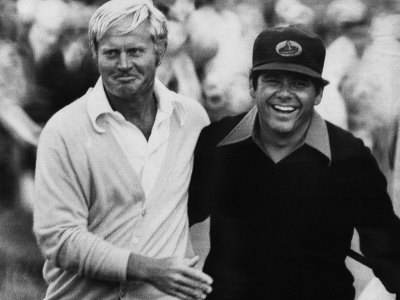
Two of the golfers that helped me start thinking along these lines were Nicklaus and Trevino.
Nicklaus was known as a golfer with a very poor wedge game and terrible sand game by PGA Tour standards. We’ve always been told how important it is to have a great wedge game and how every PGA Tour players has the best wedge games from 100 yards out on the planet.
So how did Jack become the greatest ever with his poor wedge game?
Well, as I’ve shown before on this blog, from ages 40-45, he was leading the PGA Tour in total driving AND greens in regulation. He also hit it a mile and was known as the greatest long iron player of all time.
For their time, we’ll shorten the ‘175+ yard range’ to 155+ yards because of the changes in technology. So if Nicklaus was hitting 300 yard drives and got up to a 430 yard par-4, he was probably hitting 9-iron or PW into the green and missing the 155+ yard range.
Then when he got on a long par-3 and needed a long iron, he was the greatest long iron player that ever lived, so it was just playing into his strength. And he could also hit almost ever par-5 in two.
Thus, Nicklaus was playing par 72’s as par 68’s and since he usually found the fairway, he didn’t have to worry so much about finding jail and having to punch out. He dominated the long par-3’s as well and on par-4’s, he was constantly under the 155+ yard range. So while he may have been a poor wedge player by PGA Tour standards, if he’s hitting wedge and the rest of the field is hitting 6-irons and 7-irons, I’ll take Jack.
I hate to say this, but I honestly think Jack’s course management skills were probably overhyped. Jack is the greatest of all time because he really was great at striking a golf ball and putting it in the hole.
Trevino OTOH was shorter off the tee, but was considered one of the all time great ballstrikers, but a terrible putter. How could this be? I thought every player on the PGA Tour is a great putter and surely one of the all time greats had to be a great putter?
I think Trevino probably wasn’t a great putter, but had plenty of years where he wasn’t in the bottom 20 on Tour. I think he found himself in the 155+ yard approach range as often as the next guy on the Tour, but it didn’t matter when you struck the ball as well as he did. And if he got on a 380 yard par-4, nutted a driver 260 and had a PW in, he was going to hit it stiff. And he’s considered one of the best bunker players of all time and probably was just great around the greens in general. So if he did miss a green, he would make the save anyway.
3JACK
Tuesday, March 1, 2011


Monday, February 28, 2011
Karlsen & Nilsson Putting Research Paper Review

I recently came across this research paper on putting that was on the AimPoint Golf Web site (www.aimpointgolf.com).
You can find the research paper at http://www.aimpointgolf.com/docs/Karlsen2010.pdf
Be warned that it reads like…a research paper. So lots of quoting of other papers and books, lots of descriptions into how the study was executed and less ‘user friendly’ verbiage.
But, they did come up with some interesting findings based on testing over 100 golfers, which included 22 PGA Tour and European Tour players. I’ll try to rattle off their findings:
- As we know, the putterface is more important than the path. They determine that Dave Pelz was pretty much correct in saying that the ball’s initial direction is 83% due to the face and 17% to the path.
- Of the golfer’s studied the variation in their path from stroke to stroke was greater than their variation in the face angle at impact. This surprised me because in the full swing, usually it’s the exact opposite…a golfer’s clubhead path will be very consistently the same while their face angle can be all over the place from shot to shot.
- They studied only right handed golfers and the tendency was for them to aim left at address with the putter. The Tour players averaged about 1* left of the target.
- Here’s a big one, the golfers tested claimed that they *felt* that the mallet putters were easier to aim. HOWEVER, the golfers actually aimed the ‘blade putters’ (i.e. Ping Anser, Ping Zing 2, etc) better. This is because the mallets had big alignment lines and other gadgets like the 2-ball mallet that made it feel like it was easier to aim, but the reality was that they aimed the ‘normal’ style putter better.
- Obviously, there was a correlation between a player’s handicap and their ability to hit putts from 40 feet away close. So it was likely that a player with a 5 handicap would hit 40 footers closer to the cup on average than a player with a 10 handicap.
- Optimally, the putter face should rotate about 1.6*
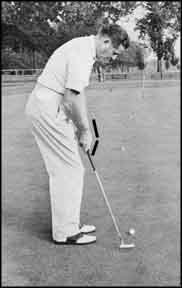
- Therefore the ‘straight back-straight thru’ stroke (which really doesn’t exist anyway), is considered not optimal.
- Obviously, the optimal ‘face change’ was 0*. Optimally you would like to aim dead at the target (0*) and then return that putterface right back to 0* at impact.
- Small ‘face change’ is okay, but keep it to about 1.5*. I remember that Loren Roberts’ SAM Puttlab report shows a golfer with a 2* closed face at address who then manages to open the blade to 0* at impact. This tells me that while Roberts’ putting stroke looks nice, it’s very compensation oriented putting stroke.
- Downswing time is best at the 270 to 370 millisecond range. The golfers they tested that were out of this range were usually too slow, so a too fast of a downswing usually isn’t the problem.
- Elite players (Tour pros) tend to aim 1* left at address and then open the blade to about 0.4* left at impact.
- Heavier shafts tend to make the ball travel shorter
- They felt that their research showed that more golfers could greatly improve with a heavier putter shaft.
- They strongly feel that green reading is much more important than technique when it comes to having a good speed/touch on a putt.
Overall it was a pretty interesting read once you could siphon thru the typical research paper stuff. My two complaints are that I wish the sample size was bigger and I question some of the books and research they reference.
Sample size (in this case) is the number of golfer’s studied. I believe they tested 116 golfers. IIRC, 100 is actually considered the minimum for a legitimate scientific study. Obviously, the greater the sample size the more accurate the test will depict ‘what really happens.’
While Dave Pelz worked for NASA at one point, I’ve been told that much of his putting research was later proven to not have big enough sample sizes and to be flawed. Thus, referencing his work is a bit questionable if Pelz’s work is considered inaccurate. I’m sure if you want to know more, you could ask Geoff Mangum all about it (www.puttingzone.com)
Still, there’s a lot of interesting things going on here. Particularly with their study of the mallets which helps explain why they continue to grow in popularity. The heavier putter shaft theory is intriguing as well.
3JACK
Friday, February 25, 2011
Upcoming Edel Golf Wedges and Wedge Fitting System
While I was at the 2011 PGA Merchandise show, one of the things I came across was Edel Golf’s (www.edelgolf.com) new line of wedges.
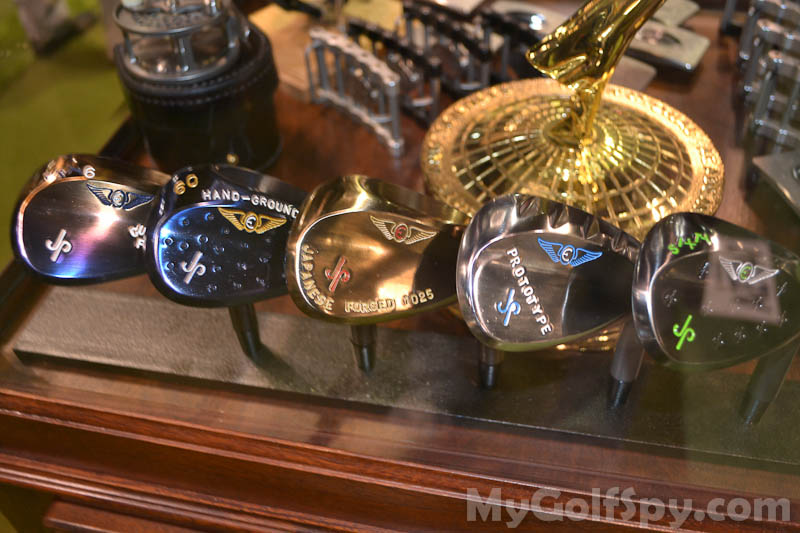

The wedges piqued my interest when I found that they had a wedge fitting system because I was extremely impressed with Edel Golf’s putter fitting system which not only fitted the putter for your aim, but also fitted your stroke by finding the best weight and putter shaft for you.
Unfortunately, I assumed that the wedges would be on their Web site after the show and when they were not, I had a lot of my readers asking me about the Edel Wedges and I didn’t have any answer for them.
One of the issues I’ve had with equipment fitting is in particular wedge fitting. Most wedge fitting sorta assumes that the golfer knows whether or not they are a digger (big divots) or sweeper (little divots) or somewhere in between. Then they give the golfer a wedge and the golfer has to try and figure out whether or not they like the feel. If they don’t, then they hand them another wedge. It’s almost like going to the optometrist to get fitted for glasses where they say ‘is this better than the last one’ and after awhile you’re so confused that you really don’t think it matters. Particularly for higher handicap golfers who are not as in tune with their feel for clubs as lower handicappers and professionals are.
So I talked about this with the Director of Sales and Product Development, Bobby Dean and here’s what he had to say.

The Edel Wedges and fitting system is based off of the research and ideas of Golf Digest Top 50 and Golf Magazine Top 100 Instructor, Mike Adams (www.mikeadamsgolf.com)
Part of the main concept is each fitter goes thru detailed training and they’ll spend about the first few minutes working with the player’s wedge swing because they find that many golfers typically will ‘back up out of it’ with the wedge which will distort the wedge that would truly work best for their swing and produce the best results. It’s not looking to change anybody’s full swing, but if you’re a digger with your irons then they don’t want you to take a different swing with the wedge that may turn you into a sweeper with just the wedges.
This is something that I like the idea behind because the problem I find with most clubfitters is that they know so little about the golf swing that they cannot assist the golfer and then the golfer winds up with a club that is fit for a lousy golf swing.
After that, the fitters are trained to figure out what wedge works best for you from the fairway, deep rough and sand. From what I understand, if you’re working with a fitter in Oregon where the turf is softer, they can fit the wedges according to what you would need if you play in the state of Oregon. But if you’re working with a fitter in Texas, where hardpan is prevalent, the same fitting would apply but the fitter would be able to fit you based on what those Texas conditions require.

Another feature is that Edel Golf will have a wedge fitting cart, much like the ones you see at golf stores (like the above picture).
The cart will have:
17 different heads
8 different grinds
13 different shafts
They are attachable shafts and heads, much like the Titliest and Mizuno fitting carts. So when the golfer is trying out a wedge, they can interchange different shafts, heads and grinds to figure what they like better and the fitter can see what works best for them.
The wedges will range from 50* in loft to 62*. There’s almost pretty much complete customization such as the finish on the clubhead, paintfills, stamping, etc. Furthermore, they will have forged heads or cast heads available. I would assume that the cast heads are cheaper. Also, the percussion center is more in the middle of the club instead of leaning towards the heel.
The expected launch date of this is May or June of this year.
Overall, I like what I hear as not only are there a lot of options, but the fitting cart is a very big benefit. One top 100 instructor who was trained on fitting openly stated that after being trained of fitting by Edel, they realized that they had been fitting wedges incorrectly for a long time.
I’d still like to see a company say something along the lines of ‘if your attack angle with a SW is -6* or more, then all things being equal you are a digger. Or if your SW attack angle is -2* or less, all things being equal you are a sweeper. We will then take into consideration the surface you usually play on and then determine what wedge fits you.’ But either way, the wedge fitting ‘bar’ is about to be raised and when that happens, other companies will start to follow suit and come up with their own ideas as to how to best fit the golfer.
3JACK
The wedges piqued my interest when I found that they had a wedge fitting system because I was extremely impressed with Edel Golf’s putter fitting system which not only fitted the putter for your aim, but also fitted your stroke by finding the best weight and putter shaft for you.
Unfortunately, I assumed that the wedges would be on their Web site after the show and when they were not, I had a lot of my readers asking me about the Edel Wedges and I didn’t have any answer for them.
One of the issues I’ve had with equipment fitting is in particular wedge fitting. Most wedge fitting sorta assumes that the golfer knows whether or not they are a digger (big divots) or sweeper (little divots) or somewhere in between. Then they give the golfer a wedge and the golfer has to try and figure out whether or not they like the feel. If they don’t, then they hand them another wedge. It’s almost like going to the optometrist to get fitted for glasses where they say ‘is this better than the last one’ and after awhile you’re so confused that you really don’t think it matters. Particularly for higher handicap golfers who are not as in tune with their feel for clubs as lower handicappers and professionals are.
So I talked about this with the Director of Sales and Product Development, Bobby Dean and here’s what he had to say.
The Edel Wedges and fitting system is based off of the research and ideas of Golf Digest Top 50 and Golf Magazine Top 100 Instructor, Mike Adams (www.mikeadamsgolf.com)
Part of the main concept is each fitter goes thru detailed training and they’ll spend about the first few minutes working with the player’s wedge swing because they find that many golfers typically will ‘back up out of it’ with the wedge which will distort the wedge that would truly work best for their swing and produce the best results. It’s not looking to change anybody’s full swing, but if you’re a digger with your irons then they don’t want you to take a different swing with the wedge that may turn you into a sweeper with just the wedges.
This is something that I like the idea behind because the problem I find with most clubfitters is that they know so little about the golf swing that they cannot assist the golfer and then the golfer winds up with a club that is fit for a lousy golf swing.
After that, the fitters are trained to figure out what wedge works best for you from the fairway, deep rough and sand. From what I understand, if you’re working with a fitter in Oregon where the turf is softer, they can fit the wedges according to what you would need if you play in the state of Oregon. But if you’re working with a fitter in Texas, where hardpan is prevalent, the same fitting would apply but the fitter would be able to fit you based on what those Texas conditions require.
Another feature is that Edel Golf will have a wedge fitting cart, much like the ones you see at golf stores (like the above picture).
The cart will have:
17 different heads
8 different grinds
13 different shafts
They are attachable shafts and heads, much like the Titliest and Mizuno fitting carts. So when the golfer is trying out a wedge, they can interchange different shafts, heads and grinds to figure what they like better and the fitter can see what works best for them.
The wedges will range from 50* in loft to 62*. There’s almost pretty much complete customization such as the finish on the clubhead, paintfills, stamping, etc. Furthermore, they will have forged heads or cast heads available. I would assume that the cast heads are cheaper. Also, the percussion center is more in the middle of the club instead of leaning towards the heel.
The expected launch date of this is May or June of this year.
Overall, I like what I hear as not only are there a lot of options, but the fitting cart is a very big benefit. One top 100 instructor who was trained on fitting openly stated that after being trained of fitting by Edel, they realized that they had been fitting wedges incorrectly for a long time.
I’d still like to see a company say something along the lines of ‘if your attack angle with a SW is -6* or more, then all things being equal you are a digger. Or if your SW attack angle is -2* or less, all things being equal you are a sweeper. We will then take into consideration the surface you usually play on and then determine what wedge fits you.’ But either way, the wedge fitting ‘bar’ is about to be raised and when that happens, other companies will start to follow suit and come up with their own ideas as to how to best fit the golfer.
3JACK
Thursday, February 24, 2011
Sevam1 & Elk SITD Clinic Part I
Here's a video of part I of a clinic that friends of the 3Jack blog, Sevam1 and Steve Elkington, put on in California.
A lot of it the loyal readers have seen before. I plan on doing a small little special on golf shoes in about 1-2 weeks. Stay tuned.
3JACK
A lot of it the loyal readers have seen before. I plan on doing a small little special on golf shoes in about 1-2 weeks. Stay tuned.
3JACK
Wednesday, February 23, 2011
Thoughts On Learning To Develop Your Swing...

In my opinion, the greatest attribute of Homer Kelley’s book, ‘The Golfing Machine’ was how Homer Kelley laid out *how* a golfer can best learn to develop an effective and efficient golf swing.
Certainly, The Golfing Machine is not infallible. However, it really does not make a difference whatever scientific study on the swing is infallible or is more infallible than TGM if there’s no real path for the golfer to learn that study.
THAT is really what TGM is about for me. Remember, Homer Kelley wrote guides and manuals for Boeing for years. Imagine him writing a manual for some type of machinery and just discussing the inner parts of the machine. Nobody would care. Instead, he had to set forth a way for the reader to apply what he’s written.
Unfortunately, too many TGM critics completely overlook this and get bogged down into the jargon and format of the book along of whether the science is right or wrong. Let me be clear, I think ‘getting the science right’ is important…but it’s useless if we can’t figure out a way to apply it and learn from it.
For my money, Kelley’s most brilliant concept in the book was ‘learning feel from mechanics.’ Why? Because pretty much every athletic endeavor teaches ‘learning mechanics from feel’ and Mr. Kelley figured out that ‘hey, these feels everybody talks about are subjective.’ So whether it’s baseball, basketball, hockey, football, etc…they also teach ‘mechanics from feel’ and have done so for over 100 years and continue to do so today.
But nowhere is ‘learning mechanics from feel’ more prevalent in golf. Just take a look at the most recent Golf Digest instructional tip by Steve Stricker called ‘Steal my Feel.’ http://www.golfdigest.com/golf-instruction/2011-02/steal-feel-stricker

I try to feel as if I'm returning my left hand at impact so it faces the target again – Steve StrickerThat’s basic ‘learning mechanics from feel.’ Essentially it’s a ‘if you feel this, that will put you in the correct mechanics’ type of instruction.
And like I’ve said, a feel that may work for Stricker may very well not work for me. And I think most people would agree with me that these feels tend to ‘wear off’ after awhile. A feel that was working well for me in June may stop working for me in August.
It’s not that feels are unimportant. Far from that. The feel will allow the golfer to repeat the mechanics they want time after time. It’s just that a golfer needs to really understand *how* to feel and how to learn the swing in order to get that feel that will work best for them.
UNDERSTANDING COMPENSATIONS
Compensations are more or less moves the golfer attempts to make in order to get the swing ‘back on track.’ For instance, if a golfer gets their backswing off plane, then they will have to make a compensation or a series of compensations in order to get their downswing back on plane.
Not all compensations are bad.
For instance, take a look at Jim Furyk’s compensation filled golf swing.
According to Trackman, Furyk is the golfer whose clubpath and clubface are the most consistently closest to 0* to the target on the PGA Tour of everybody they have measured. Thus, not all compensations are bad.
But where compensations are troubling is that they require the golfer to be able to use their timing and their hand-eye coordination to ‘get back on track.’ Some golfers like Furyk and Miller Barber can make those major compensations and hit it great, time after time. But most cannot.
The good instructors figure out what compensations are causing problems and what compensations are not an issue. The ‘method teachers’ will just tell you to change every compensation because it doesn’t fit into their method.
The pitfall that some golfers fall into is that they will start believing that because somebody like Furyk can make a ton of compensations and hit it well, then they should be able to make a ton of compensations and hit it well because those compensations are part of their ‘natural golf swing.’ I find this notion to be horribly flawed because I would think our ‘natural golf swing’ would be the one we have the first day we ever swing a golf club. But over time we started to figure some things out, took some lessons and hopefully got better.
Again, the key is to assess the compensations and figure which ones are ‘okay’ and which ones need to be eliminated.
ELIMINATING BAD COMPENSATIONS
Often times compensations occur when a golfer ‘gets off track’, makes a compensation to get back on track and then is rewarded with a good shot for that compensation. Again, that’s fine if the golfer can do that over and over again. However, if the golfer cannot make that compensation time after time or it runs the risk of hitting a bad shot that will kill you, particularly on crucial swings, it’s probably time to eliminate that compensation from your swing.
For example, let’s say on the backswing you have a very open clubface. In order to ‘get back on track’, you try to really ‘turn the hands over’ thru impact in order to square up the clubface at impact. That would be the compensation.
After years of swinging the club this way, you start to get pretty good at making this compensation for the open clubface at the top of the golf swing. But, every once in awhile you hit some dreaded snap hooks, particularly when the shot becomes more important.
When you first started playing with that open clubface in the backswing, you probably hit blocks and slices. But once you started to actively turn your wrists over thru impact, you started to get rewarded with good golf shots more often.
What good golf instructors do is they take away that reward when the golfer ‘gets off track’ and then tries to get back on track with a compensatory move. In the case of the golfer who has a very open clubface going back and then compensates by turning the wrists over thru impact…a good instructor may change something like the grip or the takeaway to get the clubface more square or closed in the back swing. Then they will discuss the mechanics of the downswing and essentially tell the golfer ‘here’s the compensation you make, here’s what I want you to do.’
Now if the golfer makes that compensation they will not be ‘rewarded’ with a good shot. That’s because the face should be square or closed in the backswing, so if the golfer compensates by turning the wrists over, they’ll have a closed clubface and hit a smothered hook.
And because they won’t be rewarded for making the compensation, they’ll gradually stop making that compensation. And if the golfer has enough awareness, they’ll start to understand the feedback they are getting and they should start to understand something like ‘if I blocked it, my face got too open in the backswing and I made the correct downswing. If I smothered it, my face was fine in the backswing and then I went back to the old compensation.’
THE 15TH CLUB IN THE BAG

As I’ve discussed many times before, I consider the video camera as the ‘15th Club.’ For the most part, we usually get new golf clubs with the thought that the new equipment will make us better. Well, a camera will cost less than a new driver, a new set of irons and less than a lot of new putters. Yet, I firmly believe that a camera will help your game more than these clubs and will allow the golfer to use these clubs more towards their potential.
I currently own a Casio EX-FH20, which cost me $240 for everything brand new. I haven’t drawn a line on a software program with my swing in over 2 years. I really don’t need to. Instead, I used the camera for checkups on my swing, making sure nothing gets out of hand because I’d rather fix problems right away instead of neglecting them only to have to make a major overhaul down the road.
From there, I can utilize the camera as my ‘teacher’ to get me into the right mechanics and I can then ‘learn feel from mechanics.’ Then it just becomes a game of using that feel which will allow me to correct those mechanics.
SYNOPSIS
Learn feel from mechanics, not mechanics from feel
-Understand your compensations
-Understand the compensations that work for you and that don’t work for you
-Take away the reward for the flaws and compensations you don’t want in your swing
-Use the 15th club in the bag to effectively practice when your instructor is not there
3JACK
Subscribe to:
Posts (Atom)