I'm currently reading Geoff Mangum's 'Optimal Putting' book, but that is roughly 300 pages long so it will take me awhile before I can put in a review. Anyway, here's a good video of Geoff explaining the 'clock method' of how to read putts. Of course, first you have to understand the fall line and find the proper fall line.
At the risk of sounding like I am tooting my own horn, I've pretty much always been a good putter. But understanding this concept that Geoff teaches in the video below has noticeably improved my putting as now I've practically eliminated bad misreads from my game.(I call a bad misread a misread where I think it goes one way and it winds up going the exact opposite way) So generally now when it comes to misreads, they are more of the type that I have the right idea, they just don't break as much or break more than I think they should. To me, this is sort of the key to good putting. I look at when I putt that all I'm trying to do is make a *decent* read, a *decent stroke* with *decent alignment* and a *decent launch*, then if it still doesn't go in I've got to take it. There's simply too many other factors, many of which are out of the golfer's control, that can make you miss a putt.
I spoke to one tour player about putting and those were also his exact same sentiments about what he tries to accomplish with his putting.
For more of Geoff's YouTube videos, go to http://www.youtube.com/profile?user=geoffmangum&view=videos
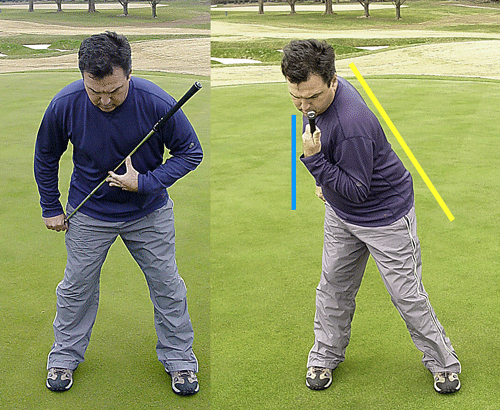
Another inexpensive, but quality training aid is the Pure Ball Striker (that little orange thing on the grip in the pic above) created by Jeff Evans. The PBS can attach to any club and grip and teaches the golfer how to correctly use and feel Homer Kelley's Pressure Point #3, the right index finger (for righties).
Here, Mr. Hogan explains it better than I do.
The lack of understanding of PP#3 is common for many golfers since there's a tendency to cast or flip the club and after impact when the club should be more in line with the left arm, golfers tend to not properly use PP#3 and get the club more in line with the right arm after impact.
I've found that this device does help just about everybody to some degree. It helped me a little bit and I still use it when I'm getting too handsy and over-accelerating the clubhead and not using my pivot to hit the ball.
I just got done watching Brian Manzella's 'Never Hook Again 2.0' video. The purpose of the video is to develop a swing (Manzella calls it "a pattern") that will prevent the golfer from ever hooking the ball.
Like Manzella's 'Never Slice Again 2.0' video, NHA 2.0 perfectly describes what goes on with a hooked shot and then works on developing a certain type of swing that will make hooking the ball almost impossible.
I would say that NHA 2.0 is better for the lower handicap player than the NSA 2.0 video. And to me, the pattern used in NHA 2.0 is not nearly as 'extreme' as the pattern used in NSA 2.0. As far as tour pros go, they are much more likely to use the NHA 2.0 pattern than the NSA 2.0 pattern, although Bubba Watson does use some of the NSA 2.0 pattern.
Overall I liked the NHA 2.0 video and thought it was more useful than the NSA 2.0 video. Once again, Manzella does a beautiful job of explaining things in a simple and easy manner while still being precise. Furthermore, the web version is only $9.99, which is another steal in Manzella's video library.
The video is as it says...showing how tour caddies map out the greens for their players. The caddies have it a little easier since they can get pin placements from past tournaments from the tour office. You and I really don't have that luxury and instead would have to map out the entire green. However, as I pointed out in a previous post (http://3jack.blogspot.com/2008/12/exelys-breakmaster-update.html), tour caddy who goes by the handle 'Overkill' on the lynnblakegolf.com forum has a simple method for mapping the entire green. Although there's one big difference...the caddies on this video use the Exelys Breakmaster exclusively whereas 'Overkill' prefers the bubble level green reader (although he does have the Breakmaster as well).
Orr's video works with Charlie Wi's looper (Mark Urbanek) and Billy Mayfair's caddy (Todd Montoya). Both room together, but have very different methods of mapping the greens. However, each method can be useful to a player wanting to map out the greens at their local course for themself.
The video itself is meant for low handicappers...particularly those very dedicated to their games and anybody who wants to become a caddy. There's a couple of instances where the audio struggles a bit, but overall the video and audio quality is very good.
This is a solid video and more or less interesting than anything else. Since I'm a bit of a fanatic who plans to get back into playing serious golf, this video works for me since I plan on mapping out greens for future tournaments. It also may be helpful for the low to mid handicapper who plays the same course all of the time and would like to map out the greens so he can take so more nassau's from his playing partners.
That being said, I think it's much more important to get Orr's "How to Read the Greens" video since if the golfer can read the greens, he really doesn't need the green map. And while preperation is key to success, execution is still more important.
I like to read old threads over at LynnBlakeGolf.com. Here's a thread worth checking out on the swing sequence of a young Bobby Clampett with commentary from The Golfing Machine author, Homer Kelley (http://www.lynnblakegolf.com/forum/showthread.php?t=2680)
A book I recommend as a "must read" for beginners and can help players of all levels is Bobby Clampett's 'The Impact Zone.'
Most people recognize Clampett as an announcer for CBS and then hear about this book and think "those who can't, teach (and announce)." But in reality, at one point Clampett was one of the greatest players in the world and had an incredibly bright future. He has Hogan-esque ball striking with arguably an even better short game. Early in his career, it seemed like he was a sure thing to win a few majors and become a Hall of Famer.
But as well all know, there are no sure things in golf.
One of Clampett's problems was he had a very flat swing. Seeking some instruction when he started to struggle a little, he wound up going to all sorts of swing instructors who focused on his swing plane and other issues (Clampett calls it "swing style") instead of working on his Impact Zone (Clampett calls it "swing dynamics"). Clampett grew up under the tutelage of Ben Doyle and had his greatest success with Doyle focusing more on "swing dynamics" than "swing style." Once he got away from Doyle's instruction, his game took a turn for the worse and he wound up being known sort of as the Ian Baker-Finch of his time (great golfer who suddenly had the full swing yips). Eventually Clampett went back to Doyle and his game turned right around. However, by then he was a lot older and with the effect Tiger Woods had on the game, he didn't have the distance and time to dedicate himself (he's a family man) to compete with the young guys on a consistent basis.
Anyway, here's a look at Clampett's swing today.
Looks pretty darn good, right?
This book has three excellent aspects to it, IMO.
1. It teaches what the clubhead is supposed to do through the impact zone so it's easy to understand (down, out and forward)>
2. It teaches how to get to master the impact zone.
3. It teaches how to practice.
While #1 is important, I sort of believe that #3 is just as important. If I've said it once I'll say it a million times. This game needs to be taught from green to fairway to tee, not the other way around. In any walk of life, when we are learning something we learn the easy and simple stuff first and once we have a good grasp of that, we move on to more difficult and complex stuff.
Except for golf...
In golf so many golfers and instructors have us learn the difficult and complex stuff first (full swing) and the easy and simple stuff is almost an afterthought. And after reading 'The Impact Zone' (and seeing some of Ben Doyle's teaching videos) it drives me nuts whenever I see somebody getting a lesson and they start out by pulling the driver out of the bag and giving a few rips.
The "Green to Tee" teaching method is how the old time golf instructors used to teach the game. Harvey Penick was a big believer in teaching chipping first because in his words it was a miniature version of the game. Now it seems like instructors are worried about swing plane and length of swing which only causes more confusion, no improvement in play and shelling out more money for new clubs that won't work and more instruction that won't work.
I've actually had this notion that the game should be taught this way for some time, but couldn't exactly justify the reasoning. The Impact Zone justifies the reasoning for you. So while this is a GREAT book for beginners and mid-handicappers who really don't know much about the swing and are looking to improve, it shows that even low handicappers should practice in this fashion as well.
'The Impact Zone' can be found at almost every book store for around $19.99.




 A book I recommend as a "must read" for beginners and can help players of all levels is Bobby Clampett's 'The Impact Zone.'