Here's a video from short game guru, James Ridyard, showing some practice and short game concepts in action:
3JACK
Wednesday, October 21, 2015


Tuesday, October 20, 2015
The Accelerating Putter with Preston Combs
Here's a video from golf instructor, Preston Combs, discussing the acceleration profile of different golfers with their putting strokes using the SAM Puttlab and the new SAM Puttlab 3D view:
3JACK
3JACK
Monday, October 19, 2015
The Search for Flatstick Nirvana - Part VIII (10.19.15)
Part I - http://3jack.blogspot.com/2015/08/the-search-for-flatstick-nirvana-part-i.html
Part II - http://3jack.blogspot.com/2015/09/the-search-for-flat-stick-nirvana-part.html
Part III - http://3jack.blogspot.com/2015/09/the-search-for-flatstick-nirvana-part.html
Part IV - http://3jack.blogspot.com/2015/09/the-search-for-flatstick-nirvana-part_9.html
Part V - http://3jack.blogspot.com/2015/10/the-search-for-flatstick-nirvana-part-v.html
Part VI - http://3jack.blogspot.com/2015/10/the-search-for-flatstick-nirvana-part.html
Part VII - http://3jack.blogspot.com/2015/10/the-search-for-flatstick-nirvana-part_12.html
What may seem like downright shilling for his site, I’m genuinely amazed by what I learn each week on David Orr’s Flatstick Academy Web site. While the putting results are still a work in progress, the key term is ‘progress.’ Rome wasn’t built in a day and guys like Jimmy Walker and Aaron Baddeley just didn’t wake up one day with that ability to putt. But, the point of this series of posts is to find that ‘Billy Baroo’ and not only am I improving my putting stroke mechanics, but I’m starting to learn more about finding that putter that will help me best fit a putter to my stroke and allow that putter to become the ‘Billy Baroo’ in my bag.
From my research in statistics on Tour, I’ve found that putting from 3-15 feet matters most. And if you want to refine it even more, putting from 5-15 feet matters the very most. Occasionally you can get that good putter that struggles from 3-5 feet. But, that’s more the exception than the rule.
But what I see out of the best putters is that they tend to show up on the greens that have the lowest make percentages like Pebble Beach and Riviera. Torrey Pines has a low make percentage, but the course is so long that it often times counts out long hitters. However, great putters like Brandt Snedeker and Ben Crane have had success and Tiger has dominated the course (Jason Day won there this past season and he’s an excellent putter as well). And what these courses have in common is more undulated greens.
One of the things that David has discussed on his site is the different kinds of strokes one can employ by how they ‘power’ the putting stroke. I have decided to start using a ‘lead side’ stroke and as David has pointed, it tends to favor making right-to-left breaking putts. There’s a tendency to push the left-to-righters and if a player struggles with the right-to-left breaking putts, it’s likely that it is due to an under-read of the putt. With AimPoint, I don’t worry too much about under-reading a putt.
And having practiced a lot of clock drills, I’ve found that I am more likely to push those left-to-right putts:
The only difference in my clock drill is that I use 10 golf balls instead of 4. It really helps determining the differences in the break.
Well before I got into David’s site, I had felt that the best putters on Tour were the best at making break putts, particularly sidehill and downhill breaking putts. And that’s because the courses like Riviera and Pebble feature a lot of breaking putts.
After reading his articles on the Web site, it has only strengthened my confidence in that belief. It’s very likely for any type of stroke to have a bias to struggle on a certain kind of putt and I think the best putters have figured out how eliminate those biases while the other putters have started to compensate for their inability to make a certain type of breaking putt.
Obviously, I think stroke mechanics and practice are involved. But, I still want to find a putter that will make pushing those left-to-right putts less likely. With the Edel Torque Balanced putter, it’s fairly light (345 grams) it is a blade style putter, but it has the weight removed from the toe:

So I think in general it has features to make it less likely to push the putt. However, I believe that the grip (PURE Grips midsize grip) may be a little too large for my right hand which can cause some pushes.
Another great video from David was posted this past week with regards to putter fitting and the length and lie to fit a putter.
There were 2 things I didn’t know until now:
1. You need to fit for length by physical makeup the golf. Not only by height and wingspan, but also by the anatomy and flexibility of your shoulders, elbows and thumbs.
2. You can have a putter too short for you that causes your arms to be too straight and when your arms are too straight for your physical make, those straight arms can increase tension throughout your arms, shoulders and neck. I was only taught before that having the elbows flexed too much would cause tension and that ‘straight arms’ would reduce tension. But now David is showing that is often not the case.
It’s funny because I can pinpoint a lot of my putting issues to when I started to go with putters that were 34” or shorter and I used to putt better with 35” putters. The ‘straight arms’ putting was all the craze.
In fact, let’s take a look at these incredible putters and their elbow bend in their putting.
AARON BADDELEY

JASON DAY

JIMMY WALKER

BRANDT SNEDEKER

GREG CHALMERS

LUKE DONALD

TIGER AND BRAD FAXON

It doesn’t mean that the straight arms can’t work as we take a look at some of these great putters:
BEN CRENSHAW

ANDY NORTH

BRENDON TODD

So, IMO, both styles can work, but the bent arm style is far more prevalent than the straight arm style which is contrary to what many instructors and instruction books are telling us.
What got me was that I never knew that straight arms could cause tension and it would explain my issues with getting yippy once I went to a shorter putter. Fortunately, David shows how we can fit length properly. Unfortunately, my putter is only 34” long and needs to be about 35” long (David showed fitting himself for length and he came out to 34” and he’s only about 5’8” or 5’9” tall). When I started to try and fit myself as he prescribes in the video, I had to stand a little closer to the ball. But once I did, the tension went away in my arms despite having more elbow bend.
So the next steps in finding the Billy Baroo may be getting a slightly smaller grip from the midsize PURE Grip and finding something about 1 inch or so longer.
3JACK
Part II - http://3jack.blogspot.com/2015/09/the-search-for-flat-stick-nirvana-part.html
Part III - http://3jack.blogspot.com/2015/09/the-search-for-flatstick-nirvana-part.html
Part IV - http://3jack.blogspot.com/2015/09/the-search-for-flatstick-nirvana-part_9.html
Part V - http://3jack.blogspot.com/2015/10/the-search-for-flatstick-nirvana-part-v.html
Part VI - http://3jack.blogspot.com/2015/10/the-search-for-flatstick-nirvana-part.html
Part VII - http://3jack.blogspot.com/2015/10/the-search-for-flatstick-nirvana-part_12.html
What may seem like downright shilling for his site, I’m genuinely amazed by what I learn each week on David Orr’s Flatstick Academy Web site. While the putting results are still a work in progress, the key term is ‘progress.’ Rome wasn’t built in a day and guys like Jimmy Walker and Aaron Baddeley just didn’t wake up one day with that ability to putt. But, the point of this series of posts is to find that ‘Billy Baroo’ and not only am I improving my putting stroke mechanics, but I’m starting to learn more about finding that putter that will help me best fit a putter to my stroke and allow that putter to become the ‘Billy Baroo’ in my bag.
From my research in statistics on Tour, I’ve found that putting from 3-15 feet matters most. And if you want to refine it even more, putting from 5-15 feet matters the very most. Occasionally you can get that good putter that struggles from 3-5 feet. But, that’s more the exception than the rule.
But what I see out of the best putters is that they tend to show up on the greens that have the lowest make percentages like Pebble Beach and Riviera. Torrey Pines has a low make percentage, but the course is so long that it often times counts out long hitters. However, great putters like Brandt Snedeker and Ben Crane have had success and Tiger has dominated the course (Jason Day won there this past season and he’s an excellent putter as well). And what these courses have in common is more undulated greens.
One of the things that David has discussed on his site is the different kinds of strokes one can employ by how they ‘power’ the putting stroke. I have decided to start using a ‘lead side’ stroke and as David has pointed, it tends to favor making right-to-left breaking putts. There’s a tendency to push the left-to-righters and if a player struggles with the right-to-left breaking putts, it’s likely that it is due to an under-read of the putt. With AimPoint, I don’t worry too much about under-reading a putt.
And having practiced a lot of clock drills, I’ve found that I am more likely to push those left-to-right putts:
The only difference in my clock drill is that I use 10 golf balls instead of 4. It really helps determining the differences in the break.
Well before I got into David’s site, I had felt that the best putters on Tour were the best at making break putts, particularly sidehill and downhill breaking putts. And that’s because the courses like Riviera and Pebble feature a lot of breaking putts.
After reading his articles on the Web site, it has only strengthened my confidence in that belief. It’s very likely for any type of stroke to have a bias to struggle on a certain kind of putt and I think the best putters have figured out how eliminate those biases while the other putters have started to compensate for their inability to make a certain type of breaking putt.
Obviously, I think stroke mechanics and practice are involved. But, I still want to find a putter that will make pushing those left-to-right putts less likely. With the Edel Torque Balanced putter, it’s fairly light (345 grams) it is a blade style putter, but it has the weight removed from the toe:

So I think in general it has features to make it less likely to push the putt. However, I believe that the grip (PURE Grips midsize grip) may be a little too large for my right hand which can cause some pushes.
Another great video from David was posted this past week with regards to putter fitting and the length and lie to fit a putter.
There were 2 things I didn’t know until now:
1. You need to fit for length by physical makeup the golf. Not only by height and wingspan, but also by the anatomy and flexibility of your shoulders, elbows and thumbs.
2. You can have a putter too short for you that causes your arms to be too straight and when your arms are too straight for your physical make, those straight arms can increase tension throughout your arms, shoulders and neck. I was only taught before that having the elbows flexed too much would cause tension and that ‘straight arms’ would reduce tension. But now David is showing that is often not the case.
It’s funny because I can pinpoint a lot of my putting issues to when I started to go with putters that were 34” or shorter and I used to putt better with 35” putters. The ‘straight arms’ putting was all the craze.
In fact, let’s take a look at these incredible putters and their elbow bend in their putting.
AARON BADDELEY
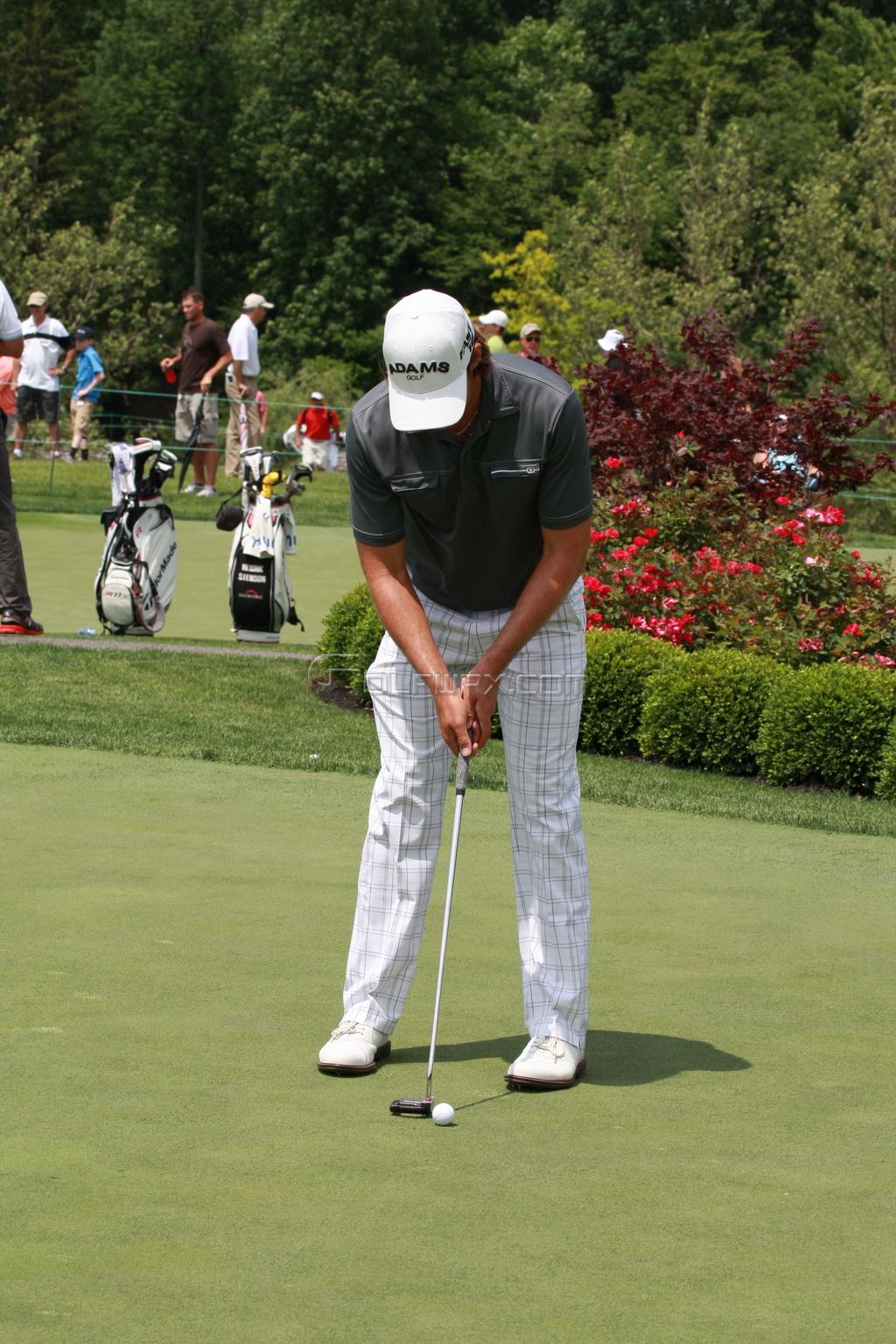
JASON DAY

JIMMY WALKER
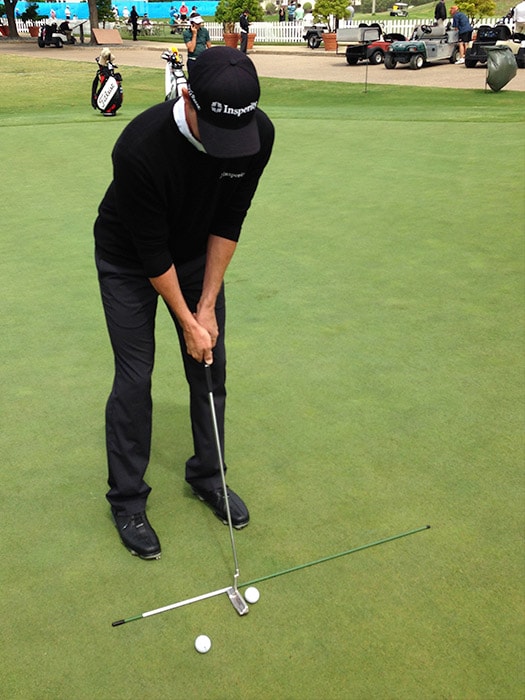
BRANDT SNEDEKER
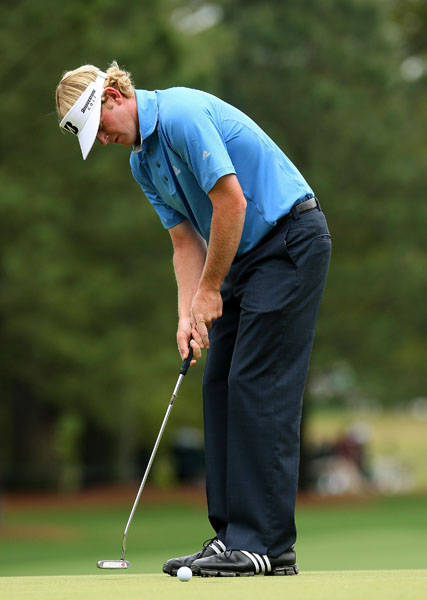
GREG CHALMERS
LUKE DONALD

TIGER AND BRAD FAXON
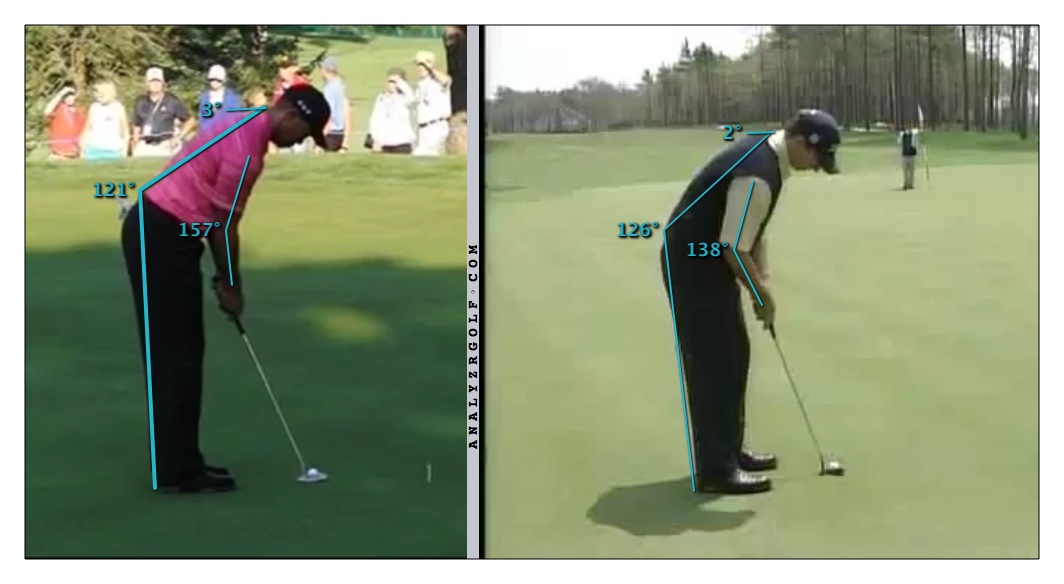
It doesn’t mean that the straight arms can’t work as we take a look at some of these great putters:
BEN CRENSHAW

ANDY NORTH

BRENDON TODD

So, IMO, both styles can work, but the bent arm style is far more prevalent than the straight arm style which is contrary to what many instructors and instruction books are telling us.
What got me was that I never knew that straight arms could cause tension and it would explain my issues with getting yippy once I went to a shorter putter. Fortunately, David shows how we can fit length properly. Unfortunately, my putter is only 34” long and needs to be about 35” long (David showed fitting himself for length and he came out to 34” and he’s only about 5’8” or 5’9” tall). When I started to try and fit myself as he prescribes in the video, I had to stand a little closer to the ball. But once I did, the tension went away in my arms despite having more elbow bend.
So the next steps in finding the Billy Baroo may be getting a slightly smaller grip from the midsize PURE Grip and finding something about 1 inch or so longer.
3JACK
Wednesday, October 14, 2015
Kelvin Miyrahia on Matthew Fitzpatrick Golf Swing
Here's a video from Kelvin Miyahira going over the swing from 2015 British Masters Champion, Matthew Fitzpatrick:
3JACK
3JACK
Monday, October 12, 2015
The Search for Flatstick Nirvana - Part VII (10.12.15)
I had actually written up this post last week and was scheduled to post it up today, but I started to read some articles and videos on David Orr’s Flatstick Academy (http://flatstickacademy.com) and I believe I’ve made a major breakthrough in my putting.
Contrary to popular belief, I’m not very technical or mechanical when it comes to golf. I’m very feel oriented (as I believe every golfer is) and I like details (which I don’t believe every golf cares for). It’s very important for me to not only figure out what to do going forward, but to determine what I did poorly in the past, what I did well in the past and what I did ‘in between’ in the past and why. When I get all of that information, I start to improve by leaps and bounds and start to ‘own’ what I’m doing. I have hopes that I have finally figured out many of those things I did with my putting stroke in the past after coming across some of the articles on David’s site.
First, let’s take a look at my SAM Puttlab report that I did with John Graham back in January. I was using a custom Edel putter during this time and rarely practiced my putting. This stroke was awful:

At the time, I thought the stroke was awful because it was going left with an open face. But, the stroke is more awful because of other things which I will get to. I will not try to give away what is on David’s Web site, but I learned that this is a similar stroke pattern used by many great putters like Jimmy Walker and Loren Roberts.
Here’s my report in October with the Edel Torque Balanced Putter (which I aimed at address much better).

So, we see a very different putter path, going from 2.1 degrees to the left in January to 1.6 degrees to the right in October. That’s a change of 3.7 degrees in 10 months. The face is now closed as well. The consistency is down a bit when it comes to face impact and putter path from January. Although overall the stroke in October was FAR BETTER (again, overall) than it was in January.
Here’s the overall stroke pattern in January:

The dashed line represents the backstroke. The straight (un-dashed) line is the thru-stroke. As we can see in January, the backstroke is very much going back down the line without much of an arc.
Here’s the stroke from October.

Now we a much bigger arc inward with the follow thru going more down the line or a little outside (inside-to-out). We can also see that the follow thru is shorter. This despite in January I was hitting about 7 foot putts and in October I was hitting about 12-foot putts.
Here was the timing of the stroke back in January:

I feel the key numbers are backswing time and time to impact. That is the time it takes to go from the address position to impact. It depends on who you talk to, but the general consensus is the Tour average is about 1.0 seconds (or 1,000 milliseconds) to go from address to impact.
Here’s the timing of the stroke in October.
 As we can see, the stroke gets a little quicker in October by about 45 milliseconds.
But the real key is the acceleration profile.
Here’s a diagram that Erik Barzeski (www.thegolfevolution.com) created a while ago to show what poor versus good versus great acceleration profiles look like:

You can find the rest of the fantastic article by Erik here: http://thesandtrap.com/forums/topic/74295-putting-do-not-accelerate-through-the-ball/
In essence, since we are using a pendulum like motion with the putter and we want to hit up on the ball, the peak speed and acceleration will be at the bottom of the pendulum. And that means that the best acceleration profiles will have the golfer reaching peak speed and acceleration (speed over time) BEFORE impact.
Here’s Loren Roberts’ acceleration profile:

Roberts has a funny stroke because he hits the peak acceleration and speed before impact pretty clearly and then accelerates again well after impact. But that’s because he has a very long and very slow putting stroke. In order to keep the follow thru as long as Roberts does, I believe he has to re-accelerate after impact. Probably tough to do, but all that matters is that he hits peak speed and acceleration prior to impact.
Here is Tiger Woods (from 2007):

Again, peak speed and acceleration prior to impact. And Tiger and Roberts have 2 completely different strokes. Tiger has much more arc and face rotation and is far quicker than Roberts’ stroke.
And here’s Paul Azinger’s:

I believe Azinger was using a belly putter on this stroke.
Here’s my awful stroke in January:

Yikes!
So, I worked on that diligently and later on started working with the Pelz Putting Tutor. And here’s my acceleration profile from October:

This is far better than it was in January. I would label this as somewhere between Barzeski’s ‘poor’ and ‘good.’ Still, it bothered me that I could not get the peak speed and acceleration prior to impact.
That is when I started to read David’s articles on cataloging putting strokes by how the golfer powers the stroke. I feel David’s work is about getting the arc and the face rotation to come close to matching (wider the arc more face rotation is needed) and having compatible biomechanical and neurological pieces to the corresponding arc and face rotation.
What I didn’t know are things like the arc of the backstroke doesn’t have to match the arc of the thru stroke, that there are different ways to reach a ‘great’ acceleration profile (peak speed and acceleration prior to impact) and how different strokes produce different paths, different face angles at impact and different impact dispersion (and different smash factors).
So thru reading the articles and watching the videos on David’s site, I started to piece together what went on:
- When I was a very good putter in college, I utilized a ‘lead side’ stroke that had compatible pieces to it.
- Eventually I started to read too much and listen to too many people and thought my backstroke needed to have more arc (and therefore more face rotation).
- I thought that I needed to get the face angle more square at impact (in January it was 0.5 degrees to the right)
- I then started to use my lead side to make the backstroke and the trail side to make the thru stroke (death to your acceleration profile).
- In January, I started to work on speeding up my backstroke in order to allow ‘gravity to do the work’ which is ill-advised with a lead side stroke
- I then started to use my lead hand to make the backstroke and used the trail arm to make the thru stroke, but over time I was starting to use more of my trail side to make that backstroke (more compatible). This produced a better overall stroke and a better acceleration profile. And the stroke started to resemble what you see out of trail side strokes (cataloged on David’s site).
- The problem now is that I don’t think the trail side stroke is for me. But I have started to develop pieces that work with a trailside stroke. So, I either need to continue to develop those pieces with a trail side stroke or work on the lead side stroke.
For now, I’ve decided to revert back to the lead side stroke. The good thing is now I understand the lead side stroke far better than I ever did even when I executed it very well. I just feel that I was likely a good putter in college because I had a good acceleration profile and trying to re-create a good acceleration profile with a stroke that is the exact opposite of what I used to do when I had a good acceleration profile is likely inadvisable.
So, how does that relate to finding my Billy Baroo?
David talks extensively about putters and their designs which includes things like head and hosel design along with weight and length and I can now see why I prefer a putter that felt heavier the shaft and why I putted well with the Ping B61 (head shape) and the Wilson 8802 (hosel design and shaft to head weight). And why I started putting so well with the Edel Torque Balanced putter. I went decided to switch back to the lead side stroke on Friday night and worked diligently with the Pelz Putting Tutor and on Saturday that was the best I’ve putted since July.
I hope to get another SAM Puttlab report, this time with the lead side stroke up soon.
3JACK
Contrary to popular belief, I’m not very technical or mechanical when it comes to golf. I’m very feel oriented (as I believe every golfer is) and I like details (which I don’t believe every golf cares for). It’s very important for me to not only figure out what to do going forward, but to determine what I did poorly in the past, what I did well in the past and what I did ‘in between’ in the past and why. When I get all of that information, I start to improve by leaps and bounds and start to ‘own’ what I’m doing. I have hopes that I have finally figured out many of those things I did with my putting stroke in the past after coming across some of the articles on David’s site.
First, let’s take a look at my SAM Puttlab report that I did with John Graham back in January. I was using a custom Edel putter during this time and rarely practiced my putting. This stroke was awful:
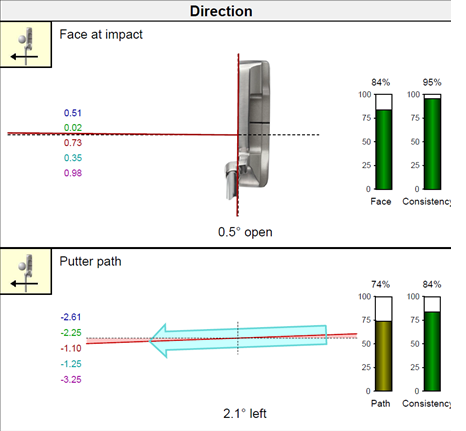
At the time, I thought the stroke was awful because it was going left with an open face. But, the stroke is more awful because of other things which I will get to. I will not try to give away what is on David’s Web site, but I learned that this is a similar stroke pattern used by many great putters like Jimmy Walker and Loren Roberts.
Here’s my report in October with the Edel Torque Balanced Putter (which I aimed at address much better).

So, we see a very different putter path, going from 2.1 degrees to the left in January to 1.6 degrees to the right in October. That’s a change of 3.7 degrees in 10 months. The face is now closed as well. The consistency is down a bit when it comes to face impact and putter path from January. Although overall the stroke in October was FAR BETTER (again, overall) than it was in January.
Here’s the overall stroke pattern in January:

The dashed line represents the backstroke. The straight (un-dashed) line is the thru-stroke. As we can see in January, the backstroke is very much going back down the line without much of an arc.
Here’s the stroke from October.

Now we a much bigger arc inward with the follow thru going more down the line or a little outside (inside-to-out). We can also see that the follow thru is shorter. This despite in January I was hitting about 7 foot putts and in October I was hitting about 12-foot putts.
Here was the timing of the stroke back in January:

I feel the key numbers are backswing time and time to impact. That is the time it takes to go from the address position to impact. It depends on who you talk to, but the general consensus is the Tour average is about 1.0 seconds (or 1,000 milliseconds) to go from address to impact.
Here’s the timing of the stroke in October.

But the real key is the acceleration profile.
Here’s a diagram that Erik Barzeski (www.thegolfevolution.com) created a while ago to show what poor versus good versus great acceleration profiles look like:
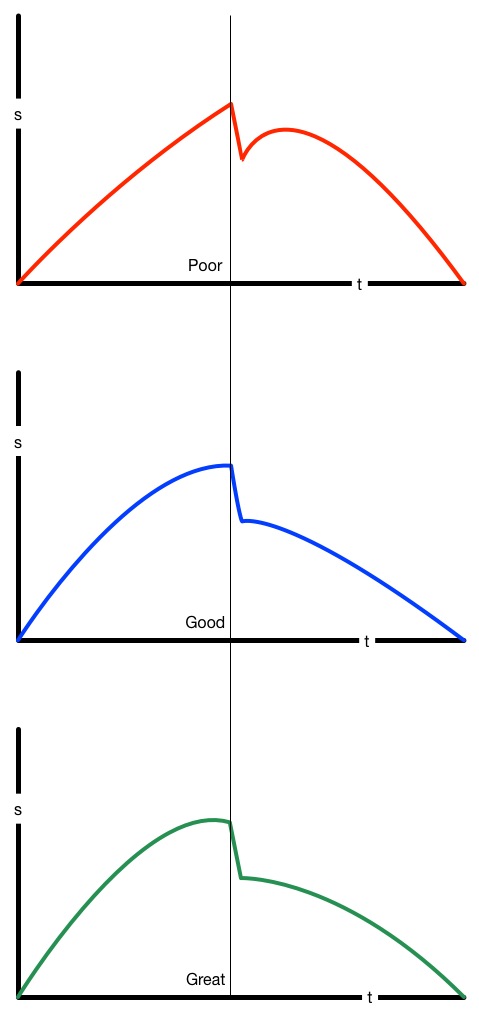
You can find the rest of the fantastic article by Erik here: http://thesandtrap.com/forums/topic/74295-putting-do-not-accelerate-through-the-ball/
In essence, since we are using a pendulum like motion with the putter and we want to hit up on the ball, the peak speed and acceleration will be at the bottom of the pendulum. And that means that the best acceleration profiles will have the golfer reaching peak speed and acceleration (speed over time) BEFORE impact.
Here’s Loren Roberts’ acceleration profile:

Roberts has a funny stroke because he hits the peak acceleration and speed before impact pretty clearly and then accelerates again well after impact. But that’s because he has a very long and very slow putting stroke. In order to keep the follow thru as long as Roberts does, I believe he has to re-accelerate after impact. Probably tough to do, but all that matters is that he hits peak speed and acceleration prior to impact.
Here is Tiger Woods (from 2007):

Again, peak speed and acceleration prior to impact. And Tiger and Roberts have 2 completely different strokes. Tiger has much more arc and face rotation and is far quicker than Roberts’ stroke.
And here’s Paul Azinger’s:

I believe Azinger was using a belly putter on this stroke.
Here’s my awful stroke in January:

Yikes!
So, I worked on that diligently and later on started working with the Pelz Putting Tutor. And here’s my acceleration profile from October:

This is far better than it was in January. I would label this as somewhere between Barzeski’s ‘poor’ and ‘good.’ Still, it bothered me that I could not get the peak speed and acceleration prior to impact.
That is when I started to read David’s articles on cataloging putting strokes by how the golfer powers the stroke. I feel David’s work is about getting the arc and the face rotation to come close to matching (wider the arc more face rotation is needed) and having compatible biomechanical and neurological pieces to the corresponding arc and face rotation.
What I didn’t know are things like the arc of the backstroke doesn’t have to match the arc of the thru stroke, that there are different ways to reach a ‘great’ acceleration profile (peak speed and acceleration prior to impact) and how different strokes produce different paths, different face angles at impact and different impact dispersion (and different smash factors).
So thru reading the articles and watching the videos on David’s site, I started to piece together what went on:
- When I was a very good putter in college, I utilized a ‘lead side’ stroke that had compatible pieces to it.
- Eventually I started to read too much and listen to too many people and thought my backstroke needed to have more arc (and therefore more face rotation).
- I thought that I needed to get the face angle more square at impact (in January it was 0.5 degrees to the right)
- I then started to use my lead side to make the backstroke and the trail side to make the thru stroke (death to your acceleration profile).
- In January, I started to work on speeding up my backstroke in order to allow ‘gravity to do the work’ which is ill-advised with a lead side stroke
- I then started to use my lead hand to make the backstroke and used the trail arm to make the thru stroke, but over time I was starting to use more of my trail side to make that backstroke (more compatible). This produced a better overall stroke and a better acceleration profile. And the stroke started to resemble what you see out of trail side strokes (cataloged on David’s site).
- The problem now is that I don’t think the trail side stroke is for me. But I have started to develop pieces that work with a trailside stroke. So, I either need to continue to develop those pieces with a trail side stroke or work on the lead side stroke.
For now, I’ve decided to revert back to the lead side stroke. The good thing is now I understand the lead side stroke far better than I ever did even when I executed it very well. I just feel that I was likely a good putter in college because I had a good acceleration profile and trying to re-create a good acceleration profile with a stroke that is the exact opposite of what I used to do when I had a good acceleration profile is likely inadvisable.
So, how does that relate to finding my Billy Baroo?
David talks extensively about putters and their designs which includes things like head and hosel design along with weight and length and I can now see why I prefer a putter that felt heavier the shaft and why I putted well with the Ping B61 (head shape) and the Wilson 8802 (hosel design and shaft to head weight). And why I started putting so well with the Edel Torque Balanced putter. I went decided to switch back to the lead side stroke on Friday night and worked diligently with the Pelz Putting Tutor and on Saturday that was the best I’ve putted since July.
I hope to get another SAM Puttlab report, this time with the lead side stroke up soon.
3JACK
Wednesday, October 7, 2015
The Search for Flatstick Nirvana - Part VI (10.7.15)

Part I - http://3jack.blogspot.com/2015/08/the-search-for-flatstick-nirvana-part-i.html
Part II - http://3jack.blogspot.com/2015/09/the-search-for-flat-stick-nirvana-part.html
Part III - http://3jack.blogspot.com/2015/09/the-search-for-flatstick-nirvana-part.html
Part IV - http://3jack.blogspot.com/2015/09/the-search-for-flatstick-nirvana-part_9.html
Part V - http://3jack.blogspot.com/2015/10/the-search-for-flatstick-nirvana-part-v.html
I had come across David Orr’s Flatstick Academy Web site thru my interview on Tony Wright’s Podcast (http://3jack.blogspot.com/2015/09/interview-with-tony-wright.html)
For those that don’t know, the irony of this is that David grew up about 15 minutes from my hometown in New York. At the time, David was playing the Ben Hogan Tour (now the Web.com Tour) and was an excellent ballstriker that struggled badly with the putter. In fact, David gave me a swing lesson when I was in 10th grade (one of only 2 lessons I ever had before I went to college).
Here is the Web site link to the Flatstick Academy. Membership is only $10 a month with no commitment. He updates the site every week with new videos and articles on putting.
I was a bit skeptical of the site in trying to determine what my issues were with putting and how to apply it to my putting. But, I’ve found that in particular the student lesson videos are extremely helpful because there is such a variety of golfers with different putting issues which have different symptoms and different plans for those problems that I started to determine what some of my issues were.
The other thing I really like about the FlatstickAcademy.com is that you can see David’s influence from M.O.R.A.D., Stack and Tilt and The Golfing Machine in the sense how he has cataloged the biomechanics of the putting stroke and it’s not about what is ‘right’ or ‘wrong’ or what is ‘good’ or ‘bad’, but more about understanding the movements and trying to make biomechanical pieces of the entire putting process compatible.
One theme of David’s work is that we want the arc of the stroke and the face rotation to come close to ‘matching.’ If you have a wide arc, you’ll need more face rotation. If you have a small arc, you’ll need less face rotation and vice versa.
So, if you have a posture like Michelle Wie’s, it is compatible with a smaller arc and therefore less face rotation.

So if one utilizes the Wie stance and had a wider arc, then perhaps there is something they are doing biomechanically that is creating that wider arc such as how their arms are position at address. And I *think* David’s philosophy is to determine if the player needs to either change their arm position to have a narrower arc or change their posture to fit their arm position and arc.
And unlike a lot of other instruction in different areas of the game, David doesn’t have a particular preference. If you want to putt left hand low, so be it. Let’s figure out what the student has to do in order to putt better left hand low. Same with the armlock method, anchoring or whether you want to use a high MOI putter, blade putter, Anser style model, etc.
I do believe in golf that it is a more prudent way to learn by figuring out what the greats had in common. I think too much of swing instruction relies on looking at ‘the Tour average’ or even worse, looking at some player on Tour that ‘looks pretty’ instead of looking at a player that is actually an excellent ballstriker. We see a lot of Stuart Appleby swings on YouTube and he’s more or less a mediocre ballstriker, but we see very few swings of players like Jim Herman, Kevin Chappell and Charles Warren who are far more skilled ballstrikers.
With putting, I think there are FEWER similarities by the legitimately great putters compared to the swing similarities of the legitimately great ballstrikers. Carl Pettersson and Scott McCarron used the broomstick. Crenshaw used a blade with a very wide arc and a large backstroke. Loren Roberts actually cut across his putts (albeit slightly). Brandt Snedeker has a ‘wristy pop-stroke.’ Daniel Summerhays is much more hunched over than Jimmy Walker or Aaron Baddeley who has his forearms much more on plane than Walker. Therefore, I tend to believe it’s more important to understand all of the biomechanics. And David shows his influence from Geoff Mangum as he can thoroughly discuss neuroscience with putting. Combine that with his nearly 25 years of teaching, he actually knows how to teach golfers so he can take his knowledge and apply it to the student so they can implement it into their putting.
***
With that, I started to make some changes. I felt that I had the following issues with my putting:
1. I didn’t see the lines well and I was worried that my aim, which has usually been awful, was still poor.
2. I felt that I had a small arc type of stroke but had too much face rotation.
3. My backstroke was too slow.
I decided to change the following based on watching David’s videos on the Flatstick Academy:
- Change my grip in hopes of reducing the amount of face rotation
- Change the position of my elbows in hopes of increasing the stroke arc a little.
- Make sure to keep my foot pressure stable and towards the ball of my left foot in hopes of avoiding a ‘cut-across’ stroke.
I felt my backstroke was too slow, but I didn’t know exactly what the timing of the backstroke was, so I wanted to get on a SAM Puttlab to get a confirmation. I then went to see Billy Ore at the PGA Village to get on his SAM Puttlab and see what he thought.
3JACK
Tuesday, October 6, 2015
The Search For Flatstick Nirvana - Part V (10.6.15)
Part I - http://3jack.blogspot.com/2015/08/the-search-for-flatstick-nirvana-part-i.html
Part II - http://3jack.blogspot.com/2015/09/the-search-for-flat-stick-nirvana-part.html
Part III - http://3jack.blogspot.com/2015/09/the-search-for-flatstick-nirvana-part.html
Part IV - http://3jack.blogspot.com/2015/09/the-search-for-flatstick-nirvana-part_9.html


The SeeMore putters do have toe hang to them, they just get ‘face balanced’ when you put them on plane. My guess is that it creates for a putter that fits well with a wider arc and more face rotation. The Edel Torque Balanced series actually has the opposite of ‘toe hang.’ The putter actually hangs ‘toe up.’

3JACK
Part II - http://3jack.blogspot.com/2015/09/the-search-for-flat-stick-nirvana-part.html
Part III - http://3jack.blogspot.com/2015/09/the-search-for-flatstick-nirvana-part.html
Part IV - http://3jack.blogspot.com/2015/09/the-search-for-flatstick-nirvana-part_9.html
I had taken a one week vacation and with being swamped with work coming back from vacation, I took a break from The Search for Flatstick Nirvana.
During this time I was at the PGA Tour Superstore trying some putters out while I was awaiting for them to put a new grip on. I tried out one particular putter and I was knocking almost everything I look at it with it. 5-footers, 25-footers, even 50-footers. I started to harken back to that day I tried out the Wilson 8802 on the practice green and was making everything with it and decided I had to buy THAT particular putter before somebody else did.
The new putter?
The Edel Torque Balanced E-3 model.
During this time I was at the PGA Tour Superstore trying some putters out while I was awaiting for them to put a new grip on. I tried out one particular putter and I was knocking almost everything I look at it with it. 5-footers, 25-footers, even 50-footers. I started to harken back to that day I tried out the Wilson 8802 on the practice green and was making everything with it and decided I had to buy THAT particular putter before somebody else did.
The new putter?
The Edel Torque Balanced E-3 model.
I was actually introduced to the Torque Balanced putter by David Edel when he started to make the DeVincenzo series putter.


The idea is that the ‘face balanced’ putter design is not actually face balanced. Check out this video discussing the subject.
The SeeMore putters do have toe hang to them, they just get ‘face balanced’ when you put them on plane. My guess is that it creates for a putter that fits well with a wider arc and more face rotation. The Edel Torque Balanced series actually has the opposite of ‘toe hang.’ The putter actually hangs ‘toe up.’
They offer the current Torque Balanced models in one of these 3 designs:


I had only tried the mallet version (E-1) before since I felt my eye was better for the mallet version. So, I happened to try out the E-3 version (blade) and fell in love with it. It’s about as solid feeling of a putter as you can find.
The Edel Torque Balanced putters can also be fit in the same way their custom style putters. They can fit for aim as they can use one of the 3 head designs, change the sight dots and alignment lines and also offer 3 different shaft offsets. They also have a black finish if preferred.
When I brought the putter home and started to use it on the Pelz Putting Tutor I was not only getting it thru the gate far more often, but I went from hitting the left marble when I missed with the Anser style putter to hitting the right marble when I missed with the Edel putter. I hit 50 putts a piece with my TaylorMade putter, my Ping B61 putter and a Edel Torque Balanced putter thru the Pelz Putting Tutor and here were the results.
Ping B61: 31 out of 50 = 62%
TaylorMade Ghost Daytona: 28 out of 50 = 56%
Edel E-3 Torque Balanced: 44 out of 50 = 88%
So, a massive improvement in launching the ball where I'm aiming which is one of the key 4 skills to putting.
Have I found that Billy Baroo?
Stay tuned...
Subscribe to:
Posts (Atom)