Here, Chuck Evans explains TGM's 'cut shot therapy drill.'
3JACK
Monday, March 15, 2010


Sunday, March 14, 2010
Putts Gained Statistical Rankings

Here's an interesting article by the Wall Street Journal discussing a new statistical study set forth by some MIT mathematicians in order to better rank putters on the PGA Tour. WALL STREET JOURNAL ARTICLE
Here's the key premise to the article:
With this baseline established, the model compares the results of each putt a pro takes to the expected putts-to-go average on that particular green by a hypothetical average field. If a player holes a 15- footer whose value is 1.82, he gains .82 strokes on the field. If he needs two putts, he loses .18 strokes on the field. At the end of the round, the model adds up all the pluses and minuses to produce the net putts-gained statistic.I applaud the PGA Tour for trying to put this together. This is very much along the lines of baseball's 'Sabermetrics' methodology which is widely used today. For instance, Sabermetrics can measure pitchers performances by looking at how they do given strength of competition and the ballpark they pitch in. So, if Pitcher A has a 3.00 ERA at a 'hitters park' and Pitcher B has a 2.80 ERA at a 'pitcher's park', Sabermetrics can go into detail and show who was truly the better pitcher.
The best putter in 2009 by this measure was Luke Donald, who gained an average of 0.905 strokes on the field by virtue of his putting skill alone. Mr. Stricker, who finished No. 1 in putting average last year largely because of his proficiency with approach shots, ranked a surprising 69th in putts gained per round. (Deeper analysis by MIT showed that Mr. Stricker's ranking was also negatively affected because he happened to play on the "easiest" greens of all 166 players sampled.)
So, here are the rankings from 2009 of 'putts gained.'
1. Luke Donald
2. Tiger Woods
3. Ben Curtis
4. Bryce Molder
5. Brad Faxon
6. Jim Furyk
7. Brandt Snedeker
8. Brian Gay
9. Matt Kuchar
10. Aaron Baddeley
11. Greg Chalmers
12. Parker McLachlin
13. Bob Heintz
14. Chris Couch
15. Joe Ogilvie
16. Matt Jones
17. Fredrik Jacob
18. Jason Day
19. Geoff Ogilvy
20. Webb Simpson
21. Kevin Na
22. Pat Perez
23. Charlie Wi
24. Scott McCarron
25. Jeff Klauk
26. Mike Weir
27. Stephen Leaney
28. Zach Johnson
29. Stephen Ames
30. Jesper Parnevik
31. Ben Crane
32. Spencer Levin
33. Padraig Harrington
34. George McNeil
35. Hunter Mahan
36. Stewart Cink
37. Ryuji Imada
38. Brandt Jobe
39. Nathan Green
40. Paul Casey
41. Corey Pavin
42. Mark Wilson
43. Retief Goosen
44. Ryan Moore
45. Tim Clark
46. Richard Johnson
47. Vaughn Taylor
48. Jerry Kelly
49. Carl Pettersson
50. Chris Riley
51. Bob Estes
52. David Mathis
53. Dicky Pride
54. Harrison Frazar
55. Tim Petrovic
56. Kenny Perry
57. Dean Wilson
58. Eric Axley
59. James Driscol
60. Bo Van Pelt
61. Daniel Chopra
62. Nick Watney
63. Anthony Kim
64. Kevin Sutherland
65. James Nitties
66. Lee Janzen
67. Angel Cabrera
68. Jeff Quinney
69. Steve Stricker
70. Marc Leishman
71. Henrik Stenson
72. Jeff Overton
73. Ryan Palmer
74. Jeev Singh
75. Lucas Glover
76. Mathias Gronberg
77. Rod Pampling
78. Ted Purdy
79. Steve Marino
80. Paul Goydos
81. Kevin Streelman
82. Michael Letzig
83. JJ Henry
84. Todd Hamilton
85. Steve Lowery
86. Charley Hoffman
87. Justin Leonard
88. Justin Rose
89. Bubba Watson
90. David Toms
91. Ian Poulter
92. Aron Price
93. John Mallinger
94. Arjun Atwal
95. Scott Piercy
96. Marc Turnesa
97. Chad Campbell
98. Troy Matteson
99. Dustin Johnson
100. Matt Bettenco
101. Graeme McDowell
102. John Senden
103. Brad Adamonis
104. Brian Bateman
105. Woody Austin
106. Scott Sterlin
107. Bill Lunde
108. Scott Verplank
109. Bill Haas
110. Mark Brooks
111. Colt Knost
112. Cliff Kresge
113. Cameron Beckman
114. Johnson Wagner
115. John Merrick
116. Martin Laird
117. Troy Kelly
118. Nick O'Hern
119. Brian Davis
120. John Rollins
121. Jason Dufner
122. David Bergani
123. Michael Allen
124. Bob Tway
125. DA Points
126. Tom Pernice,
127. Martin Kaymer
128. Rich Beem
129. Andres Romero
130. KJ Choi
131. Charles Howel
132. YE Yang
133. Sergio Garcia
134. Patrick Sheehan
135. Wil Collins
136. Sean O'Hair
137. Steve Elkington
138. Chris Stroud
139. David Duval
140. Tim Herron
141. Brendon Todd
142. Jimmy Walker
143. Matt Weibring
144. Bart Bryant
145. Chris DiMarco
146. Brian Vranesh
147. Brett Quigley
148. Kent Jones
149. Phil Mickelson
150. Tim Wilkinson
151. Tommy Armour
152. Aaron Watkins
153. Frank Licklit
154. Chez Reavie
155. Dudley Hart
156. John Huston
157. Camilo Villegas
158. Steve Flesch
159. Kevin Stadler
160. Davis Love II
161. Brendon de Jonge
162. Steve Allan
163. Tag Ridings
164. Kris Blanks
165. Charles Warre
166. Mark Calcavecchia
167. Leif Olson
168. Mathew Goggin
169. Fred Couples
170. Rory Sabbatini
171. Rory McIlroy
172. Jeff Maggert
173. Briny Baird
174. Jason Bohn
175. Jonathan Kaye
176. Roland Thatch
177. Tyler Aldridge
178. Ernie Els
179. Alex Cejka
180. Derek Fathaue
181. Robert Garrigus
182. Jarrod Lyle
183. Glen Day
184. Michael Bradley
185. Shaun Micheel
186. Greg Owen
187. Billy Andrade
188. DJ Trahan
189. Casey Wittenberg
190. Tom Lehman
191. Kyle Stanley
192. Heath Slocum
193. Jonathan Byrd
194. Ken Duke
195. Greg Kraft
196. Trevor Immelman
197. Gary Woodland
198. Nicholas Thompson
199. Peter Lonard
200. Tommy Gainey
201. Boo Weekley
202. Scott Gutsche
203. Carlos Franco
204. Rocco Mediate
205. Matthew Borch
206. Robert Allenby
207. Jason Gore
208. Peter Tomasulo
209. Vijay Singh
210. Stuart Applebly
211. JP Hayes
212. Darron Stiles
213. Notah Begay
214. Danny Lee
215. Joe Durant
216. JB Holmes
217. Rick Price
218. James Oh
219. Kirk Triplett
220. Adam Scott
221. Billy Mayfair
222. Jay Williamson
223. Will MacKenzie
224. Ricky Barnes
225. Robert Gamez
Let's take a look at this in conjunction with my '2009 Total Ballstriking Stats'
First, let's take a look at the top 10 PUTTS GAINED and see where they ranked in my total ballstriking stats. The ballstriking rankings will be in parentheses:
1. Luke Donald (141)
2. Tiger Woods (13)
3. Ben Curtis (169)
4. Bryce Molder (47)
5. Brad Faxon (184)
6. Jim Furyk (52)
7. Brandt Snedeker (86)
8. Brian Gay (93)
9. Matt Kuchar (97)
10. Aaron Baddeley (179)
Now, let's take a look at the top 10 BALLSTRIKERS and their putts gained rankings:
1. Jason Bohn (174)
2. Heath Slocum (192)
3. David Toms (90)
4. Jay Williamson (222)
5. Robert Allenby (206)
6. Greg Owen (186)
7. Joe Durant (215)
8. John Senden (102)
9. Kenny Perry (56)
10. D.J. Trahan (188)
I'll probably be referring to this in my 'scouting reports' and Major Championship overviews on the forum.
3JACK
Saturday, March 13, 2010
Analyzing David Duval's Swing
One thing I’ve always been curious about is what caused David Duval’s swing to go awry.
Obviously, injuries and vertigo played a factor. I had a friend who had vertigo and it really knocked him for a loop for almost 2 years. I don’t think that can go understated.
But still, it’s been years since that has happened and like Lag Erickson likes to say ‘impact is objective.’
Many golfers don’t realize just how great Duval once was. He was the guy that could’ve given Tiger a real run for his money because he basically did everything just as well as Tiger. He could hit it long, he could hit it accurately, he was a good iron player and at the time…many thought he was a better putter than Tiger was. Duval’s putting was really good at the time.
Here’s a look at Duval’s swing back in 1999.
When I look at this swing and have become a bit better versed in Lag Erickson’s Advanced Ball Striking swing philosophy, Duval’s swing fits very well with what ABS is about. It pretty much hits all of the major characteristics…probably better than any other PGA Tour pro today.
Now, let’s take a look at his current swing.
There’s not a lot of difference going on here. I think Clampett brings up a good point, but probably not the point you are thinking.
Before I get into that, let’s look at Duval’s ballstriking stats over the years:
TOTAL DRIVING
1997 – 11th
1998 – 2nd
1999 – 1st
2000 – 2nd
2001 – 46th
2002 – 85th
2006 – 145th
2008 – 191st
2009 – 163
What’s interesting here is that his power dipped a bit in this time. But the total driving stats are mostly due to his very inaccurate driving of the golf ball. I would imagine that has played a bit of a role in his driving distance as he may take some off his swing in order to keep the ball in play.
Here’s a look at his GIR stats:
GREENS IN REGULATION
1997 – 24
1998 – 5
1999 – 1
2000 – 9
2001 – 41
2002 – 100
2006 – 187
2008 – 197
2009 – 184
One thing Clampett said that really struck a chord with me was that Duval used to never miss left after he hit that first shot out of bounds left.
However, his swing looks pretty much the same as it did back in 1999. So what is the big difference that I see?
The clubface.
Duval has always had a closed face at the top of the swing, but the face is now more shut…particularly in the takeaway and in the downswing.
1999 SWING


2009 SWING


In the 2009 swing, the bottom pic where he is at P5 we can see a lot more clubface than we could in 1999.
This is something I went over in my very first lesson with Ted Fort (www.mariettagolfcenter.com). Like Duval, I had a very shut clubface in the backswing. To get that clubface back to square at impact, I would need to open it up to square. But the issue was that it would almost make a vertical hinge motion in order to do so, a hinge action not prescribed for full swings.
And if I didn’t open the clubface enough on the downswing, I would have a closed face and miss left. If I overdid it, then I would have an open face and could miss right. All in all, I had to rely too much on my hands and not enough on my pivot.
Duval still has a world class pivot action IMO, but since he has that clubface so closed, he still needs to use his hands and coordination to square up the face. I think the big problem is Duval knew too little about the golf swing when he started to struggle and then went to instructors that didn’t help him any. Then he tried to go back to his ‘old way’ of swinging and went back to his old strong grip, but didn’t realize that his shut clubface is now much more shut than it was in the past and has yet to fully correct it.
I think the swing is pretty much there to return Duval back to his former glory. But his clubface is the key monkey wrench in his machine. Get that straightened out and it will still probably take some time to regain his confidence, but eventually he’ll get it.
3JACK
Obviously, injuries and vertigo played a factor. I had a friend who had vertigo and it really knocked him for a loop for almost 2 years. I don’t think that can go understated.
But still, it’s been years since that has happened and like Lag Erickson likes to say ‘impact is objective.’
Many golfers don’t realize just how great Duval once was. He was the guy that could’ve given Tiger a real run for his money because he basically did everything just as well as Tiger. He could hit it long, he could hit it accurately, he was a good iron player and at the time…many thought he was a better putter than Tiger was. Duval’s putting was really good at the time.
Here’s a look at Duval’s swing back in 1999.
When I look at this swing and have become a bit better versed in Lag Erickson’s Advanced Ball Striking swing philosophy, Duval’s swing fits very well with what ABS is about. It pretty much hits all of the major characteristics…probably better than any other PGA Tour pro today.
Now, let’s take a look at his current swing.
There’s not a lot of difference going on here. I think Clampett brings up a good point, but probably not the point you are thinking.
Before I get into that, let’s look at Duval’s ballstriking stats over the years:
TOTAL DRIVING
1997 – 11th
1998 – 2nd
1999 – 1st
2000 – 2nd
2001 – 46th
2002 – 85th
2006 – 145th
2008 – 191st
2009 – 163
What’s interesting here is that his power dipped a bit in this time. But the total driving stats are mostly due to his very inaccurate driving of the golf ball. I would imagine that has played a bit of a role in his driving distance as he may take some off his swing in order to keep the ball in play.
Here’s a look at his GIR stats:
GREENS IN REGULATION
1997 – 24
1998 – 5
1999 – 1
2000 – 9
2001 – 41
2002 – 100
2006 – 187
2008 – 197
2009 – 184
One thing Clampett said that really struck a chord with me was that Duval used to never miss left after he hit that first shot out of bounds left.
However, his swing looks pretty much the same as it did back in 1999. So what is the big difference that I see?
The clubface.
Duval has always had a closed face at the top of the swing, but the face is now more shut…particularly in the takeaway and in the downswing.
1999 SWING
2009 SWING
In the 2009 swing, the bottom pic where he is at P5 we can see a lot more clubface than we could in 1999.
This is something I went over in my very first lesson with Ted Fort (www.mariettagolfcenter.com). Like Duval, I had a very shut clubface in the backswing. To get that clubface back to square at impact, I would need to open it up to square. But the issue was that it would almost make a vertical hinge motion in order to do so, a hinge action not prescribed for full swings.
And if I didn’t open the clubface enough on the downswing, I would have a closed face and miss left. If I overdid it, then I would have an open face and could miss right. All in all, I had to rely too much on my hands and not enough on my pivot.
Duval still has a world class pivot action IMO, but since he has that clubface so closed, he still needs to use his hands and coordination to square up the face. I think the big problem is Duval knew too little about the golf swing when he started to struggle and then went to instructors that didn’t help him any. Then he tried to go back to his ‘old way’ of swinging and went back to his old strong grip, but didn’t realize that his shut clubface is now much more shut than it was in the past and has yet to fully correct it.
I think the swing is pretty much there to return Duval back to his former glory. But his clubface is the key monkey wrench in his machine. Get that straightened out and it will still probably take some time to regain his confidence, but eventually he’ll get it.
3JACK
Friday, March 12, 2010
SliceFixer Students Video
Here's a video compilation somebody made of SliceFixer's (Geoff Jones) students swings. I thought some would really enjoy.
3JACK
3JACK
Thursday, March 11, 2010
Understanding the Unorthodox Swings - Part 5
Here we look at Jeev Milkha Singh.
From the Face On view the swing looks somewhat orthodox.
From the DTL view is where we see some oddities in his swing.
He has a pretty upright address position with little flex in his knees. He then takes the club a little outside and laid off at P4, but the really lowers his Center of Gravity (COG) and gets the club on the elbow plane beautifully.

Then at impact he has 'plenty of right arm' and saves that right arm past impact.

I think that a key to Singh's swing is he keeps the right heel pretty flat on the ground at impact. While it's hardly mandatory, it helps Singh lower his COG which is needed given how high his COG at the top of the swing.
3JACK
From the Face On view the swing looks somewhat orthodox.
From the DTL view is where we see some oddities in his swing.
He has a pretty upright address position with little flex in his knees. He then takes the club a little outside and laid off at P4, but the really lowers his Center of Gravity (COG) and gets the club on the elbow plane beautifully.
Then at impact he has 'plenty of right arm' and saves that right arm past impact.
I think that a key to Singh's swing is he keeps the right heel pretty flat on the ground at impact. While it's hardly mandatory, it helps Singh lower his COG which is needed given how high his COG at the top of the swing.
3JACK
Wednesday, March 10, 2010
D-Plane and Ray Romano

On our forum we've been talking about the 'Haney Project' starring Ray Romano. And in the past we've discussed things like D-Plane, the 'new ball flight laws' and what constitutes 'thinking too much' in the golf swing.
It never ceases to amaze me how all sorts of golfers, even instructors, are insistent on believing that the golf swing and instruction HAS TO BE simple.
Why?
Because they are afraid of 'thinking too much.'
The problem is that whether we like it or not, the golf swing is a very complex subject. And even worse, trying to make it simple often times just leads to confusion which leads 'thinking too much.'
As I stated once, 'too much thinking, not enough understanding.'
THAT to me is the key. Understanding the info. If you really understand the subject, then you will not be as confused and you will cease 'over-thinking' things.
Some golfers are lucky enough to be very sharply in tune with their swing and how to adjust...almost subconsciously....in order to properly strike the golf ball. But, there are not many Fred Couples types in the world.
There also were not many Beethoven's or Mozart's in this lifetime either, but for some reason golfer's tend to believe that it doesn't apply to golf.
Go figure.
When watching 'The Haney Project' it's very obvious that Romano's big issue is his lack of clubface control. It's also very obvious that Romano is very confused as to why his missed shots are so bad.
This is where a simple 'new ball flight laws' explanation helps.
Believe me, I've been there. Right now I'm hitting a pretty nice push draw (that I would like to straighten out, but I'll live with it for now).
What does the 'new ball flight laws tell us?'
My clubface is OPEN at impact and my path is a little further right of the clubface at impact.
That's a big difference from the 'old ball flight laws' which would tell me that my face is CLOSED at impact and my path is out to the right.
But let's say the initial direction is at the target and then hooks hard left of the target. The old ball flight laws would tell us that the path was at the target, but the face was closed. The 'new ball flight laws' would tell us that the face is SQUARE and the path is too far out to the right.
That's a big thing to know. And that takes some thinking. But if you UNDERSTAND the facts, you can start to put yourself on the right path to correcting the problem.
Here's a golfer who hit a bad shot, a ground ball to the left.
I'm sure his playing partners would tell him 'hey, you looked up on that one.' Y'know...'keeping it simple.'
But let's take a look at him at impact.

So what's happening is that his buddies are not helping him and he just gets more confused.
What's worse is his buddies will tell him other simple things like 'try a smoother takeaway' or 'swing slower' in order to get him to 'keep his head down' when he's ignoring things like swing plane, clubface, low point, pivot and footwork.
That's a big reason why golfers haven't improved their average score in the past 80 years...too many of them want a quick fix and a simple solution when the swing takes work and is a complex endeavor. The key is to understand the swing by understanding certain parts at a time.
Some golfers are able to pick up many parts of the swing and understand them quite quickly. Some need more time. But being in fear of working to understand the complexities of the swing will just make things more confusing from my experience.
3JACK
Tuesday, March 9, 2010
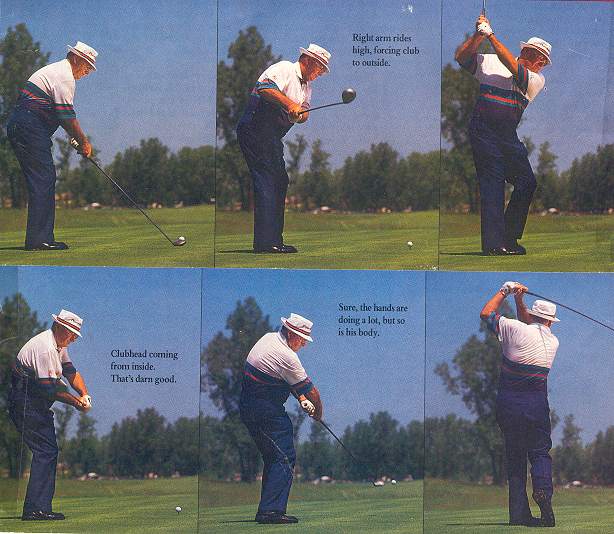
Understanding the Unorthodox Swings - Part 4
Here I look at Mr. X, Miller Barber.

I don't have this swing sequence available for a full image, but here's a .pdf file of Barber in his early days. In fact, this swing seems even more unorthodox and extreme than the swing sequence above.
MILLER BARBER SWING SEQUENCE .PDF
While most people marvel at Barber's 'flying right elbow', I'm more amazed at just how closed his clubface is on the backswing. Then on the downswing, his downswing plane is extremely upright. I heard one poster who referred to it as the 'guillotine plane' when looking at the .pdf swing sequence.
I think Barber had a few things going for him.
1. Incredible hand-eye coordination.
Yes, there are so many ways to hit a golf ball effectively, but I dare anybody to try this and see if they can even come close to hitting the ball well. My guess is that they would fail miserably. That downswing is so upright, that at the last second he winds up dramitically flattening out the plane so he can hit the ball.
2. He had a great work ethic.
As the .pdf file says, he worked extremely hard on the range to keep his swing going.
3. He has a very good pivot.
A must for PGA Tour level ballstriking.
4. He uses pitch elbow.
I think this saves his swing as it allows him to flatten out that extremely steep downswing plane.
I'm guessing in TGM terms he would be known as a 'triple shift' swing plane golfer.
And from looking at the swing, it's no surprise that the author of the .pdf file states that Barber is known for taking extremely steep divots.
3JACK
I don't have this swing sequence available for a full image, but here's a .pdf file of Barber in his early days. In fact, this swing seems even more unorthodox and extreme than the swing sequence above.
MILLER BARBER SWING SEQUENCE .PDF
While most people marvel at Barber's 'flying right elbow', I'm more amazed at just how closed his clubface is on the backswing. Then on the downswing, his downswing plane is extremely upright. I heard one poster who referred to it as the 'guillotine plane' when looking at the .pdf swing sequence.
I think Barber had a few things going for him.
1. Incredible hand-eye coordination.
Yes, there are so many ways to hit a golf ball effectively, but I dare anybody to try this and see if they can even come close to hitting the ball well. My guess is that they would fail miserably. That downswing is so upright, that at the last second he winds up dramitically flattening out the plane so he can hit the ball.
2. He had a great work ethic.
As the .pdf file says, he worked extremely hard on the range to keep his swing going.
3. He has a very good pivot.
A must for PGA Tour level ballstriking.
4. He uses pitch elbow.
I think this saves his swing as it allows him to flatten out that extremely steep downswing plane.
I'm guessing in TGM terms he would be known as a 'triple shift' swing plane golfer.
And from looking at the swing, it's no surprise that the author of the .pdf file states that Barber is known for taking extremely steep divots.
3JACK
Subscribe to:
Posts (Atom)