The Tour makes their 87th trip to the AT&T Pebble Beach Pro-Am:
This event will feature rounds at Spyglass Hill GC, Monterey Peninsula CC and Pebble Beach Golf Links. The cut comes after Saturday with each player getting 1 round at each course. After the cut is made, the final round will feature each player playing at Pebble Beach GL for a second time. This is also a Pro-Am and each player will be paired with an Amateur.
While it’s a historic tournament with a great tradition and I generally really like Pebble Beach and Spyglass, this is not one of my personal favorite events of the year. As a statistician, I’m not a fan of events that play more than one course because the Tour only keeps ShotLink data on one course. As a competitive golfer, my dislike is that weather can influence performance and players that get on a certain course at a certain time could greatly benefit due to sheer luck.
The rounds are very long since it’s a Pro-Am each day. You’re looking a 6+ hour rounds and with the players between 3 courses, it’s hard to get to see the players you want. Television loves to stick to the name players anyway, but it’s not uncommon at the Pebble Beach Pro-Am for the leader thru 3 rounds almost get zero coverage because of how the event is formatted.
Typically when I go to Tour events I go on Tuesday because your regular Tour event has a pro-am on Monday and Wednesday (Wednesday is the bigger pro-am event). That way I can talk with my clients without them having to focus on the pro-am event and the obligations they have to give time to their amateur partners. I know at Bay Hill, the amateur pays $8k to play in the Wednesday pro-am.
But watching these Wednesday pro-ams are painful. Lots of amateurs that have no shot of breaking 100 on a course with thick rough, super slick green, lots of water and forced carries. As a spectator, you have to watch out because the ball may just go anywhere when the amateur is playing. The PB Pro-Am used to generate my interest because the celebrities were interesting and likeable people such as Jack Lemmon and Clint Eastwood. Now the event revolves around Bill Murray, who is brilliant, but not always the most likeable celebrity.
So for the Tour players, this is either an event you look forward to because of the courses and the tradition or it’s an event that you begrudgingly play in because you need to get into any event you can or the courses fit your game to a tee.
One major thing is that Pebble Beach is vastly different than when they set it up for the US Open. For instance, the tee on the 17th is moved about 40 yards forward for the Tour pros in this event compared to the US Open. The main complaint I’ve heard from golfers about Pebble Beach is that it has the great holes and everything else is rather pedestrian. I’ve never played Pebble Beach, but from looking at it on Google Earth, I like the design because as long as it avoids poorly designed holes, I see that as the natural ebb and flow of a course. Not every hole on a course is going to be spectacular and when you throw some ordinary looking designed holes it helps emphasize the great holes even more.
Anyway, Pebble features some of the smallest greens on Tour. There’s not a lot of reason to fire at flags because the green complexes are only about 3,000 square feet compared to modern courses that are closer to 6,000+ square feet. The greens at Pebble also are the slowest with the most severe contours and that brings the make percentages way down. It’s one of the few courses where good putters tend to have an advantage. The reason for Dustin Johnson’s success here despite not being a great putter is that he putts more effectively on slower greens, even if they have severe contours.
As great as the 18th hole is, it’s not a ‘critical hole’ at Pebble. The last critical hole comes on the tricky par-5 14th hole.
Projected Winning Score: -19
3JACK’S FAVORITES
Dustin Johnson +550
Jason Day +1,000
Jordan Spieth +1,100
Gary Woodland +2,500
Paul Casey +2,800
Phil Mickelson +2,800
3JACK’S DARK HORSE PICKS
Matt Kuchar +3,300
Patrick Reed +3,500
Kevin Kisner +5,000
Aaron Wise +15,000
Chris Stroud +25,000
3JACK
Wednesday, February 7, 2018


Monday, February 5, 2018
Review of The Golf Lab's TaylorMade M1 vs. M3 Driver Head Study Video
In recent years a big trend with YouTube and golf instructors is for them to develop YouTube channels dedicated to club reviews. What’s odd is the overwhelming majority of the reviewers are from England for whatever reason. One would think that this would be more prevalent with US instructors given how equipment sales are much larger in the US than in Europe. In fact, we are seeing an influx of Japanese OEM’s that are trying to force their way into the US market like Honma, Epon and PRGR because it’s undeniable how big the US market is with golf equipment.
But, the big time review channels consist of British golf pros like:
Rick Shiels (265k subscribers) (https://www.youtube.com/user/RickShielsPGAGolf)
Mark Crossfield (236k subscribers) (https://www.youtube.com/user/4golfonline)
Peter Finch (126k subscribers) (https://www.youtube.com/user/peterfinchgolf)
In fact, Shiels has reached such popularity that he has been named as one of the judges for Wilson Golf’s next Driver vs. Driver 2 reality show coming up on The Golf Channel this year.
I had mentioned that Shiels was going to be one of the judges in my 2018 PGA Merchandise Show review and that I thought it was a great choice, even though I’m not a big fan of the reviews.
My issue with the reviews is that regardless of the reviewer, the reviews are pretty much the same and it’s mostly subjective data. The reviewer will go over the club(s) they are going to review. What the marketing behind the club says and then hit a bunch of shots with a launch monitor and go over the ball flight numbers (the only real objective data in the review) and mostly go with what their thoughts are on the feel and looks of the club. I’ve even seen Rick Shiels review the naming of the model such as his dislike of the name ‘Epic’ for the Callaway models.
This really is not a knock against those reviewers as looks and feel play a huge role in a club purchase. I believe that not only do most golfers purchase equipment based on looks and feel, but that there is normally a universal standard of sorts when it comes to looks. Most people find blade irons to be pretty while they just don’t see game improvement irons to look that great. The same goes for the Wilson Triton driver which I’ve mostly heard from owners that it performed great…but the looks and feel (mostly from the sound) were underwhelming.
But my point is that the lack of objective data in these reviews leaves a lot left to be desired for more critical golfers like myself. For instance, I tend to put too much spin on the ball so I am always looking for a low spinning driver head. But, it’s difficult to tell a comparison of what heads will derive more or less spin or lower or higher launch angles unless you actually get fitted. And many fitters do not have all of the driver heads a golfer could want to try in order to find the best possible fit. And the ones that do are quite pricey and provide ‘ala carte’ pricing.

Ala carte pricing is when the clubfitter takes the retail price of each of the components of a club that they have custom fitted for the golfer.
For instance, let’s say you are fitted for the Ping G400 driver with a Mitsubishi Tensei shaft and a GolfPride Multi-Compound grip. The pricing would be as follows in ‘ala carte’ pricing:
And that does not include the fee for the club fitter to put the club together which usually is around $100 to $150 (and they often charge sales tax). By the end you’re looking at a driver that costs over $950. And drivers due lose some of their COR (spring effect) after a couple of years of use as Kelvin Miyahira tested this out a few years ago (it’s one of the big selling points of the Krank Golf drivers…their heads don’t lose COR over time). So you could pay nearly $1,000 for a custom fitted that could need to be replaced in 3 years and by then that model is no longer being sold.
In essence, there really needs to be a better way to do this for the consumer. There really needs to be a Consumer Reports version of studying golf equipment using objective data and stop relying solely on how the reviewer(s) just happen to be swinging the club that day. Fortunately, we may have finally come across that with The Golf Lab’s video of the Taylor Made M1 vs. Taylor Made M3 driver head study
The Golf Lab is based out of Barrie, Ontario a suburb of Toronto. It is headed up by golf instructor Liam Mucklow who was awarded the Canadian Golf Instructor of the Year award in 2014. Here’s a list of The Golf Lab Team and their credentials and backgrounds:
http://www.mygolflab.ca/team
What The Golf Lab has created is one of the most state of the art facilities in the world for golf instruction and club fitting.
As many readers already know, I’ve been a huge fan of the GolfMechanix products since I purchased their MOI Auditor Machine back in 2012. But GolfMechanix has so many other great products that The Golf Lab has in their studio such as the digital lie and loft bending machine that can measure the loft and face angle at different parts of the face.
As Tom Wishon pointed out years ago with his head designs…the loft changes on OEM driver heads throughout the face. This is due to the ‘roll’ design of the heads. The loft gets lower towards the bottom of the head and the loft increase towards the crown of the head. Wishon created drivers with what he calls Graduated Roll Technology in order to not lose loft on shots hit low on the head…while only seeing a slight increase in the loft on shots struck higher on the head.
http://www.golfclub-technology.com/images/grt.gif
The Golf Lab also has GolfMechanix’s Center of Gravity locator machine (retails about at $5,500). This is the key piece of equipment in these reviews. Most driver heads are fairly similar in terms of size (roughly 460 cc), lie angle and loft options as well as the COR. Companies have a regulation in terms of COR and each company pushes the limit on COR. Thus, any claim that you will hit this driver ’20 yards further!’ should be taken with a grain of salt.
It’s not that a golfer cannot hit a certain driver 20 yards further, but it has little to do with the driver having a ‘hotter’ face and it’s unlikely they will be able to be able to swing the club with faster club speed and a faster resultant ball speed that, by themselves, would produce 20 yards more distance. Instead, if you can find the head with the right Center of Gravity for your swing (as well as the right shaft), then you can start to get into a legitimate conversation of hitting it 20 yards further and straighter. And thus you’re getting into a conversation of actually making a smart, logical decision in purchasing a piece of equipment.
In recent years I feel that OEM’s have made great strides in creating legitimate differences in their driver heads. I feel the TaylorMade twist face is legitimate in terms of making off-center hits better. Also companies like TaylorMade, Callaway and Ping have found better designs of the Center of Gravity and loft specs to create better performance. Check out this Be Better Golf video at the 11:00 minute mark where they Brendon DeVore hits a very popular 2007 TaylorMade driver model versus the M1 at the MyGolfSpy lab.
And that is what The Golf Lab’s M1 vs. M3 driver head study is about:
Access to the entire video costs $13 and can be found here:
https://vimeo.com/ondemand/m1vm3/254182426
The Golf Lab has stated that they plan to more videos. Hopefully they can find a membership plan or a lower price point to do more videos so one can carefully examine and compare year’s models of all OEM drivers.
I won’t go into the findings here because that is what the video is for. But Mucklow and his assistant, Carson Hau, do a great job of clearly explaining what the numbers mean and how that will affect the ball flight conditions. Mucklow also hits each the M1 and the M3 driver with the weight moved all the way forward and the weight moved all the way back and shows the results and explains the conclusions as to why the ball performed different with each head and where they moved the weight. And just as importantly, unlike most reviewers…Mucklow uses the same golf shaft in each head (and each weight location)…a Fujikura Atmos Blue 6 X-Stiff shaft that he says is his gamer shaft. That is critical because most reviewers use a different shaft when they compare clubs and the shaft properties can easily alter the launch conditions of a shot.
Hopefully, this can develop into something similar to the Wishon Shaft Bend Profile database that Tom Wishon has that can tell you the properties of thousands of golf shafts. In the meantime, it’s an excellent presentation of understanding the design of a driver head. And whether you are an amateur or a golf instructor, shouldn’t you understand the fundamentals of the equipment you are using?
I think so.
3JACK
But, the big time review channels consist of British golf pros like:
Rick Shiels (265k subscribers) (https://www.youtube.com/user/RickShielsPGAGolf)
Mark Crossfield (236k subscribers) (https://www.youtube.com/user/4golfonline)
Peter Finch (126k subscribers) (https://www.youtube.com/user/peterfinchgolf)
In fact, Shiels has reached such popularity that he has been named as one of the judges for Wilson Golf’s next Driver vs. Driver 2 reality show coming up on The Golf Channel this year.
I had mentioned that Shiels was going to be one of the judges in my 2018 PGA Merchandise Show review and that I thought it was a great choice, even though I’m not a big fan of the reviews.
My issue with the reviews is that regardless of the reviewer, the reviews are pretty much the same and it’s mostly subjective data. The reviewer will go over the club(s) they are going to review. What the marketing behind the club says and then hit a bunch of shots with a launch monitor and go over the ball flight numbers (the only real objective data in the review) and mostly go with what their thoughts are on the feel and looks of the club. I’ve even seen Rick Shiels review the naming of the model such as his dislike of the name ‘Epic’ for the Callaway models.
This really is not a knock against those reviewers as looks and feel play a huge role in a club purchase. I believe that not only do most golfers purchase equipment based on looks and feel, but that there is normally a universal standard of sorts when it comes to looks. Most people find blade irons to be pretty while they just don’t see game improvement irons to look that great. The same goes for the Wilson Triton driver which I’ve mostly heard from owners that it performed great…but the looks and feel (mostly from the sound) were underwhelming.
But my point is that the lack of objective data in these reviews leaves a lot left to be desired for more critical golfers like myself. For instance, I tend to put too much spin on the ball so I am always looking for a low spinning driver head. But, it’s difficult to tell a comparison of what heads will derive more or less spin or lower or higher launch angles unless you actually get fitted. And many fitters do not have all of the driver heads a golfer could want to try in order to find the best possible fit. And the ones that do are quite pricey and provide ‘ala carte’ pricing.
For instance, let’s say you are fitted for the Ping G400 driver with a Mitsubishi Tensei shaft and a GolfPride Multi-Compound grip. The pricing would be as follows in ‘ala carte’ pricing:
And that does not include the fee for the club fitter to put the club together which usually is around $100 to $150 (and they often charge sales tax). By the end you’re looking at a driver that costs over $950. And drivers due lose some of their COR (spring effect) after a couple of years of use as Kelvin Miyahira tested this out a few years ago (it’s one of the big selling points of the Krank Golf drivers…their heads don’t lose COR over time). So you could pay nearly $1,000 for a custom fitted that could need to be replaced in 3 years and by then that model is no longer being sold.
In essence, there really needs to be a better way to do this for the consumer. There really needs to be a Consumer Reports version of studying golf equipment using objective data and stop relying solely on how the reviewer(s) just happen to be swinging the club that day. Fortunately, we may have finally come across that with The Golf Lab’s video of the Taylor Made M1 vs. Taylor Made M3 driver head study
***
The Golf Lab is based out of Barrie, Ontario a suburb of Toronto. It is headed up by golf instructor Liam Mucklow who was awarded the Canadian Golf Instructor of the Year award in 2014. Here’s a list of The Golf Lab Team and their credentials and backgrounds:
http://www.mygolflab.ca/team
What The Golf Lab has created is one of the most state of the art facilities in the world for golf instruction and club fitting.
As many readers already know, I’ve been a huge fan of the GolfMechanix products since I purchased their MOI Auditor Machine back in 2012. But GolfMechanix has so many other great products that The Golf Lab has in their studio such as the digital lie and loft bending machine that can measure the loft and face angle at different parts of the face.
As Tom Wishon pointed out years ago with his head designs…the loft changes on OEM driver heads throughout the face. This is due to the ‘roll’ design of the heads. The loft gets lower towards the bottom of the head and the loft increase towards the crown of the head. Wishon created drivers with what he calls Graduated Roll Technology in order to not lose loft on shots hit low on the head…while only seeing a slight increase in the loft on shots struck higher on the head.
http://www.golfclub-technology.com/images/grt.gif
The Golf Lab also has GolfMechanix’s Center of Gravity locator machine (retails about at $5,500). This is the key piece of equipment in these reviews. Most driver heads are fairly similar in terms of size (roughly 460 cc), lie angle and loft options as well as the COR. Companies have a regulation in terms of COR and each company pushes the limit on COR. Thus, any claim that you will hit this driver ’20 yards further!’ should be taken with a grain of salt.
It’s not that a golfer cannot hit a certain driver 20 yards further, but it has little to do with the driver having a ‘hotter’ face and it’s unlikely they will be able to be able to swing the club with faster club speed and a faster resultant ball speed that, by themselves, would produce 20 yards more distance. Instead, if you can find the head with the right Center of Gravity for your swing (as well as the right shaft), then you can start to get into a legitimate conversation of hitting it 20 yards further and straighter. And thus you’re getting into a conversation of actually making a smart, logical decision in purchasing a piece of equipment.
In recent years I feel that OEM’s have made great strides in creating legitimate differences in their driver heads. I feel the TaylorMade twist face is legitimate in terms of making off-center hits better. Also companies like TaylorMade, Callaway and Ping have found better designs of the Center of Gravity and loft specs to create better performance. Check out this Be Better Golf video at the 11:00 minute mark where they Brendon DeVore hits a very popular 2007 TaylorMade driver model versus the M1 at the MyGolfSpy lab.
And that is what The Golf Lab’s M1 vs. M3 driver head study is about:
Access to the entire video costs $13 and can be found here:
https://vimeo.com/ondemand/m1vm3/254182426
The Golf Lab has stated that they plan to more videos. Hopefully they can find a membership plan or a lower price point to do more videos so one can carefully examine and compare year’s models of all OEM drivers.
I won’t go into the findings here because that is what the video is for. But Mucklow and his assistant, Carson Hau, do a great job of clearly explaining what the numbers mean and how that will affect the ball flight conditions. Mucklow also hits each the M1 and the M3 driver with the weight moved all the way forward and the weight moved all the way back and shows the results and explains the conclusions as to why the ball performed different with each head and where they moved the weight. And just as importantly, unlike most reviewers…Mucklow uses the same golf shaft in each head (and each weight location)…a Fujikura Atmos Blue 6 X-Stiff shaft that he says is his gamer shaft. That is critical because most reviewers use a different shaft when they compare clubs and the shaft properties can easily alter the launch conditions of a shot.
Hopefully, this can develop into something similar to the Wishon Shaft Bend Profile database that Tom Wishon has that can tell you the properties of thousands of golf shafts. In the meantime, it’s an excellent presentation of understanding the design of a driver head. And whether you are an amateur or a golf instructor, shouldn’t you understand the fundamentals of the equipment you are using?
I think so.
3JACK
Wednesday, January 31, 2018
What to Look For: 2018 Waste Management Open
The Tour comes back to the loudest hole in golf at TPC Scottsdale:
From Wikipedia:
The Phoenix Open began 86 years ago in 1932 but was discontinued after the 1935 tournament. The rebirth of the Phoenix Open came in 1939 when Bob Goldwater, Sr. convinced fellow Thunderbirds to help run the event. The Thunderbirds, a prominent civic organization in Phoenix, were not as enthusiastic about running the event as he was, leaving Goldwater, Sr. to do most of the work in getting a golf open started.
What makes the Phoenix Open special is that in general, the course is not well received by the players. Prior to the renovations by Tom Weiskopf the course was often thought of as a bomber’s course that lacked imagination. Weiskopf put in some changes to take the bombers’ clear advantage away, but it’s still not very well received because of the location of waste areas and some really cruel shots.
In fact, the world famous 16th hole is one of the most bland par-3’s you can find on Tour.
But, what makes top Tour players come to Phoenix is the fans. You’ll never get to experience a crowd like the 16th in your life. And the attendance over 4 days is likely to hit close to 500,000. It’s the fans that make this a special experience and it’s the fans at Scottsdale that coronate the beginning of the PGA Tour season.
With the renovations, the course is more about a complete driving performance. The rough is negligible, but the waste areas take something away from the bombers. From there, mid length approach shots will separated the contenders from everybody else.
17 and 18 are excellent finishing holes (both are critical holes on the course) and the 16th has the atmosphere that’s like no other.
Projected Winning Score: -15
3JACK’S FAVORITES
Jordan Spieth +800
Hideki Matsuyama +1,000
Rickie Fowler +1,100
Justin Thomas +1,400
Alex Noren +3,300
Tony Finau +3,300
3JACK’S DARK HORSE PICKS
JB Holmes +4,000
Ryan Palmer +5,500
Kevin Streelman +12,500
Lucas Glover +15,000
3JACK
From Wikipedia:
The Phoenix Open began 86 years ago in 1932 but was discontinued after the 1935 tournament. The rebirth of the Phoenix Open came in 1939 when Bob Goldwater, Sr. convinced fellow Thunderbirds to help run the event. The Thunderbirds, a prominent civic organization in Phoenix, were not as enthusiastic about running the event as he was, leaving Goldwater, Sr. to do most of the work in getting a golf open started.
What makes the Phoenix Open special is that in general, the course is not well received by the players. Prior to the renovations by Tom Weiskopf the course was often thought of as a bomber’s course that lacked imagination. Weiskopf put in some changes to take the bombers’ clear advantage away, but it’s still not very well received because of the location of waste areas and some really cruel shots.
In fact, the world famous 16th hole is one of the most bland par-3’s you can find on Tour.
But, what makes top Tour players come to Phoenix is the fans. You’ll never get to experience a crowd like the 16th in your life. And the attendance over 4 days is likely to hit close to 500,000. It’s the fans that make this a special experience and it’s the fans at Scottsdale that coronate the beginning of the PGA Tour season.
With the renovations, the course is more about a complete driving performance. The rough is negligible, but the waste areas take something away from the bombers. From there, mid length approach shots will separated the contenders from everybody else.
17 and 18 are excellent finishing holes (both are critical holes on the course) and the 16th has the atmosphere that’s like no other.
Projected Winning Score: -15
3JACK’S FAVORITES
Jordan Spieth +800
Hideki Matsuyama +1,000
Rickie Fowler +1,100
Justin Thomas +1,400
Alex Noren +3,300
Tony Finau +3,300
3JACK’S DARK HORSE PICKS
JB Holmes +4,000
Ryan Palmer +5,500
Kevin Streelman +12,500
Lucas Glover +15,000
3JACK
Thursday, January 25, 2018
The Week That Was: 2018 PGA Merchandise Show (Part 2)
On Wednesday is the first official day of the PGA Merchandise Show. One has to go to the Orange County Convention Center to appreciate how enormous it is. It’s the largest convention center in the world and as enormous as the PGA Merchandise Show is, it may only take up about 1/8th of the entire convention center. OCCC actually expands across International Drive and the enormity of it (did I mention it’s enormous?) is something to behold.
What I do is I go to the PGAShow.com Web site before the show and go thru the list of all of the exhibitors. I then look at the ones that I’m not familiar with and I check to see what they are about. If it’s something that I may be interested in I click on them to my ‘favorites.’ They web site used to compile them all together for you in either alphabetical order or by the order of their booth number. The site no longer does that for some reason, so I had to create a spreadsheet in Google Sheets and then I just carried my phone with me and went to the booths I wanted to go to.
You really don’t need to list the large OEM booths in your ‘favorites’ because you will spot them. Places like Titleist, TaylorMade, Callaway, Ping, etc. are really something incredible for an exhibit booth. Travis Matheiu’s booth had a pool table, DJ and was giving away free beer. But the reason why the favorites list is important is that it’s easy to forget about those lesser known companies that really have something great to offer. This is how I found MySwing Golf and Ikkos over the years.
Let’s get this out of the way…this was a very good, solid PGA Show. I don’t think it quite lives up to the 2011 show, but I wouldn’t argue too much against that. You had so much new stuff that had yet to be released where in years past stuff had been released months before the show. I really think OEM’s and tech companies need to be cognizant of that because by releasing it before the show you really kill off the hype and interest in the product.
There was a real buzz about TaylorMade M3 and M4 along with the Callaway Rogue, the Thin Ply Technology shafts, the Ping G400 Max driver, the Titleist SM7 wedges, the new Scotty Camerons and Trackman’s latest upgrade that not only track’s short game and putting, but now has impact location:

I think this helps better justify Trackman’s pricing which is in the $25k range while competitors are closer to the $10-$12K range as Trackman has more functionality now with a robust system that can provide full swing, short game and putting data along with impact location. The major advantage in terms of functionality that I see from Trackman’s competitors at this point would be FlightScope’s acceleration profile which is a great product for shaft fitting.
The focus with radar/sensor systems seems to be trending towards putting. And while there were some interesting products, SAM Puttlab is still the top machine out there in my opinion.
Their latest edition provides so many countless upgrades and can replay overhead views of the putting stroke. That’s where I saw longtime friend and fellow 315 refugee, David Orr (www.flatstickacademy.com) doing a presentation.
David was doing the SAM Puttlab presentation on a putting surface, that I assume was a PuttView surface. They can alter the slope of the putt and in David’s presentation they changed it to flat to 2% breaking right to left in about 10-15 seconds. What I found interesting was that I could not notice the slope change and that’s why it’s so important to feel the break using your feet instead of your eyes. And I think that’s one of the issues I have with reading putts…I will read them with my feet, but the peripheral vision can greatly misinterpret the slope.
One of the things I checked out was The Most Important Stretch in Golf:
The MISIG is a bit of an exercise and swing training tool in one. For the better players I think it’s more designed for exercise. I was going to buy one, but it was one of the first booths I visited and they had a great PGA Show price of $60 (normally it’s $90). I didn’t want to carry it around and when I got done with the Show I forgot to go back there and purchase one. The benefits I see for it is that I have problems with my right scapula and it often leads to elbow issues and when I tried the MISIG, it really started to loosen up that scapula. I also think that using it for your non-dominant side is a helpful stretch as well. It comes with 3 different bands to provide different amounts of resistance.
Next to the SAM Puttlab was 4D Motion. My issues with 4D Motion in the past was mostly their avatars were not very good, but that has much improved. You’re seeing a lot of 3D mocap companies learn from each other, but I still feel that MySwing Golf with 3Jack Blog reader, Peter Gauthier, is still a step ahead of everybody. Now MySwing has variable options for products with different price points. MySwing has always been very affordable, but now it’s even more affordable depending on what product you choose. Here’s a link with their different products available:
https://www.myswing.com/product-page-2-2/
It should be noted that the big thing MySwing has integrated is a force plate system so not only can you get the body motion data, but the pressure data as well.
Also by the SAM Puttlab was my good friend Scott Fawcett (www.playinglesson.com) and his DECADE golf data. He’s now certifying instructors which is a great thing to see. We discussed how my findings in 2017 Pro Golf Synopsis were in line with what he has researched as well. But Scott’s work is so advanced in terms of visuals and understanding of what really goes into an effective golf strategy. Everybody in golf likes to use the old say ‘everybody has a plan until they get punched in the face’, but failing to plan is really planning to fail. And you can plan for when you take that right cross to the chin just like you can plan when you pipe a 300 yard drive down the middle of the fairway.
I’m glad to see that Scott is getting his work out there because you would be amazed at how even Tour players get talked out of strategy that is really common sense over time of playing competitively. Things like not understanding that if you’re 70 yards closer to the hole…you’re generally far better off than having your ‘money yardage’ into green. And if you’re not…then you simply need to work on your short game because you’re leaving strokes out there.
But, I feel that proper strategy off the tee and on par-5’s is normally more offensive minded than defensive minded. And I think with so many players being way too conservative off the tee they are not letting their talent shine and they are not allowing themselves…to be themselves. It causes frustration to grow and can make playing the game very bland. So anybody that really knows the mathematical strategy to the game and can convey that to golfers I’m fully on board with.
One of my favorite booths that I was looking forward to was the GolfMechanix booth.
GolfMechanix is the cream of the crop when it comes to golf club fitting tools and tools for OEM’s. I was hoping they would have the Golf Head Center of Gravity Locator Machine on display:
They didn’t due to the size of the machine. But I was told it measures the 3 dimensions of the Center of Gravity with relation to the longitudinal (height), latitudinal (east-west) and how far forward or backward in the head the CoG is located. I think this is what real product reviews and testing are missing…giving facts and details about clubs and determining how those properties will affect the ball flight instead of basing everything on the looks and how the reviewer happens to be swinging the club that day.
Problem is that CG locator machine is very expensive ($5k+). I did get to see the Shaft machine that can find the spine as well as flex zone profiling (bend profiles of the shaft):
That retails for $730 and I think it’s a great product for a fitter that can afford to get plenty of shafts and then test them and find more affordable alternatives for their golfers.
I did get to hit the Thin Ply Technology shaft at their booth. The shaft felt fine, but the issue I had was the lack of comparison to other shafts to see how it performed. I got on Trackman and my swing was lousy as I was hitting balls with sneakers on, my feet and legs were sore from walking so much and I hate hitting into nets (kills my swing). My average club speed was 109 mph, but with a +5 to +6 degree upward attack angle. I was getting too much right pelvic tilt and secondary tilt, which is a common problem when I’m swinging poorly and it causes high attack angles, high dynamic lofts and thus, high spin rates. My average carry was about 270 yards, but the spin rates were were around 3,000 rpm’s. Again, I wasn’t swinging it well for numerous factors, but that’s a big goal for me in 2018…get the attack angle down a little to +2 to +3, decrease the dynamic loft and lower the spin rate to the 2,300 or less range. I figure that the current swing (again, I didn’t swing it well) was probably costing me about 3-6 mph of club speed and probably close to 10 mph of ball speed.
And that’s why I decided to go over to the FlightScope and purchase the FlightScope Mevo.
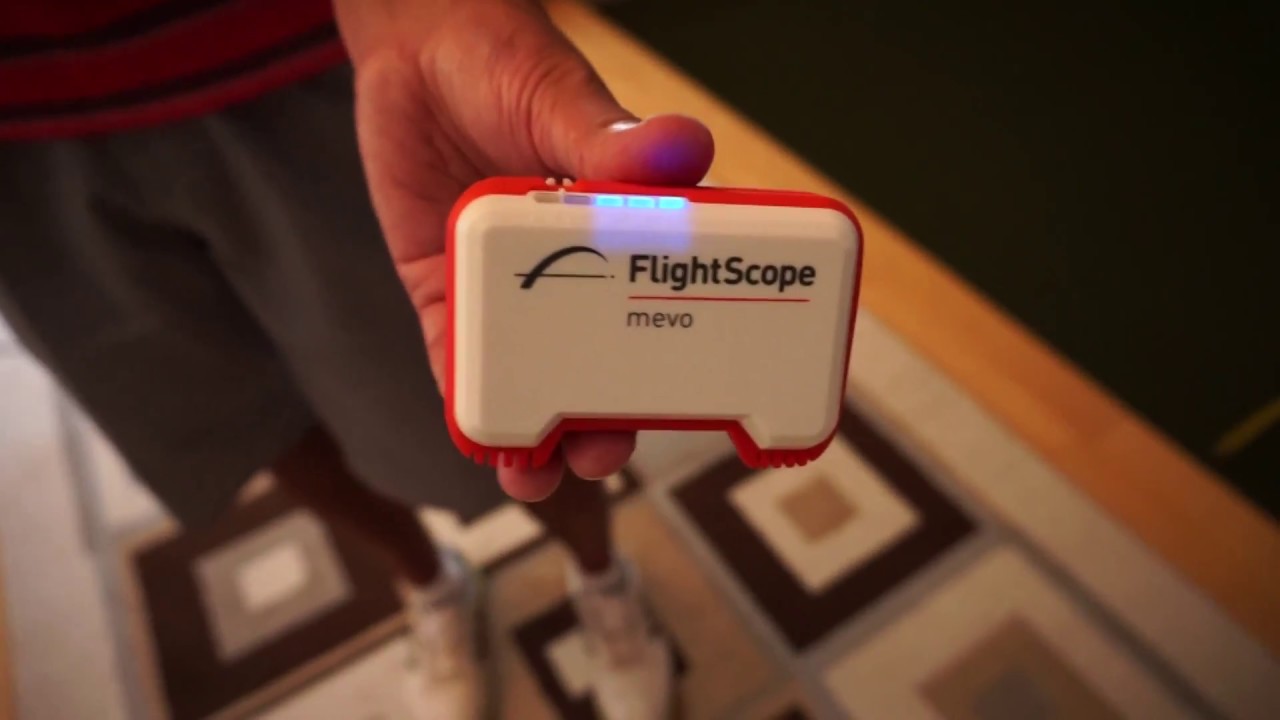
The Mevo, as many of you already know can track the following:

Obviously, it does not have attack angle and dynamic loft numbers. But, I can use it to look at vertical launch, club speed and spin rate numbers and get a better understanding of my progress with the swing. I also believe that it’s a good training tool for club speed as it’s easy to get lazy with club speed if you don’t train with something that measure it.
I also plan to do some club fitting with it. I know my 5-iron isn’t not properly gapped as it only goes about 4 yards further than my 6-iron. But, I can also do some tests with golf balls, drivers, and hopefully put myself and my friends into some better equipment fits. They had a deal at the show where you could get the Mevo for $450 instead of the typical retail price of $500.
Before I made my way over to Fujikura I tried out the Halo Neuroscience (www.haloneuro.com) booth. This is one of those companies that I researched on the Exhibitor List on the PGA Show web site before I made my way over.
A couple of years ago I was really high on Ikkos’ CopyMe Golf. And I still think it was a good concept that helped my game quite a bit. The issue with CopyMe Golf is that it is based on the visuals you see from golfers or whatever model you want to copy. And often times what you think you see on video isn’t exactly what is happening.
For instance, you may see a golfer getting their lead wrist into flexion in the downswing (ala Jon Rahm) and think that all you need to do is actively get your lead wrist into flexion. But, in reality there are easier ways to do that instead of consciously trying to get the lead wrist into flexion.
From what I’ve been told from the Halo Neuro people the head phones do not play any music or binaural beats (unless you want them to). They have pads that stimulate the motor cortex of the brain to help you more quickly develop whatever you’re working on. I tested it out and you could start to feel it tingling on your skull. And you can change the amount of sensation with their app.
I don’t know if it works or not, but I do believe they have a 60 day guarantee. They retail for $750, but if I could get even better improvement than what I got from Ikkos, it certainly would be worth it. The other problem I had with Ikkos is that I switched over to an Android phone and while Ikkos has an app for Android, the thing never works. It appears that Ikkos is basically giving up on the golf concept and focusing more on using it for swimming training anyway.
Lastly, I hit up Fujikura. Fujikura is usually in their own room and not out in the exhibition floor. It’s a no frills approach with nothing but a water cooler, some tables and chairs and Fujikura dealers can come in and have a one-on-one talk with people like Director of Tour Operations Pat McCoy, Vice President Alex Dee and President David Schnider. This room allows for Fujikura to communicate with their dealers more effectively. It’s a laid back setting, you don’t have to worry about all of the noise and people having to stand while talking to you, and all of the distractions that come with the Exhibit floor. It’s a time to deal with questions and concerns their dealers have.
The great news is that there is a lot of great things on the horizon for Fujikura and they were explaining some things to me that we will go into when I take a trip out to Southern California and visit Fujikura this Spring. I hope to have the experience done in a vlog format so people can best understand what Fujikura is doing and also show the fitting process with their ENSO machine. One of my highlights…for me anyway…was getting the chance to talk in depth with Alex Dee as I’m a huge fan of his work and understanding of shaft technology and how to develop shafts. I am a firm believer that Fujikura is the greatest graphite shaft company in the world. Nobody has more of a variety of shafts with different properties that can fit and has the ability to have made great shafts.
After that I attended Preston Combs’ (https://www.yourpargolf.com) and John Dunigan’s (http://www.johndunigan.com/) get together dinner at Kobe Steakhouse which was excellent. The following people were there:
Denny Lucas (www.kelvinmiyahiragolf.com)
Lloyd Higley (www.lloydhigleygolf.com)
Brendan Kennedy (https://www.heathrowcc.com/golf/garl/instruction)
Mike Manavian (https://greenwichdxsportslabs.com)
David Orr (www.flatstickacademy.com)
Lucas Donah
James Ridyard (www.jamesridyardgolf.com)
Nick Chertock (www.golfprogress.com)
James Hong (http://www.uskidsgolf.com/play-and-learn/coaches/find-coach/418222)
Rob McGill (https://www.stonesrivercc.org/Club_Info/Meet_the_Staff/PGA_Golf_Professional,_Rob_McGill.aspx)
Jason Sutton (www.golfgurutv.net)
And many others that I unfortunately cannot remember at this time. It was a good time for all and again…the reason why it’s always worth it to go to the PGA Merchandise Show.
3JACK
What I do is I go to the PGAShow.com Web site before the show and go thru the list of all of the exhibitors. I then look at the ones that I’m not familiar with and I check to see what they are about. If it’s something that I may be interested in I click on them to my ‘favorites.’ They web site used to compile them all together for you in either alphabetical order or by the order of their booth number. The site no longer does that for some reason, so I had to create a spreadsheet in Google Sheets and then I just carried my phone with me and went to the booths I wanted to go to.
You really don’t need to list the large OEM booths in your ‘favorites’ because you will spot them. Places like Titleist, TaylorMade, Callaway, Ping, etc. are really something incredible for an exhibit booth. Travis Matheiu’s booth had a pool table, DJ and was giving away free beer. But the reason why the favorites list is important is that it’s easy to forget about those lesser known companies that really have something great to offer. This is how I found MySwing Golf and Ikkos over the years.
Let’s get this out of the way…this was a very good, solid PGA Show. I don’t think it quite lives up to the 2011 show, but I wouldn’t argue too much against that. You had so much new stuff that had yet to be released where in years past stuff had been released months before the show. I really think OEM’s and tech companies need to be cognizant of that because by releasing it before the show you really kill off the hype and interest in the product.
There was a real buzz about TaylorMade M3 and M4 along with the Callaway Rogue, the Thin Ply Technology shafts, the Ping G400 Max driver, the Titleist SM7 wedges, the new Scotty Camerons and Trackman’s latest upgrade that not only track’s short game and putting, but now has impact location:
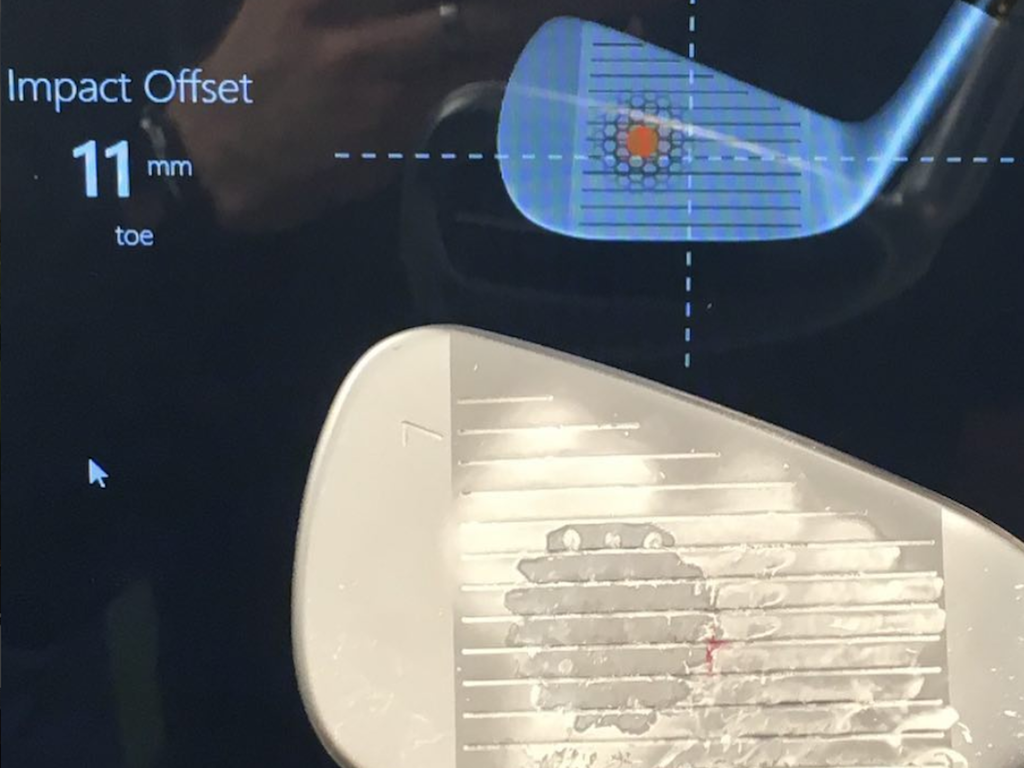
I think this helps better justify Trackman’s pricing which is in the $25k range while competitors are closer to the $10-$12K range as Trackman has more functionality now with a robust system that can provide full swing, short game and putting data along with impact location. The major advantage in terms of functionality that I see from Trackman’s competitors at this point would be FlightScope’s acceleration profile which is a great product for shaft fitting.
The focus with radar/sensor systems seems to be trending towards putting. And while there were some interesting products, SAM Puttlab is still the top machine out there in my opinion.
Their latest edition provides so many countless upgrades and can replay overhead views of the putting stroke. That’s where I saw longtime friend and fellow 315 refugee, David Orr (www.flatstickacademy.com) doing a presentation.
David was doing the SAM Puttlab presentation on a putting surface, that I assume was a PuttView surface. They can alter the slope of the putt and in David’s presentation they changed it to flat to 2% breaking right to left in about 10-15 seconds. What I found interesting was that I could not notice the slope change and that’s why it’s so important to feel the break using your feet instead of your eyes. And I think that’s one of the issues I have with reading putts…I will read them with my feet, but the peripheral vision can greatly misinterpret the slope.
One of the things I checked out was The Most Important Stretch in Golf:
The MISIG is a bit of an exercise and swing training tool in one. For the better players I think it’s more designed for exercise. I was going to buy one, but it was one of the first booths I visited and they had a great PGA Show price of $60 (normally it’s $90). I didn’t want to carry it around and when I got done with the Show I forgot to go back there and purchase one. The benefits I see for it is that I have problems with my right scapula and it often leads to elbow issues and when I tried the MISIG, it really started to loosen up that scapula. I also think that using it for your non-dominant side is a helpful stretch as well. It comes with 3 different bands to provide different amounts of resistance.
Next to the SAM Puttlab was 4D Motion. My issues with 4D Motion in the past was mostly their avatars were not very good, but that has much improved. You’re seeing a lot of 3D mocap companies learn from each other, but I still feel that MySwing Golf with 3Jack Blog reader, Peter Gauthier, is still a step ahead of everybody. Now MySwing has variable options for products with different price points. MySwing has always been very affordable, but now it’s even more affordable depending on what product you choose. Here’s a link with their different products available:
https://www.myswing.com/product-page-2-2/
It should be noted that the big thing MySwing has integrated is a force plate system so not only can you get the body motion data, but the pressure data as well.
Also by the SAM Puttlab was my good friend Scott Fawcett (www.playinglesson.com) and his DECADE golf data. He’s now certifying instructors which is a great thing to see. We discussed how my findings in 2017 Pro Golf Synopsis were in line with what he has researched as well. But Scott’s work is so advanced in terms of visuals and understanding of what really goes into an effective golf strategy. Everybody in golf likes to use the old say ‘everybody has a plan until they get punched in the face’, but failing to plan is really planning to fail. And you can plan for when you take that right cross to the chin just like you can plan when you pipe a 300 yard drive down the middle of the fairway.
I’m glad to see that Scott is getting his work out there because you would be amazed at how even Tour players get talked out of strategy that is really common sense over time of playing competitively. Things like not understanding that if you’re 70 yards closer to the hole…you’re generally far better off than having your ‘money yardage’ into green. And if you’re not…then you simply need to work on your short game because you’re leaving strokes out there.
But, I feel that proper strategy off the tee and on par-5’s is normally more offensive minded than defensive minded. And I think with so many players being way too conservative off the tee they are not letting their talent shine and they are not allowing themselves…to be themselves. It causes frustration to grow and can make playing the game very bland. So anybody that really knows the mathematical strategy to the game and can convey that to golfers I’m fully on board with.
One of my favorite booths that I was looking forward to was the GolfMechanix booth.
GolfMechanix is the cream of the crop when it comes to golf club fitting tools and tools for OEM’s. I was hoping they would have the Golf Head Center of Gravity Locator Machine on display:
They didn’t due to the size of the machine. But I was told it measures the 3 dimensions of the Center of Gravity with relation to the longitudinal (height), latitudinal (east-west) and how far forward or backward in the head the CoG is located. I think this is what real product reviews and testing are missing…giving facts and details about clubs and determining how those properties will affect the ball flight instead of basing everything on the looks and how the reviewer happens to be swinging the club that day.
Problem is that CG locator machine is very expensive ($5k+). I did get to see the Shaft machine that can find the spine as well as flex zone profiling (bend profiles of the shaft):
That retails for $730 and I think it’s a great product for a fitter that can afford to get plenty of shafts and then test them and find more affordable alternatives for their golfers.
I did get to hit the Thin Ply Technology shaft at their booth. The shaft felt fine, but the issue I had was the lack of comparison to other shafts to see how it performed. I got on Trackman and my swing was lousy as I was hitting balls with sneakers on, my feet and legs were sore from walking so much and I hate hitting into nets (kills my swing). My average club speed was 109 mph, but with a +5 to +6 degree upward attack angle. I was getting too much right pelvic tilt and secondary tilt, which is a common problem when I’m swinging poorly and it causes high attack angles, high dynamic lofts and thus, high spin rates. My average carry was about 270 yards, but the spin rates were were around 3,000 rpm’s. Again, I wasn’t swinging it well for numerous factors, but that’s a big goal for me in 2018…get the attack angle down a little to +2 to +3, decrease the dynamic loft and lower the spin rate to the 2,300 or less range. I figure that the current swing (again, I didn’t swing it well) was probably costing me about 3-6 mph of club speed and probably close to 10 mph of ball speed.
And that’s why I decided to go over to the FlightScope and purchase the FlightScope Mevo.
The Mevo, as many of you already know can track the following:
Obviously, it does not have attack angle and dynamic loft numbers. But, I can use it to look at vertical launch, club speed and spin rate numbers and get a better understanding of my progress with the swing. I also believe that it’s a good training tool for club speed as it’s easy to get lazy with club speed if you don’t train with something that measure it.
I also plan to do some club fitting with it. I know my 5-iron isn’t not properly gapped as it only goes about 4 yards further than my 6-iron. But, I can also do some tests with golf balls, drivers, and hopefully put myself and my friends into some better equipment fits. They had a deal at the show where you could get the Mevo for $450 instead of the typical retail price of $500.
Before I made my way over to Fujikura I tried out the Halo Neuroscience (www.haloneuro.com) booth. This is one of those companies that I researched on the Exhibitor List on the PGA Show web site before I made my way over.
A couple of years ago I was really high on Ikkos’ CopyMe Golf. And I still think it was a good concept that helped my game quite a bit. The issue with CopyMe Golf is that it is based on the visuals you see from golfers or whatever model you want to copy. And often times what you think you see on video isn’t exactly what is happening.
For instance, you may see a golfer getting their lead wrist into flexion in the downswing (ala Jon Rahm) and think that all you need to do is actively get your lead wrist into flexion. But, in reality there are easier ways to do that instead of consciously trying to get the lead wrist into flexion.
From what I’ve been told from the Halo Neuro people the head phones do not play any music or binaural beats (unless you want them to). They have pads that stimulate the motor cortex of the brain to help you more quickly develop whatever you’re working on. I tested it out and you could start to feel it tingling on your skull. And you can change the amount of sensation with their app.
I don’t know if it works or not, but I do believe they have a 60 day guarantee. They retail for $750, but if I could get even better improvement than what I got from Ikkos, it certainly would be worth it. The other problem I had with Ikkos is that I switched over to an Android phone and while Ikkos has an app for Android, the thing never works. It appears that Ikkos is basically giving up on the golf concept and focusing more on using it for swimming training anyway.
Lastly, I hit up Fujikura. Fujikura is usually in their own room and not out in the exhibition floor. It’s a no frills approach with nothing but a water cooler, some tables and chairs and Fujikura dealers can come in and have a one-on-one talk with people like Director of Tour Operations Pat McCoy, Vice President Alex Dee and President David Schnider. This room allows for Fujikura to communicate with their dealers more effectively. It’s a laid back setting, you don’t have to worry about all of the noise and people having to stand while talking to you, and all of the distractions that come with the Exhibit floor. It’s a time to deal with questions and concerns their dealers have.
The great news is that there is a lot of great things on the horizon for Fujikura and they were explaining some things to me that we will go into when I take a trip out to Southern California and visit Fujikura this Spring. I hope to have the experience done in a vlog format so people can best understand what Fujikura is doing and also show the fitting process with their ENSO machine. One of my highlights…for me anyway…was getting the chance to talk in depth with Alex Dee as I’m a huge fan of his work and understanding of shaft technology and how to develop shafts. I am a firm believer that Fujikura is the greatest graphite shaft company in the world. Nobody has more of a variety of shafts with different properties that can fit and has the ability to have made great shafts.
After that I attended Preston Combs’ (https://www.yourpargolf.com) and John Dunigan’s (http://www.johndunigan.com/) get together dinner at Kobe Steakhouse which was excellent. The following people were there:
Denny Lucas (www.kelvinmiyahiragolf.com)
Lloyd Higley (www.lloydhigleygolf.com)
Brendan Kennedy (https://www.heathrowcc.com/golf/garl/instruction)
Mike Manavian (https://greenwichdxsportslabs.com)
David Orr (www.flatstickacademy.com)
Lucas Donah
James Ridyard (www.jamesridyardgolf.com)
Nick Chertock (www.golfprogress.com)
James Hong (http://www.uskidsgolf.com/play-and-learn/coaches/find-coach/418222)
Rob McGill (https://www.stonesrivercc.org/Club_Info/Meet_the_Staff/PGA_Golf_Professional,_Rob_McGill.aspx)
Jason Sutton (www.golfgurutv.net)
And many others that I unfortunately cannot remember at this time. It was a good time for all and again…the reason why it’s always worth it to go to the PGA Merchandise Show.
3JACK
The Week That Was: The 2018 PGA Merchandise Show (Part 1)
It was good to go to the PGA Merchandise Show this year after taking last year off. Even if the show is underwhelming, the time spent meeting old friends for once a year and meeting new people and people you have talked to over the internet, but not face to face is what will always make going to the PGA Merchandise Show worth it.
Tuesday is Demo Day. However, I got to play golf at Reunion Resort as the guest of Howard Glover along with his instructor and my Atlanta instructor, Ted Fort (www.fortifiedgolf.com). We also played with one of Ted’s students Dan McMurrian.

This was the first time I have ever played Reunion. I’ve played almost every quality course open to the public in the Orlando area, but Reunion has remained elusive because you either need to be the guest of somebody or be staying at Reunion. Mr. Fort beat us all shooting 71 while I shot 74 and Ted continues his dominance over me in the Official World Golf Rankings. I was fairly pleased with my ball striking outside of my short irons. My putting is a glorified dumpster fire at this point. Mr. Glover was kind enough to spend some time with me on Wednesday at the show to explain some putting mechanics and how to allow gravity to take over in the thru stroke as he once struggled with that as well and is now a really great putter with a superb putting stroke. Honestly, if I had his putting I probably would have shot 67.
Ted showed me his custom putter from BlackLabGolf.com. It was a thing of beauty. Black Lab Golf allows full customization of their putters and made him a Saber Tooth model that is face balanced, but has no shaft offset. Tough to find that combination from putting OEM’s.
The Palmer course was very nice. I always felt that as popular as Mr. Palmer was, he was a very underrated course designer. I think he was one of the best course designers in the world in the past 30 years. He made this design fairly easy, but it was far from boring and it featured the typical Palmer features of greens that sit down below and penalizing golfers that are above the cup.
I have only played the Palmer course at Reunion, but I have been to the two practice ranges a bunch of times and have eaten at Reunion. It’s really a fun, comfortable place to hang out and I would advise anybody looking to take a trip to Orlando to take a look at Reunion as a place to stay.
Afterward, I went to Orange County National for the Demo Day. I arrived there at about 2pm. The range was packed as it always is. However, there was not as much in the putting department on the putting greens as there has been in the past.
Wilson Staff had a big tent. Their new driver looks awesome and they are returning the popular show Driver vs. Driver:

I was glad to see this come back. While Wilson Golf is a large corporation, I admire their willingness to take a risk with this concept because it could mean not only making a breakthrough product, but it also is a great way to give back to the golfing community. Having worked in corporations and crunching the numbers on proposed projects…most companies never take that risk as they have shareholders to answer to if the project fails. But, that type of mindset will never advance a company if they are too afraid of ever taking a loss in hopes of creating a better product.
I don’t think the Wilson Triton driver sales did all that well. Although the golfers that have one that I have talked to swear by it. But what Driver vs. Driver did was create more brand awareness for Wilson and that is the biggest issue for Wilson. This survey results on brand perception from MyGolfSpy is a great example:
https://mygolfspy.com/one-word-survey-results/

That’s why I scoff at the excuses I hear from ESPN apologists about ESPN’s ratings going down due to online streaming, etc. While I don’t quite buy into those excuses…the bigger issue is ESPN’s brand image is horrible right now and in order to improve revenues and ratings…it requires the company to restore their brand image and eventually the revenues and ratings will come along. That’s the main job for most CEO’s…it’s not the financial aspects…it’s really about the brand and its image with consumers. Kudos to Wilson Golf for understanding that and being willing to take the risk to try and improve their brand’s image and contribute to the golf community.
I also think it’s great that they are having Rick Shiels on as a panelist. I’m not a big fan of how club reviewers review clubs on YouTube. But, Shiels has nearly 270,000 subscribers on YouTube. And he is closer to being on the same wavelength in terms of knowing what serious and semi-serious gear heads want in a driver.
The problem with Demo Day was that:
1) It was windy and dusty. Wind and dust makes 3Jack’s sinuses go bad
2) The products you wanted to see this year, everybody wanted to see. That meant long lines to wait to hit.
3) The clubs are not going to be fitted for you and you would have a better chance of being struck by lightning while winning the lottery than you would finding an X-Stiff shaft.
So I got to see the new M3 and M4 drivers from TaylorMade, but didn’t get to hit them at Demo Day. I also got to see the new High Toe wedge from TaylorMade, which looks like they aped it off Edel:


It also has a channel on the sole like the Edel Digger Grind. The channel is not as deep. It essentially has 12* of bounce as I was told by a TaylorMade rep.
We are starting to see an influx of Japanese OEM’s coming over to the US market, so we had Yonex, Honma, Epon and PRGR at Demo Day. I really like their new RS driver

The feel is very similar to the old Wishon 919THI driver.
I also tried out the Miura 52* K-Grind.
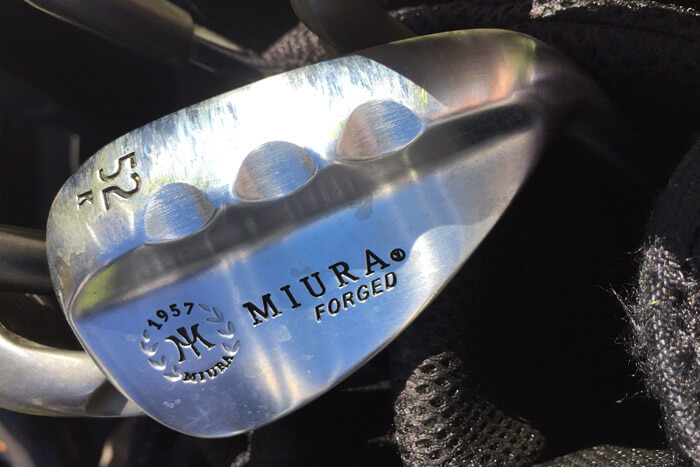
I used to own a 56* K-Grind and I really loved it. However, I switched to a 52*/60* setup and at the time Miura didn’t have a 52* K-Grind. The 52* wedge is a bit of a difficult find for me because it’s mostly intended to maintain a proper yardage gap from the PW. But, I also will need it occasionally from the sand, around the green and to hit half swings from 60-90 yards out. Thus, it has to have some of the grind features to be able to hit short game shots with it while not losing any yardage of full swing approach shots.
I was a little leery when they came out with the K-Grind in 52* because it only has 7* of bounce. But those channels on the back of the sole really smooth out the interaction with the turf. The only thing is that I was really impressed with Titleist’s SM7 designs.

The SM7 feels great. The turf interaction is good and I could hit a variety of different shots with their wedges. Generally, the SM7 was well received.
After that I went to a few other tents and tried things out. My golfer’s elbow was starting to act up and so many of the shafts…between being too short, too light and too soft, didn’t really fit me. And my feet were tired and I wanted to get prepped for Wednesday at the Convention Center.
3JACK
Tuesday is Demo Day. However, I got to play golf at Reunion Resort as the guest of Howard Glover along with his instructor and my Atlanta instructor, Ted Fort (www.fortifiedgolf.com). We also played with one of Ted’s students Dan McMurrian.

This was the first time I have ever played Reunion. I’ve played almost every quality course open to the public in the Orlando area, but Reunion has remained elusive because you either need to be the guest of somebody or be staying at Reunion. Mr. Fort beat us all shooting 71 while I shot 74 and Ted continues his dominance over me in the Official World Golf Rankings. I was fairly pleased with my ball striking outside of my short irons. My putting is a glorified dumpster fire at this point. Mr. Glover was kind enough to spend some time with me on Wednesday at the show to explain some putting mechanics and how to allow gravity to take over in the thru stroke as he once struggled with that as well and is now a really great putter with a superb putting stroke. Honestly, if I had his putting I probably would have shot 67.
Ted showed me his custom putter from BlackLabGolf.com. It was a thing of beauty. Black Lab Golf allows full customization of their putters and made him a Saber Tooth model that is face balanced, but has no shaft offset. Tough to find that combination from putting OEM’s.
The Palmer course was very nice. I always felt that as popular as Mr. Palmer was, he was a very underrated course designer. I think he was one of the best course designers in the world in the past 30 years. He made this design fairly easy, but it was far from boring and it featured the typical Palmer features of greens that sit down below and penalizing golfers that are above the cup.
I have only played the Palmer course at Reunion, but I have been to the two practice ranges a bunch of times and have eaten at Reunion. It’s really a fun, comfortable place to hang out and I would advise anybody looking to take a trip to Orlando to take a look at Reunion as a place to stay.
Afterward, I went to Orange County National for the Demo Day. I arrived there at about 2pm. The range was packed as it always is. However, there was not as much in the putting department on the putting greens as there has been in the past.
Wilson Staff had a big tent. Their new driver looks awesome and they are returning the popular show Driver vs. Driver:
I was glad to see this come back. While Wilson Golf is a large corporation, I admire their willingness to take a risk with this concept because it could mean not only making a breakthrough product, but it also is a great way to give back to the golfing community. Having worked in corporations and crunching the numbers on proposed projects…most companies never take that risk as they have shareholders to answer to if the project fails. But, that type of mindset will never advance a company if they are too afraid of ever taking a loss in hopes of creating a better product.
I don’t think the Wilson Triton driver sales did all that well. Although the golfers that have one that I have talked to swear by it. But what Driver vs. Driver did was create more brand awareness for Wilson and that is the biggest issue for Wilson. This survey results on brand perception from MyGolfSpy is a great example:
https://mygolfspy.com/one-word-survey-results/
That’s why I scoff at the excuses I hear from ESPN apologists about ESPN’s ratings going down due to online streaming, etc. While I don’t quite buy into those excuses…the bigger issue is ESPN’s brand image is horrible right now and in order to improve revenues and ratings…it requires the company to restore their brand image and eventually the revenues and ratings will come along. That’s the main job for most CEO’s…it’s not the financial aspects…it’s really about the brand and its image with consumers. Kudos to Wilson Golf for understanding that and being willing to take the risk to try and improve their brand’s image and contribute to the golf community.
I also think it’s great that they are having Rick Shiels on as a panelist. I’m not a big fan of how club reviewers review clubs on YouTube. But, Shiels has nearly 270,000 subscribers on YouTube. And he is closer to being on the same wavelength in terms of knowing what serious and semi-serious gear heads want in a driver.
The problem with Demo Day was that:
1) It was windy and dusty. Wind and dust makes 3Jack’s sinuses go bad
2) The products you wanted to see this year, everybody wanted to see. That meant long lines to wait to hit.
3) The clubs are not going to be fitted for you and you would have a better chance of being struck by lightning while winning the lottery than you would finding an X-Stiff shaft.
So I got to see the new M3 and M4 drivers from TaylorMade, but didn’t get to hit them at Demo Day. I also got to see the new High Toe wedge from TaylorMade, which looks like they aped it off Edel:


It also has a channel on the sole like the Edel Digger Grind. The channel is not as deep. It essentially has 12* of bounce as I was told by a TaylorMade rep.
We are starting to see an influx of Japanese OEM’s coming over to the US market, so we had Yonex, Honma, Epon and PRGR at Demo Day. I really like their new RS driver
The feel is very similar to the old Wishon 919THI driver.
I also tried out the Miura 52* K-Grind.
I used to own a 56* K-Grind and I really loved it. However, I switched to a 52*/60* setup and at the time Miura didn’t have a 52* K-Grind. The 52* wedge is a bit of a difficult find for me because it’s mostly intended to maintain a proper yardage gap from the PW. But, I also will need it occasionally from the sand, around the green and to hit half swings from 60-90 yards out. Thus, it has to have some of the grind features to be able to hit short game shots with it while not losing any yardage of full swing approach shots.
I was a little leery when they came out with the K-Grind in 52* because it only has 7* of bounce. But those channels on the back of the sole really smooth out the interaction with the turf. The only thing is that I was really impressed with Titleist’s SM7 designs.
The SM7 feels great. The turf interaction is good and I could hit a variety of different shots with their wedges. Generally, the SM7 was well received.
After that I went to a few other tents and tried things out. My golfer’s elbow was starting to act up and so many of the shafts…between being too short, too light and too soft, didn’t really fit me. And my feet were tired and I wanted to get prepped for Wednesday at the Convention Center.
3JACK
Wednesday, January 24, 2018
What To Look For: Farmers Insurance Open
The Tour comes back to San Diego for the 66th Farmers Insurance Open.
Torrey Pines was created in 1952 and the architect was William F. Bell. The Tour will play 1 round at the North Course and 3 rounds (if the player makes the cut) at the South Course. The North Course is significantly easier than the South Course which plays to 7,698 yards.
The South course was later renovated under the guidance of Rees Jones. Rees Jones loves enormous courses. If Augusta is say...Wrigley Field...Torrey Pines is Comerica Park.
This is a polarizing course on Tour. The sightlines are beautiful and many players absolutely swear by the course and the others swear at the course. Driving is difficult because the field average will be only at about 50%. The length of the course makes for difficult approaches and the greens are slow and very undulated
Projected Winning Score: -19
3JACK'S FAVORITES
Jon Rahm +700
Rickie Fowler +1,000
Hideki Matsuyama
Jason Day +1,800
Gary Woodland +4,000
3JACK'S DARK HORSE PICKS
Bud Cauley +5,500
Patrick Reed +5,500
JJ Spaun +9,000
Trey Mullinax +25,000
Sang Moon Bae +30,000
3JACK
Torrey Pines was created in 1952 and the architect was William F. Bell. The Tour will play 1 round at the North Course and 3 rounds (if the player makes the cut) at the South Course. The North Course is significantly easier than the South Course which plays to 7,698 yards.
The South course was later renovated under the guidance of Rees Jones. Rees Jones loves enormous courses. If Augusta is say...Wrigley Field...Torrey Pines is Comerica Park.
This is a polarizing course on Tour. The sightlines are beautiful and many players absolutely swear by the course and the others swear at the course. Driving is difficult because the field average will be only at about 50%. The length of the course makes for difficult approaches and the greens are slow and very undulated
Projected Winning Score: -19
3JACK'S FAVORITES
Jon Rahm +700
Rickie Fowler +1,000
Hideki Matsuyama
Jason Day +1,800
Gary Woodland +4,000
3JACK'S DARK HORSE PICKS
Bud Cauley +5,500
Patrick Reed +5,500
JJ Spaun +9,000
Trey Mullinax +25,000
Sang Moon Bae +30,000
3JACK
Wednesday, January 17, 2018
What to Look For: 2018 CareerBuilder Challenge
The Tour returns to Palm Springs for the 58th CareerBuilder Challenge (formerly known as the Bob Hope Classic). This has been a long time Pro-Am event. For years it played second fiddle to the Pebble Beach Pro-Am, but it used to not be that far behind given Mr. Hope’s popularity and Palm Springs being much closer to Hollywood and with usually better weather than what Pebble Beach would have the following couple of weeks in Northern California.
This is probably one of the most difficult events to project winners because it’s a birdie-fest and it often comes down to a wide variety of players that just happen to hit their irons well and putt well that week. It’s an extremely low scoring event as the courses are fairly wide open with little fairway and the ball travels further in the high elevation. But more critically to the low scoring is the extremely receptive and flat greens. This event usually posts the closest field average proximity to the cup on Red and Yellow Zone shots as well as short game shots around the green. That means more birdie opportunities and more chip ins.
Projected Winning Score: -23
3JACK’S FAVORITES
John Rahm +800
Brian Harman +1,400
Kevin Kisner +1,800
Webb Simpson +1,800
Phil Mickelson +2,200
3JACK’S DARK HORSE PICKS
Patton Kizzire +2,800
Zach Johnson +2,800
James Hahn +5,000
Blayne Barber +20,000
Nicholas Lindheim +20,000
3JACK
Subscribe to:
Posts (Atom)