Golf coach Andrew Rice (www.andrewricegolf.com) on creating a long 'flat spot' for better pitch shots.
The longer 'flat spot' is something that Chris Como teaches based off the insight from Dr. Sasho MacKenzie.
What's interesting is that Moe Norman often times said that he felt he had the longest flat spot of a golf swing and had the longest, but shallowest divot. As Moe liked to say about his divots "bacon strips, not pork chops."
3JACK
Tuesday, June 9, 2015


Monday, June 8, 2015
Brett Rumford on Chipping from the Thick Rough
Here's another short game lesson from one of the very best, Brett Rumford, on the short game shots from the rough.
3JACK
3JACK
Friday, June 5, 2015
New GolfWRX Column: How Launch Monitors are Affecting Tour Players' Driving

I keep track of the radar metrics on the PGA Tour each week, and so far this season I’ve started to see some noticeable differences in the radar data being produced by the field than I have in years past. So I decided to look at the Tour averages for each season since the Tour started to record the radar data back in 2007.
Here’s a chart showing those averages each season.

Read More: http://www.golfwrx.com/303456/launch-monitors-have-changed-the-way-tour-players-hit-their-drives/
Thursday, June 4, 2015
Managing the Putter Face Angle
Here's a video from instructor, Jeff Smith, on managing the club face angle with your putter:
3JACK
3JACK
Wednesday, June 3, 2015
Thoughts on Release Styles and Miss Biases
Here's a Q&A with Gabe Writer and Kelvin Miyahira:
One of the key questions they discuss is with the drive-hold release which makes it very difficult to miss towards the pull-side of the golfer.

I think that this is an interesting concept as I have been exploring the '1-way miss' for a the past 5 years. The statistics on Tour show that there is a bit of a fallacy with regards to the '1-way miss' as Tour players tend to miss fairways right or left more closer to 50% than most people imagine. In fact, Jordan Spieth (pictured above) currently has a 54.3% rightward miss bias. What I have found is that the leading players on Tour with regards to my Driving Effectiveness metric tend to have a miss bias that is within 55/45 ratio and it does not matter whether they are missing left or right.
Players with a miss bias outside that 55/45 ratio tend to not drive the ball as effectively. My feeling is that if you're missing at say, 65% shots to the left, you have a problem shot that you cannot control on demand. And given the amount of doglegs and the general design of golf holes, you have to be able to miss in the correct spots when you do miss a fairway.
After reading that information I started to believe that good golf was more about a 1-way curve of the ball. This would produce greater control and predictability. But, after years of watching Tour players hit balls and my own experience getting more into a drive-hold release, I have started to revise my thinking as far as curvature and 'miss bias.' Part of which I plan to explore more in 2016 and put in the 2016 Pro Golf Synopsis.
My revised thinking agrees more with Kelvin, the drive hold release players on Tour tend to hit it very straight or they miss right. They may hit a draw (i.e. Keegan Bradley and Rory McIlroy), but they don't miss left very often. And if they do, it's usually off a toe-hook. I think the 18th hole at Sawgrass really showed the power of the drive-hold release as drive-hold release players didn't have to worry about missing left in the water and could hit it long enough to where the fairway gets a bit wider:

Rickie Fowler, who drove it spectacularly on 18, has implemented more of a drive-hold release style since working with Butch Harmon and I don't believe it's a coincidence that he played that hole so well off the tee en route to his victory.
Unfortunately, we are still in the infancy stages of understanding things like rate of closure. But, I think it's pretty obvious that having a stable club head and club face thru impact, as seen in the drive-hold release, is something that we've seen so many great ballstrikers utilize. I think the stable club head release allows golfers to not miss left while still being able to draw the ball if needed. While the other styles of release, like the flip-roll, under-flip, knife edge, etc. employ too much club face rotation and in turn, the greater likelihood of missing too far left or too far right. The more the club head will rotate in a release, there's just more variance in where the clubface is pointing at impact.
One of the straightest drivers of the ball I've seen is my friend, Victor Rodriguez, who qualified for the Final Stage of the Re-Max Long Drive competition last year:
So, it's certainly not about 'straight = short.' It's about controlling the face thru stabilizing the face and the speed may or may not come along with it.
Where this revelation came about for me is over time my swing has developed into more of a drive-hold release.
I had noticed over the past couple of years that the tee shots that give me the most issues are on dogleg lefts and when the wind is blowing to the right. My natural ball flight is more of a fade, although I can hit a draw.
Lately, since my release has improved and the face is more stable, I have noticed that I can simply aim left on a dogleg left and not have to worry about missing too far to the left. If I hit it straight, it will end up just in the left corner or still find the fairway. If I don't hit it straight, I will just hit a fade right down the middle. But the chances of me over-drawing it are slim and none, even if I'm set up to hit a draw.
And this helps in preventing me from missing right because if I can't afford to miss right, I can just aim left enough to avoid the right side altogether.
3JACK
One of the key questions they discuss is with the drive-hold release which makes it very difficult to miss towards the pull-side of the golfer.
I think that this is an interesting concept as I have been exploring the '1-way miss' for a the past 5 years. The statistics on Tour show that there is a bit of a fallacy with regards to the '1-way miss' as Tour players tend to miss fairways right or left more closer to 50% than most people imagine. In fact, Jordan Spieth (pictured above) currently has a 54.3% rightward miss bias. What I have found is that the leading players on Tour with regards to my Driving Effectiveness metric tend to have a miss bias that is within 55/45 ratio and it does not matter whether they are missing left or right.
Players with a miss bias outside that 55/45 ratio tend to not drive the ball as effectively. My feeling is that if you're missing at say, 65% shots to the left, you have a problem shot that you cannot control on demand. And given the amount of doglegs and the general design of golf holes, you have to be able to miss in the correct spots when you do miss a fairway.
***
After reading that information I started to believe that good golf was more about a 1-way curve of the ball. This would produce greater control and predictability. But, after years of watching Tour players hit balls and my own experience getting more into a drive-hold release, I have started to revise my thinking as far as curvature and 'miss bias.' Part of which I plan to explore more in 2016 and put in the 2016 Pro Golf Synopsis.
My revised thinking agrees more with Kelvin, the drive hold release players on Tour tend to hit it very straight or they miss right. They may hit a draw (i.e. Keegan Bradley and Rory McIlroy), but they don't miss left very often. And if they do, it's usually off a toe-hook. I think the 18th hole at Sawgrass really showed the power of the drive-hold release as drive-hold release players didn't have to worry about missing left in the water and could hit it long enough to where the fairway gets a bit wider:

Rickie Fowler, who drove it spectacularly on 18, has implemented more of a drive-hold release style since working with Butch Harmon and I don't believe it's a coincidence that he played that hole so well off the tee en route to his victory.
Unfortunately, we are still in the infancy stages of understanding things like rate of closure. But, I think it's pretty obvious that having a stable club head and club face thru impact, as seen in the drive-hold release, is something that we've seen so many great ballstrikers utilize. I think the stable club head release allows golfers to not miss left while still being able to draw the ball if needed. While the other styles of release, like the flip-roll, under-flip, knife edge, etc. employ too much club face rotation and in turn, the greater likelihood of missing too far left or too far right. The more the club head will rotate in a release, there's just more variance in where the clubface is pointing at impact.
One of the straightest drivers of the ball I've seen is my friend, Victor Rodriguez, who qualified for the Final Stage of the Re-Max Long Drive competition last year:
So, it's certainly not about 'straight = short.' It's about controlling the face thru stabilizing the face and the speed may or may not come along with it.
***
Where this revelation came about for me is over time my swing has developed into more of a drive-hold release.
I had noticed over the past couple of years that the tee shots that give me the most issues are on dogleg lefts and when the wind is blowing to the right. My natural ball flight is more of a fade, although I can hit a draw.
Lately, since my release has improved and the face is more stable, I have noticed that I can simply aim left on a dogleg left and not have to worry about missing too far to the left. If I hit it straight, it will end up just in the left corner or still find the fairway. If I don't hit it straight, I will just hit a fade right down the middle. But the chances of me over-drawing it are slim and none, even if I'm set up to hit a draw.
And this helps in preventing me from missing right because if I can't afford to miss right, I can just aim left enough to avoid the right side altogether.
3JACK
Tuesday, June 2, 2015
Bryson Dechambeau What's In The Bag
Here is recent NCAA champion, Bryson DeChambeau, on his unique set of clubs that he uses:
What's In the Bag - Bryson Dechambeau from College Golf Fellowship on Vimeo.
As Bryson discussed, he uses the same length irons throughout his set (37.5 inches). This concept has been done before, most popularly from the Tommy Armour Golf EQL model back in the late 80's.

From what I recall, Tommy Armour Golf claimed that the 8-iron was the 'perfectly designed club' and that they wanted to build each club to that length.
In order to do so (regardless of the length you want), the head weights have to be the same. Typically, the head weights for irons go in 7-gram increments. Here's an example of a spec sheet from Wishon Golf showing this 7-gram increment approach (click to enlarge):

What's In the Bag - Bryson Dechambeau from College Golf Fellowship on Vimeo.
As Bryson discussed, he uses the same length irons throughout his set (37.5 inches). This concept has been done before, most popularly from the Tommy Armour Golf EQL model back in the late 80's.

From what I recall, Tommy Armour Golf claimed that the 8-iron was the 'perfectly designed club' and that they wanted to build each club to that length.
In order to do so (regardless of the length you want), the head weights have to be the same. Typically, the head weights for irons go in 7-gram increments. Here's an example of a spec sheet from Wishon Golf showing this 7-gram increment approach (click to enlarge):
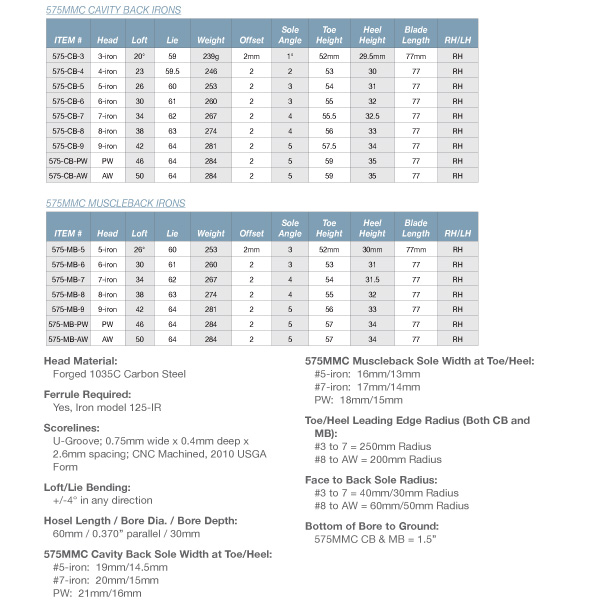
The reason for the heads changing in weight is that the typical set of irons has shafts that change in length. If you're going by the swingweight matching method with each club the same length while using incremental head weights, you're going to get extremely light long irons and extremely heavy short irons.
The same will apply if you use the MOI matching principle as well. Certainly, there will be those that will ask "Isn't MOI matching just incremental swingweights?"
Yes, it is. But, you're going in swingweight increments of roughly 0.5 swingweight points per club. When you have a 7-gram increment head weight that is going to drastically increase the swingweight, by far more than 0.5 swingweight points.
In the end, Dechambeau's MOI will be matched. The issue with the Tommy Armour EQL irons is that while they were MOI matched, that didn't mean that the MOI fitted that particular golfer's swing. If the MOI was at 2,650 for each club and the golfer actually fits more to 2,700 MOI, there is some discrepancy. But, I still believe that MOI matching, even if it is not quite fitted is better than no MOI matching.
One of the questions I frequently get is "if MOI matching is so good, then why don't the Tour players do it?"
Well, there are a variety of answers why such as them not knowing about it, fear of trying something new, not having an educated and skilled MOI matching fitter available, etc.
But, what we have seen with Tour players is that they often grab 20 or so clubs of each iron in a set (i.e. 20 4-irons, 20 5-irons, etc) and then try them out and find the one they like best and bag it. For instance, I had the opportunity to measure the MOI of Nick Faldo's old Mizuno T-Zoid irons. Knowing that Sir Nick used this process I was curious to see what the MOI of the clubs were. When I measured them, I found that Sir Nick was extremely precise as each club measured to 2,750 MOI except for his Pitching Wedge which measured in at 2,775.
So, I surmise that many PGA Tour players are MOI matching their irons without knowing it. They are just taking a longer way to do it.
Anyway, congratulations on Mr. Dechambeau and congratulations to Edel Golf for building him a great set of clubs.
3JACK
Yes, it is. But, you're going in swingweight increments of roughly 0.5 swingweight points per club. When you have a 7-gram increment head weight that is going to drastically increase the swingweight, by far more than 0.5 swingweight points.
In the end, Dechambeau's MOI will be matched. The issue with the Tommy Armour EQL irons is that while they were MOI matched, that didn't mean that the MOI fitted that particular golfer's swing. If the MOI was at 2,650 for each club and the golfer actually fits more to 2,700 MOI, there is some discrepancy. But, I still believe that MOI matching, even if it is not quite fitted is better than no MOI matching.
One of the questions I frequently get is "if MOI matching is so good, then why don't the Tour players do it?"
Well, there are a variety of answers why such as them not knowing about it, fear of trying something new, not having an educated and skilled MOI matching fitter available, etc.
But, what we have seen with Tour players is that they often grab 20 or so clubs of each iron in a set (i.e. 20 4-irons, 20 5-irons, etc) and then try them out and find the one they like best and bag it. For instance, I had the opportunity to measure the MOI of Nick Faldo's old Mizuno T-Zoid irons. Knowing that Sir Nick used this process I was curious to see what the MOI of the clubs were. When I measured them, I found that Sir Nick was extremely precise as each club measured to 2,750 MOI except for his Pitching Wedge which measured in at 2,775.
So, I surmise that many PGA Tour players are MOI matching their irons without knowing it. They are just taking a longer way to do it.
Anyway, congratulations on Mr. Dechambeau and congratulations to Edel Golf for building him a great set of clubs.
3JACK
Monday, June 1, 2015
My Meaningless Thoughts on Parsons Xtreme Golf

Friends of the blog at MyGolfSpy.com did a write-up on the new clubs from Parsons Xtreme Golf :
http://www.mygolfspy.com/pxg-parsons-golf-2015/
I think it is refreshing to see a company whose priority is set on trying to develop the best product possible while still having the demand that once they do, that they will be able return a nice profit. It sure beats the companies that are solely in it to make money and make it from the get-go by cutting corners and using brilliant and aggressive marketing campaigns.
I knew the screws were actually weights a while ago. I find it interesting that they are so particular about head weight as have been preaching the importance of head weight along with MOI matching in clubs for ultimate performance. I think Parsons is coming about as close as one company can find to create a set that can more easily match the MOI of the set.
Of course, there is a lot of discussion about the forgiveness factor. As many readers know, I play blades. Last year I tried to play some PING S55 irons, but ended up hitting them about 15 yards shorter as they launched too high and spun too much.
It seems these days that when it comes to iron *performance*, it usually revolves around:
1. Distance
2. Forgiveness
This was discussed here with PXG. And PXG states that they don't like how OEM's "try to be everything to everybody."
I think the issue is that it *may* be impossible to truly create a superior club because the individuality of the golf swing and what a golfer needs is going to be different for everybody. And that using Distance and Forgiveness as the parameters to equate as 'performance' is a bit misleading and flawed.
One of the common questions I get asked by readers is about irons that go further. Most people know that today's lofts are much lower than lofts in irons of yesteryear. But, that's one of the key points. If we are looking at the curvature of a ball's flight, the spin loft (Dynamic Loft - Attack Angle = Spin Loft) plays a huge factor because the ball will tend to curve more offline when the axis is tilted more than by producing more spin. Trackman's Fredrik Tuxen showed this at the Open Forum 2 in January of 2014 (although he showed it with a driver).
So, the idea that hitting a 7-iron as long as your old 6-iron isn't necessarily a good thing. If the new 7-iron is the same loft as your old 6-iron, it's more 6 in 1, half dozen in the other. But the other issue is that companies know golfers fall in love with hitting their irons further, so they make the clubs lighter and even a bit longer shafted. And when you start lengthening a club with a lower loft, it can provide accuracy and consistency issues.
The golfer that had a 32* 6-iron iron with a 37.5" shaft and it weighed 435 grams and the golfer hit it 175 yards may be better off with that club than a new 6-iron with 29* loft, a 38" shaft and weighs 422 grams because they are more wild with the longer, lighter and lower lofted 6-iron.
As far as forgiveness goes, people should remember that the sweet-spot of a club is only the size of a needlepoint. Regardless if it is a classic blade iron or a giant oversized Game Improvement iron. The difference is in the clubhead MOI. The classic blade is going to have less MOI around the sweet-spot point than a game improvement iron.
But, where the issue arises is that the larger difference in MOI between a blade and a Game Improvement iron really takes place further away from the sweet-spot. So, if you miss by 1-2 dimples with a blade versus a Game Improvement iron, you probably will not see much of a difference. But if you start to miss 5, 6 or 7 dimples off the sweet-spot, the Game Improvement iron will have more MOI. The problem? You're still likely to hit a poor shot when you are THAT far off the mark. And the main benefit is distance with the Game Improvement iron and if you're that far off the mark and are going to hit a ball that much offline, adding distance to the equation won't help much.
***
I think where blades get a bad name is that many of the very old school blades had no forgiveness towards the toe. This was due to the epoxy not being as strong back then, so they made the hosels longer and used a pin to help keep the shaft in place.

By making the hosel longer, the CoG of the head shifted more towards the heel and that means if you were just a little off towards the toe, there was no forgiveness whatsoever. In fact, Ben Hogan made it a priority to make irons that were not so unforgiving off the toe and it was in part what made his irons so popular. There's a common misconception that Hogan blades were small, but in fact they were probably larger than most any other blade on the market at the time.
Now, the epoxy is far better and the hosels are much smaller and many OEM's have taken Hogan's lead and found ways to make the toe quite forgiving. For me, the main benefits of blades are:
A. Lower Launch Angles (if needed)
B. Feedback can help distinguish quality of strike
C. Smaller sole and tighter grind may result in preferred turf interaction.
For me, I tend to hit a spinny ball that can go too high, so that's why hitting cavity backs tend to b e problematic. I also prefer the turf interaction with the smaller sole and tight grind. As far as feedback goes, I think it's helpful if you really want to work at it. Most of my range practice consists of me hitting my Yonex EZone blade 3-iron and I think it has helped quicken the learning process.
But, you have some of the greatest ballstrikers in the world, like Jordan Spieth, who prefer cavity backs.
JORDAN SPIETH WITB
It's just that these days there is less and less of a difference between blades and CB's and playing blades doesn't automatically make you a 'player.' It provides some different benefits from CB's and those benefits may apply to a golfer's game or they may not.
***
So, I don't think forgiveness is for everybody. And we see the potential issues with hitting irons further. However, this excerpt did grab my attention.
While the elaborate system of screws will certainly be what golfers notice, the most impressive bits of PXG’s technology are hidden beneath the surface of the 0311 irons.
While one could reasonably describe the 0311 as a wide-bodied blade, hidden in the traditional looking design (screws notwithstanding) is what PXG will tell you is the most advanced iron design ever created.
0311 construction starts with a forged open face body. An ultra-thin face is plasma welded to the body, creating a hollow cavity which is then filled with a thermoplastic elastomer. The elastomer, a flexible goo of sorts, supports the face while enhancing feel. A bonding adhesive keeps gaps from forming between the elastomer and the face.

While that may not sound like much of a radical departure from the types of technology stories told by every other golf company, PXG’s technology is groundbreaking, in part, because it allows for a face that’s half as thick as anything else on the market today. Half as thick. Nobody is even close.
Those are substantial claims. Although I would be interested on how close Yonex comes with their Ti-Hybrid MB and Cavity Back irons. The MB irons carry a titanium insert and the cavity back have a graphite insert.

Remember, just because they are claiming to have a face that is half as thick and nobody comes close, doesn't mean that it is necessarily true. I don't know if that's the case, but I would like to see how Yonex compares.
In the end though, it would mean more *true* distance. Instead of using gimmicks like lower lofts, lighter and longer shafts, the PXG claims would mean that the Smash Factor is better and allows us to hit the ball further.
But in the end, it really comes down to what fits the golfer. I like a lot of what I've read on PXG with the weight screws and the face thickness. The club looks a bit like a Ping I25 to me and it's no surprised that they grabbed some people from PING. I think it's something I'll be leery on because I promised myself that I would never by another set of CB's, again. However, they have piqued my interest and I'll keep an eye on them in the future.
3JACK
Subscribe to:
Posts (Atom)