Sunday, August 1, 2010

Footwork Follow Up

I got some questions about footwork in my last post about the subject. I have called my feet the ‘command center of my swing.’

Here’s a video of Stack and Tilt co-founder, Mike Bennett, excellent foot action.


Before I go on though, it should be noted that like anything with the golf swing, there’s plenty of ways to operate your feet and there’s plenty of cases of great golfers with footwork that is a bit ‘questionable’ to say the least. But this post is in hopes to explain footwork, what I think good footwork looks like and how it can help a golfer’s game.

Let’s first look at footwork as a chain first.

Feet-----Knees-----Hips

I think it’s safe to say that most golfers, regardless of their knowledge of the golf swing, can understand the importance of how the hips pivot and move in the golf swing. But what most golfers don’t understand is how faulty footwork can actually effect how those hips pivot. And then what happens is that they focus on the hips or they focus on something else like their swing plane and how their arms and hands move, all the while their footwork is the problem.

Another part of the footwork, although this is more to do with the knees, is using the ground to push off with which helps better power the pivot.

This collage by John Erickson (www.advancedballstriking.com) shows golfers getting more knee bend at the halfway point of the downswing than they had at address.
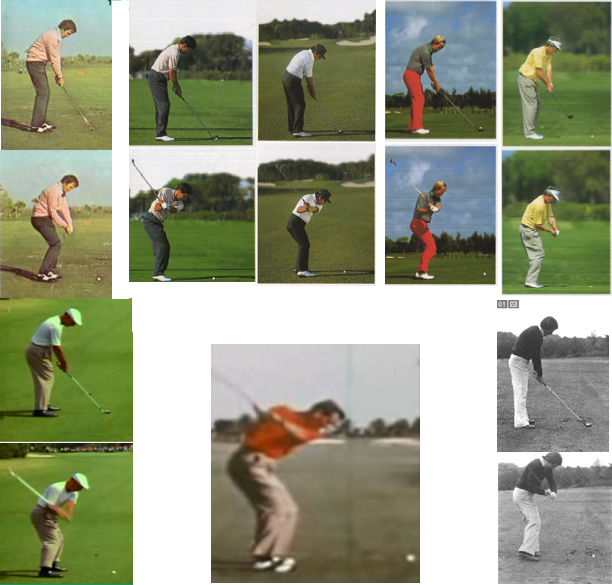

This ‘ground forces’ is something that the S&T guys talk about as well. And for good reason because if you ever watch the Fox Sports show ‘Sports Science’, they discuss ‘ground forces’ being used in every sport. In fact, imagine you were hitting a golf ball off a sheet of ice with sneakers on. Now, would you hit that ball further than you would if you were on grass with cleats on?

Obviously not.

Now, there’s obvious balance issues as well here. But, if you can push off ground you can better power your pivot as well. You don’t see baseball hitters swing with locked or straight knees for the same reason, it wouldn’t power their body rotation very well.

http://www.youtube.com/watch?v=XPtLtFbk-1Q

The other part that the feet can effect are the spine and the cranium.

For starters, faulty footwork can cause the golfer to have the rear knee ‘kick out’ towards the ball in the backswing. This will get the head moving backwards and create some excessive spine tilt on the downswing. Here’s a Shawn Clement video discussing that (don’t mind the S&T talk, that’s not what this post is about)


The other way it can effect the spine is in the opposite way. If your foot action is flawed, the golfer can ‘spin out’ and get the hips rotating too fast and the golfer doesn’t get enough spine tilt on the downswing and comes over the top.

So, what do I think is good footwork?

I’m personally a fan of keeping the rear foot flat at impact, but Hogan certainly didn’t have that:
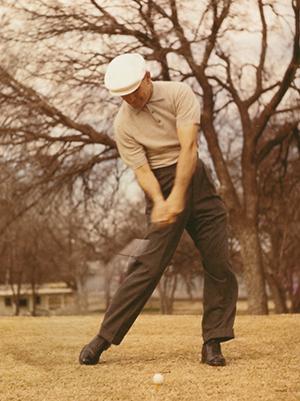

So, from a basic level I look at what the hips and knees are doing. Is the rear knee kicking towards the ball? (Moe called the rear knee kicking towards the ball ‘bogey golf’). Are the hips rotating too fast? Are we getting too much or too little axis tilt on the downswing? If not and that’s not a problem, then the footwork is working for that particular golfer.

I also tend to look at the golfer’s power in general. If they don’t have a lot of power, but are very accurate I would probably take a look at their footwork. I think this is probably the big reason for Brian Gay’s lack of power.


Without giving away teaching instructor’s lessons away, let’s take another look at Mike Bennett’s footwork.


Also, take a look at George Knudson’s foot action.


I will say this about the footwork.

Take a look at:

- Their inside ankle bone of their right foot
- Remember that the right knee should have plenty of bend in the downswing
- Try to feel like there is some gripping of the ground with the feet.
- Try to feel like you are pushing the inside arch of the right foot into the inside arch of the left foot

And remember that your right heel should be ‘pulled off’ the ground and not ‘pushed off’ the ground.

What does that mean?

Well, in order to ‘push’ the right heel off the ground, one needs to get the weight up on the toes and push the heel off the ground. We don’t want that.

Instead, we want these two things to ‘pull’ the right heel up off the ground:

1) the momentum of the swing and the pivot
2) The eventual straightening of the lead leg

Remember though, the ‘posting’ up on the straight lead leg at impact is not advisable in my book, unless you want to come over the top and hit slices. Instead, the left knee should be flexed at impact.

But, AFTER impact the leg will become straight and that will get the rear heel up off the ground. Now, the golfers with pretty good footwork who have a rear heel up off the ground, those golfers have a flexed left knee at impact, but it’s just a bit straighter than say a Moe Norman or a Kenny Perry at impact.


3JACK

Saturday, July 31, 2010

3Jack Swing Update 7.30.10

Here's a couple of recent swings:


I've been struggling with my game recently. More inconsistency than anything and both my rounds of golf and range practice usually starts off well, then fizzles badly down the stretch. I'm sure part of it is due to being out of shape and the humid and hot Florida weather which makes your grips all sweaty.

But, it has been a good learning experience.

I figure the following:

If I have 1 major flaw/alignment issue = can still strike the ball very well for the most part and occasionally hit a bad shot due to that 1 flaw/alignment isue.

2 flaws = decent golf with the occasional great round.

3 flaws = Bad struggles and even worse, correcting them takes longer

From an ABS perspective, I've learned that if you want to execute module 3 correctly, which is mostly about the torso pivoting thru the impact interval and the extension of the arms in the follow thru, you MUST have the execution in Module 1 and Module 2 down pat. So this means getting into pitch elbow and on the "4:30 line" (aka elbow plane) on the downswing and having the proper footwork. Also, you need to have the grip in place that allows you to execute Module 1 the best. If you don't have these down really really good, you'll almost definitely hit slices because the path will move left and the clubface will get open. So if you're struggling with Module 3, you may want to go back to Modules 1 and 2 and get the execution of those corrected.

I also believe that I now understand why I usually swung the club better with a flatter backswing plane than a more standard or even upright backswing plane. I could get laid off at the top of the swing with a flat backswing and still execute a nice looking downswing. But with a standard or upright backswing, getting laid off at the top throws the shaft and the sweetspot completely out of whack for me. I still like this more 'standard' backswing plane in the video above, but I have to be very conscious about not getting laid off at the top.


3JACK

Brad Faxon on Putting

Great video of Brad Faxon on putting and a reason why I think speed is so important on the green.


As you can see, Brad shows 3 different ways he could make that putt and there's more, depending on the various speeds he uses. That's a big deal because you don't have to be so dead on with your aim. Anyway, really good stuff by Faxon here.


3JACK

Thursday, July 29, 2010

Some More S&T Footwork Video

Here's a video showing the S&T footwork.


I think this is such a crucial part of the swing and should be addressed early on. In fact, I call the feet the 'command center of my swing.'

The big part of this is when done properly, it helps 'slow down' the hips from rotating too fast and thus forcing you over the top.


3JACK

Wednesday, July 28, 2010

The Swing Finish

Nice video by Mike Jacobs (www.nygolfworld.com) on the finish.


3JACK

Tuesday, July 27, 2010

No One Way To Swing The Club...

Gateway Tour player Matt Edwards certainly shows that with his swing:


3JACK

Monday, July 26, 2010

Top DDE's and Their Drivers


I decided to look at the 2009 leaders at driving distance efficiency (driving distance / clubhead speed) and what drivers they are using. So I first looked at the top 50 in DDE last season and here's the stats I got.

Club OEM------Count--------% of top 50

Taylor Made--------17-------------34%
Titleist----------------9-------------18%
Ping-------------------6-------------12%
Cleveland------------5-------------10%
Nike------------------5--------------10%
Cobra----------------4---------------8%
Bridgestone----------2---------------4%
Adams----------------1---------------2%
Callaway-------------1---------------2%

There was one golfer I wasn't sure what driver he used in 2009. That was David Mathis who used to endorse Nickent, but that company went out of business.

Here's how the top 20 fared:

Titleist-----------5------------25%
Taylor Made----4-------------20%
Ping-------------4-------------20%
Nike-------------3-------------15%
Cleveland-------2-------------10%
Cobra------------2------------10%

And here's how the top 10 fared:

Titleist------------5------------42%
Ping---------------2------------17%
Nike---------------2------------17%
Cleveland---------2------------17%
Cobra-------------1------------8%

There was a 3 way tie at 10th in the DDE rankings, so that's why there are 12 players listed in the top 10.

The 3 big paying companies for endorsements are Callaway, Taylor Made, and Nike.

Titleist won't sign the one player to the huge contract, but will pay as many players as it can a fair amount of money to play their equipment, particularly their golf ball.

So while Taylor Made owned the top 50, it's because...well.....they actually OWNED the top 50 players for the most part. But they didn't have a player in the top 10 and Titleist ruled the top 10.

And I'm not 'anti-Taylor Made' either. In fact, it seemed like when I lived in Atlanta, everybody owned a Taylor Made Burner or R9 driver and they really liked them. In fact, I thought the Burner was a good driver, period. But a very good driver for the higher handicap player. I wasn't too nutty about the R9.

Probably the biggest question here is the lack of Callaway in the top 50. That was by Ernie Els who finished tied for 35th in DDE in 2009.

Either way, much like blade style irons, the PGA Tour golfer usually goes where the money is. Believe me, if Darron Stiles could get a fat contract with Powerbilt and would lose some of his great DDE, he'd almost definitely be dumping his Titleist driver.

For me, I will probably go with the Wishon Golf 919THI driver when I finally decide to go and change my equipment. But, us amateurs have the luxury of playing the very best equipment for us without having to worry about losing endorsement dollars. I wish more golfers realized that.


3JACK