One day I would like to do a video with a plane board of some sort explaining what 'swinging left' is about and why it's preached by some golf instructors.
In the meantime, here's a video showing an above view of a swing on a plane board and hopefully some can see what the 'swinging left' concept is about.
3JACK
Monday, June 14, 2010


Sunday, June 13, 2010
Ed Furgol Golf Swing
From 1944 to 1983, Ed Furgol compiled five PGA Tour victories and six second-place finishes. He was the 1954 PGA golfer of the year and a member of the 1957 United States Ryder Cup team.
Furgol's success was remarkable considering that when he was 12, he shattered his left elbow in a playground fall.
The injury never healed properly, leaving Furgol with a crooked, cocked arm 10 inches shorter than his right arm.
Furgol did special exercises to build strength in his hands and worked tirelessly to develop a swing that would overcome his lack of power.
In 1954, Furgol was working as a club pro in St. Louis when he qualified for the United States Open, held that year at the Baltusrol Golf Club in Springfield, N.J. The 37-year-old played flawless golf and notched a one-stroke victory, which earned him $6,000.
You can click the pictures to enlarge.


3JACK
Furgol's success was remarkable considering that when he was 12, he shattered his left elbow in a playground fall.
The injury never healed properly, leaving Furgol with a crooked, cocked arm 10 inches shorter than his right arm.
Furgol did special exercises to build strength in his hands and worked tirelessly to develop a swing that would overcome his lack of power.
In 1954, Furgol was working as a club pro in St. Louis when he qualified for the United States Open, held that year at the Baltusrol Golf Club in Springfield, N.J. The 37-year-old played flawless golf and notched a one-stroke victory, which earned him $6,000.
You can click the pictures to enlarge.
3JACK
Saturday, June 12, 2010
Swing Update 6.11.10
Here's a couple of swings with my Hogan IPT 5-iron that I recently had a new shaft put in for practice purposes.
I actually had a great range session today and from the Face On view when I put in on my golf swing analysis software program, my impact alignments were very good, so it's no coincidence that my range session was so good today.
The backswing looks laid off more than it really is because I'm not really cocking the left wrist that much at the top. Still some things I don't particularly like, but overall I'll take it.
The downswing looks very good, but the path is still out to the right. Before today I had one nice session where I was either holding the flex of the shaft or coming very cloe to it for about 30 shots in a row. After that session, I was lucky to get 1 shot where I felt I held the flex of the shaft. But today I hit another streak of good swings.
Anyway, getting onto the Hogan IPT 5-iron.
One of the things I believe is that in order to stop the hook, Hogan's first solution was to make the clubs hook proof. They were very flat, they had a rib reminder in the grip that made it so he had to have a weak grip and of course, they had ultra stiff shafts. According to Hogan's personal clubmaker, they were X-stiff and tipped 2 inches, which would make them feel like you were swinging a telephone pole.
I believe that what happened is that he didn't stop hooking the ball until he discovered his 'secret', but in the meantime he developed a tremendous pivot because that's what is needed to hit shafts so stiff.
I wanted to try the same thing, but do it one club at a time. So I did it with the IPT 5-iron. I was supposed to get a 5-iron shaft from Golfsmith's that was supposed to be X100 and then I was gong to have it tipped 1/2" to make it about an X300.
Instead, Golfsmith's service took forever and I just grabbed the shaft and had a local clubmaker install it for me.
When I got to the clubmaker, he said it wasn't even a 5-iron shaft. It measured about 40 inches long and was supposed to be taper tipped as well.
Anyway, the clubmaker said he could drill the hole in the clubhead bigger so it could fit a parallel tip shaft and just tip it about 3".
I get the feeling that it wasn't an X100 shaft that they gave me, but tipping something 3 inches is going to make an super duper Hogan-esque stiff shaft and it does feel stiff, but I hit it really well today.
As we go along I will update my progress and thoughts with the ulta, super duper stiff 5-iron.
3JACK
Friday, June 11, 2010
Practicing Short Game with Trackman
Here's a video of Trackman and how one can use it for practice.
Trackman does the 'combine' like this. I think it has some potential, but I think factors like the wind and other external conditions come into question.
3JACK
Trackman does the 'combine' like this. I think it has some potential, but I think factors like the wind and other external conditions come into question.
3JACK
Thursday, June 10, 2010
Kinematic Sequence
Here's a fantastic video by Mike Jacobs and Rick Nielsen on the kinematic sequence.
3JACK
3JACK
Wednesday, June 9, 2010
Shaft Flex and Holding The Flex
One of the things I discovered with ABS and later confirming it with Lag Erickson and others at the ABS forums has to do with shaft flex in the golf swing.
I noticed awhile ago that Erickson can play quite well with all sorts of different shaft flexes as he carries quite a few different sets of vintage forged muscleback blades and some have much weaker shaft flexes compared to ones that are ultra stiff. His 'gamers' are X100's that are tipped 1/2" so they play about an X300. Still, he hit an R300 well if he was using that.
This always intrigued me when you hear some golfers who play with super stiff shafts compared to others. I played with a mini-tour golfer when I got out of college that hit it 330-360 yards off the tee and crushed his irons and used R300 shafts. Hogan, who had the ulta/super-duper/insane stiff shafts generated quite a bit of clubhead speed. In fact, some people using modern technology have claimed that Hogan's driver swing speed would be around 122 mph. But still, there certainly have been golfers who swung faster than him and used much more flexible shafts. Sergio is another golfer who uses ultra stiff shafts, yet his driver swing speed is probably around 117 mph, which is fast, but certainly not the fastest. The other guy I can think of who used ultra stiff shafts was Greg Norman in his prime, whose clubhead speed was about 125 mph back then. But so was/is Tiger's and JB Holmes, but they don't use shafts as stiff as Norman's.
Anyway, Erickson believes that the 'holy grail of the golf swing' is when a golfer can 'hold the shaft flex' past impact. What does that mean? Well, let's start with a pic of Ben Hogan before impact.

See how the clubshaft is flexing backward. That's what the club is doing if you're generating any decent amount of clubhead speed. So 'holding the flex' means maintaining as much of that flex as you can past impact.
Here's a video of Erickson demonstrating this with a very whippy shaft.
Now, what Erickson is getting at is that the shaft that has flexed back like in the Hogan pic will start to kick forward going thru impact, but holding the flex is more or less preventing the shaft from fully kicking until well past impact.
I've started to feel this 'holding the flex' a little bit with working on Module 3 of ABS. In fact, I felt it perfectly on Monday one time hitting a persimmon driver. I cannot really articulate the feeling that well but usually after impact I don't really 'feel' the clubhead. But on this shot with the persimmon, I felt the clubhead well after impact. And it was crushed and went dead straight and had a beautiful trajectory. It also made that great sound that is hard to make with persimmon. The only thing I can relate it to is if you have ever heard St. Louis Cardinals First Baseman Albert Pujols hit a baseball, it made the same type of CRACK sound. And I've hit good shots with this persimmon, including a 292 yard drive, but it never sounded quite like that shot.
A couple of days before I shot a 68 and went to the range after the round to try some thoughts I had on the swing and I had a streak where I was really 'holding the flex' or coming close to it. I noticed this becasue I was striking my Hogan Apex PC 2-iron.
I love practicing with this club because it's hard to hit as it is, but it has an ultra stiff shaft and I really have to swing well and pivot well to hit a good straight shot at the target. If I'm the teaniest bit off, I'm lucky to hit a straight push.
Anyway, this time I hit about 30 shots in a row that were all well struck, some downright flushed, and all right at the target and a few had a small draw on them.
I asked about this and why Lag and some other ABS students were able to hit all sorts of shaft flexes and why I was suddenly able to hit this 2-iron. Lag pointed to the pivot driven swing and 'holding the shaft flex.'
Here's part of what Lag teaches which is called 'swinging left', but in MORAD terms is called the 'CP Release' (on the left) vs the 'CF Release' (on the right).

You see, the big difference between the two is that the upper arms are still up against the chest area on the CP release (swinging left) and the CF Release has the arms 'thrown off' the chest.
From studying all of this, I think it boils down to the question 'how do you get the clubhead to the ball' Obviously, we all use some hands and wrists...so I'll take them out of the equation and put golfers into 3 categories:
1) Arms Dominant swing
2) Pivot Dominant swing
3) Hybrid (Arms/Pivot) swing
The Arms dominant swing has little pivot and is basically all arms. No, Ricky Fowler isn't an arms dominant swing. I would label the arms dominant swing as a hacker swing.
The pivot dominant swing is prevalent with the CP release. Hogan, Knudson, Sergio, etc...pivot dominant swings.
The hybrid is the most of us, particularly better golfers. Fowler is a hybrid, although he is all pivot in transition and then really throws the arms at the ball as he goes thru impact.
In fact, I am still a 'hybrid' swing golfer. So was Moe Norman.

But I believe that the pivot dominant golfer can basically use any shaft flex they want, almost regardless of their swing speed. Guys like Sergio and Hogan, just liked the feel of those super stiff shafts.
On the other hand, if you're an arms dominant or a hybrid, I think you are best off finding out what your clubhead speed is and picking a shaft flex based off of your clubhead speed.
Erickson attributes this to the 'holding the flex' which I don't know if that can physically or scientifically happen, but I do believe that shaft flexes are a different game for pivot dominant and hybrid swing golfers.
3JACK
I noticed awhile ago that Erickson can play quite well with all sorts of different shaft flexes as he carries quite a few different sets of vintage forged muscleback blades and some have much weaker shaft flexes compared to ones that are ultra stiff. His 'gamers' are X100's that are tipped 1/2" so they play about an X300. Still, he hit an R300 well if he was using that.
This always intrigued me when you hear some golfers who play with super stiff shafts compared to others. I played with a mini-tour golfer when I got out of college that hit it 330-360 yards off the tee and crushed his irons and used R300 shafts. Hogan, who had the ulta/super-duper/insane stiff shafts generated quite a bit of clubhead speed. In fact, some people using modern technology have claimed that Hogan's driver swing speed would be around 122 mph. But still, there certainly have been golfers who swung faster than him and used much more flexible shafts. Sergio is another golfer who uses ultra stiff shafts, yet his driver swing speed is probably around 117 mph, which is fast, but certainly not the fastest. The other guy I can think of who used ultra stiff shafts was Greg Norman in his prime, whose clubhead speed was about 125 mph back then. But so was/is Tiger's and JB Holmes, but they don't use shafts as stiff as Norman's.
Anyway, Erickson believes that the 'holy grail of the golf swing' is when a golfer can 'hold the shaft flex' past impact. What does that mean? Well, let's start with a pic of Ben Hogan before impact.
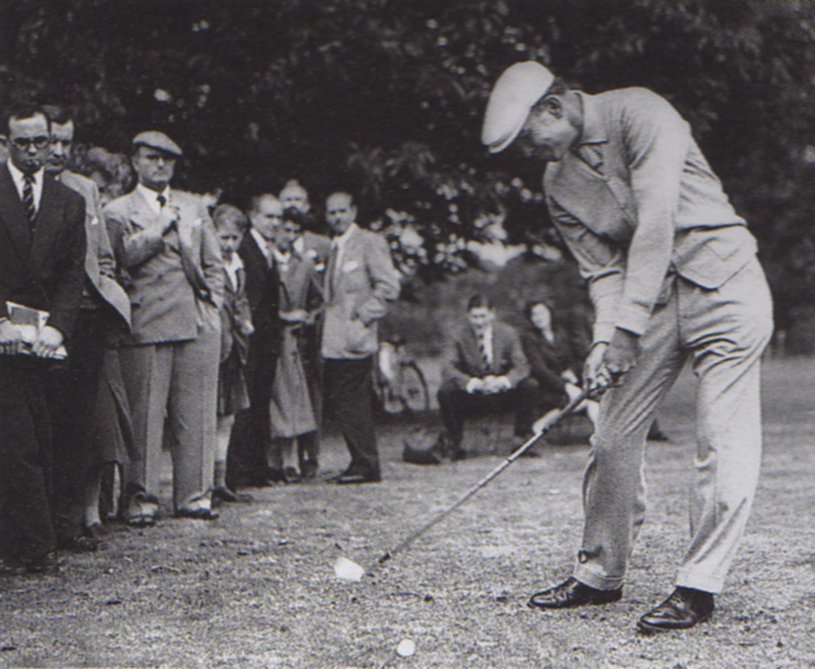
See how the clubshaft is flexing backward. That's what the club is doing if you're generating any decent amount of clubhead speed. So 'holding the flex' means maintaining as much of that flex as you can past impact.
Here's a video of Erickson demonstrating this with a very whippy shaft.
Now, what Erickson is getting at is that the shaft that has flexed back like in the Hogan pic will start to kick forward going thru impact, but holding the flex is more or less preventing the shaft from fully kicking until well past impact.
I've started to feel this 'holding the flex' a little bit with working on Module 3 of ABS. In fact, I felt it perfectly on Monday one time hitting a persimmon driver. I cannot really articulate the feeling that well but usually after impact I don't really 'feel' the clubhead. But on this shot with the persimmon, I felt the clubhead well after impact. And it was crushed and went dead straight and had a beautiful trajectory. It also made that great sound that is hard to make with persimmon. The only thing I can relate it to is if you have ever heard St. Louis Cardinals First Baseman Albert Pujols hit a baseball, it made the same type of CRACK sound. And I've hit good shots with this persimmon, including a 292 yard drive, but it never sounded quite like that shot.
A couple of days before I shot a 68 and went to the range after the round to try some thoughts I had on the swing and I had a streak where I was really 'holding the flex' or coming close to it. I noticed this becasue I was striking my Hogan Apex PC 2-iron.
I love practicing with this club because it's hard to hit as it is, but it has an ultra stiff shaft and I really have to swing well and pivot well to hit a good straight shot at the target. If I'm the teaniest bit off, I'm lucky to hit a straight push.
Anyway, this time I hit about 30 shots in a row that were all well struck, some downright flushed, and all right at the target and a few had a small draw on them.
I asked about this and why Lag and some other ABS students were able to hit all sorts of shaft flexes and why I was suddenly able to hit this 2-iron. Lag pointed to the pivot driven swing and 'holding the shaft flex.'
Here's part of what Lag teaches which is called 'swinging left', but in MORAD terms is called the 'CP Release' (on the left) vs the 'CF Release' (on the right).

You see, the big difference between the two is that the upper arms are still up against the chest area on the CP release (swinging left) and the CF Release has the arms 'thrown off' the chest.
From studying all of this, I think it boils down to the question 'how do you get the clubhead to the ball' Obviously, we all use some hands and wrists...so I'll take them out of the equation and put golfers into 3 categories:
1) Arms Dominant swing
2) Pivot Dominant swing
3) Hybrid (Arms/Pivot) swing
The Arms dominant swing has little pivot and is basically all arms. No, Ricky Fowler isn't an arms dominant swing. I would label the arms dominant swing as a hacker swing.
The pivot dominant swing is prevalent with the CP release. Hogan, Knudson, Sergio, etc...pivot dominant swings.
The hybrid is the most of us, particularly better golfers. Fowler is a hybrid, although he is all pivot in transition and then really throws the arms at the ball as he goes thru impact.
In fact, I am still a 'hybrid' swing golfer. So was Moe Norman.
But I believe that the pivot dominant golfer can basically use any shaft flex they want, almost regardless of their swing speed. Guys like Sergio and Hogan, just liked the feel of those super stiff shafts.
On the other hand, if you're an arms dominant or a hybrid, I think you are best off finding out what your clubhead speed is and picking a shaft flex based off of your clubhead speed.
Erickson attributes this to the 'holding the flex' which I don't know if that can physically or scientifically happen, but I do believe that shaft flexes are a different game for pivot dominant and hybrid swing golfers.
3JACK
Tuesday, June 8, 2010
David Orr's Fundamentals of Putting
Found an interesting post by one of David Orr's (www.orrgolf.com) students title 'The Fundamentals of Putting.' Here's David's thoughts:
Priority #1 - SpeedI really agree with David on all of this. Particularly the speed part.
Putting Experts say:
David Pelz - 17" past the hole
HA Templeton - 12" past on a level putt
Geoff Mangum - Last 2-3 revolutions (12”)
Mark Sweeney (AimPoint TV, AimChart) – Based on 12” past the hole
David Orr – 12-16” thru the hole depending on slope percentage and green speed
What do they all have in common? Consistent speed!
Consistent speed eliminates a lot of indecision
Indecision = reason why people miss putts
Have one speed, and pick the line that matches your speed.
What are your 3 Speeds in putting:
Green Speed
Delivery Speed
Cup Speed
Priority #2 - Read
Developing a normal speed (12” thru the hole) is the first step in green reading!
The first step of reading greens is knowing the intended speed that you will deliver the ball into the cup. Next take a good look at what the last 2- 3 feet will do. Learn to read putts backward from the cup to the ball. Then map out the route backwards to the ball and decide where you need to launch the ball.
Progression:
- Reading greens starts with a consistent "delivery speed"
- Identifying the fall line through the cup
- Identifying the breaking pattern within the last 2-3 feet
- Matching delivery speed and line
- Working backward from cup to ball
- Targeting for distance and elapsed time for arrival.
- Launch it!
Priority #3 - Aim
Aim your ball or your putter to the AimPoint, not the apex of the putt.
Priority #4 - Stroke
“A good putting stroke is a "well-timed consistent moving pattern" that launches the ball reasonably on-line with a quality roll that traverses along or near the intended curvilinear/ linear line with a good touch (consistent delivery speed) that maintains the linear and angular velocities of the ball over the surface irregularities as it enters the cup with a speed that will not reduce the capture width of the cup or "Wobbles" off line!” – David Orr
Back when I was just out of college, I traveled to some mini-tour events that I played with another friend of mine in town. He was easily the best putter I have ever golfed with.
One of the things that I remember thinking about when watching him putt was how he could read greens so well. At the time I chalked it up to a talent that you cannot learn, but AimPoint Golf shows us differently.
But the other thing I noticed was his speed was really consistent. He was very firm with his putts, hitting them probably on average about 2 feet past the cup. But I would guess that his missed putts were going 2 to 3.5 feet bye on an amazingly consistent basis.
I think that fantastic consistent speed of his allowed him to figure out the line much easier. Since he played quite a bit of golf and practiced often, a 12 foot putt with a moderate right to left break on a green with a 10 stimp was probably something he had seen a million times before an knew exactly where to aim it an how much it would break for him.
And he had the most god awful looking putting stroke and stance you would ever see.
As they said in Top Gun 'I feel the need for speed.' In putting, the golfer has need to feel the right speed.
3JACK
Subscribe to:
Posts (Atom)