Here's a nice putting drill by PGA Pro Paul Gorman.
3JACK
Monday, March 8, 2010


Sunday, March 7, 2010
A Look Into Clubmaking Tools
I would like to mention that there's a new MyGolfSpy forum that I think many members would enjoy and they are having a big contest giveaway for joining and participating in their forum. For more info, check it out HERE.
MyGolfSpy is great if you are an equipment buff.
Over on that forum, there was a thread about what core tools should a clubmaker have to get started.
I think this can also help the very serious golfer as well.
For starters, I would suggest getting a vice. You need one for grips and shaft pulling and other procedures and you can get one for about $20.
From there I would look into a lie and loft bending machine gauge.

It's important to note, especially with forged clubs, that after awhile of hitting off of hard ground and mats that lofts and lies can change. Clubfitters need to toy around with these all of the time, the serious golfer can constantly check up on their equipment specs. You can get one for about $300.
Next, a swingweight scale is important as well. Particularly if there's a change in shafts, grips, etc. While one can estimate the swingweight difference, it's better to be exact. Also, get the swingweight scale that measures static weight of the club as well.

While swingweight is important, you'll find static weight plays a factor as well. I have D5-D6 swingweights in my Hogan IPT irons. But with my Apex PC's I have D6-D7 swingweights. Why? Because the static weight of the PC's is less and I can't get the right feeling so I put some more lead tape on them
You'll also need either a blow torch or a heat gun if you're going to be doing re-shafting. The blow torch is cheaper ($10 or so), but the heat gun is better for those less confident in using a blow torch, but is more expensive ($50).
Lastly, and this is more for the serious golfer, but I would also consider a shaft frequency analyzer.

This measures the flex of a shaft. Believe me, I've had it as bad as an X-stiff shaft actually measuring a Ladies Stiff before. A clubmaker may have little use for this because shafts have no guarantee when it comes to their flex and a clubmaker can't afford to junk a shaft because it's out of whack. However, if you're a super serious golfer and can afford it, I think the frequency analyzer would allow you to junk those shafts that are way off. You can get one for $300 - $500.
Either way, I think all golfers who want to get better should know the ins and outs of their equipment and toy around with them to see what feels best and what they don't like. A forgotten art in today's world of custom fitting.
3JACK
MyGolfSpy is great if you are an equipment buff.
Over on that forum, there was a thread about what core tools should a clubmaker have to get started.
I think this can also help the very serious golfer as well.
For starters, I would suggest getting a vice. You need one for grips and shaft pulling and other procedures and you can get one for about $20.
From there I would look into a lie and loft bending machine gauge.

It's important to note, especially with forged clubs, that after awhile of hitting off of hard ground and mats that lofts and lies can change. Clubfitters need to toy around with these all of the time, the serious golfer can constantly check up on their equipment specs. You can get one for about $300.
Next, a swingweight scale is important as well. Particularly if there's a change in shafts, grips, etc. While one can estimate the swingweight difference, it's better to be exact. Also, get the swingweight scale that measures static weight of the club as well.
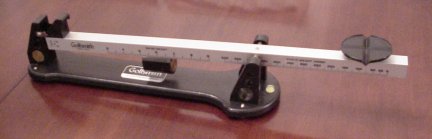
While swingweight is important, you'll find static weight plays a factor as well. I have D5-D6 swingweights in my Hogan IPT irons. But with my Apex PC's I have D6-D7 swingweights. Why? Because the static weight of the PC's is less and I can't get the right feeling so I put some more lead tape on them
You'll also need either a blow torch or a heat gun if you're going to be doing re-shafting. The blow torch is cheaper ($10 or so), but the heat gun is better for those less confident in using a blow torch, but is more expensive ($50).
Lastly, and this is more for the serious golfer, but I would also consider a shaft frequency analyzer.

This measures the flex of a shaft. Believe me, I've had it as bad as an X-stiff shaft actually measuring a Ladies Stiff before. A clubmaker may have little use for this because shafts have no guarantee when it comes to their flex and a clubmaker can't afford to junk a shaft because it's out of whack. However, if you're a super serious golfer and can afford it, I think the frequency analyzer would allow you to junk those shafts that are way off. You can get one for $300 - $500.
Either way, I think all golfers who want to get better should know the ins and outs of their equipment and toy around with them to see what feels best and what they don't like. A forgotten art in today's world of custom fitting.
3JACK
Saturday, March 6, 2010
Understanding the Unorthodox Swings - Part 3
Here I'll look at Kenny Perry's swing.
I would like to mention that Perry is indeed a great ballstriker and one of the very best over the last decade. In my PGA Tour total ballstriking stats, he usually finishes in the top 10 year after year. He's not even a great putter, but he hits it so well and is very long off the tee that he has a better chance of playing a par-72 as a par-68 than most golfers because not only does he have the distance to do it, but he's got the accuracy and consistency to keep him in play as well.
How long is he?
I paced him off at East Lake this year on a nice day and no wind and saw him drill a 4-iron on a pretty steep downward lie and drill it on the green with ease from 226 yards out.
Perry's swing IMO, reminds me a bit of Moe Norman's in that if you look at it in slow motion, you'll see that it's pretty orthodox and filled with a lot of quality mechanics. Check out these pics.


These positions really don't look all that unorthodox and I think most instructors would say that these are good positions here. He does straighten out his knees quite a bit here from where they were flexed at address. But from here he just makes a small peculiar move of reflexing his knees and turning the shoulders even more and making the 'across the line move.'
However, I believe that if I had to choose between having an across the line move or a laid off move, I would take the across the line move any day of the week because usually the across the line golfers have struggles with getting underplane. The laid off golfers tend to fight the dreaded over the top move.
That's one thing I didn't like about Hank Haney's analysis in the first episode of the 'Haney Project' with Ray Romano. An across the line move usually doesn't cause a golfer to come over the top. Thus I think Romano's issue is his wide open clubface at the top of the swing and because he has missed shots to the right, the subconscious tells him to come over the top so he can get the ball going more left. IMO, what he really needs to do is fix the clubface first and then get him out of habit of coming over the top.
But getting back to Perry...his swing isn't that unusual for the most part, just that one peculiar move. He also does keep his right foot down on the ground forever, an astute point made by Peter Kostis. Moe Norman did the same thing as well and I think when you keep it down for so long, while it's not flawed, it makes the swing look ugly, when it can be rather effective and dynamic.
3JACK
I would like to mention that Perry is indeed a great ballstriker and one of the very best over the last decade. In my PGA Tour total ballstriking stats, he usually finishes in the top 10 year after year. He's not even a great putter, but he hits it so well and is very long off the tee that he has a better chance of playing a par-72 as a par-68 than most golfers because not only does he have the distance to do it, but he's got the accuracy and consistency to keep him in play as well.
How long is he?
I paced him off at East Lake this year on a nice day and no wind and saw him drill a 4-iron on a pretty steep downward lie and drill it on the green with ease from 226 yards out.
Perry's swing IMO, reminds me a bit of Moe Norman's in that if you look at it in slow motion, you'll see that it's pretty orthodox and filled with a lot of quality mechanics. Check out these pics.
These positions really don't look all that unorthodox and I think most instructors would say that these are good positions here. He does straighten out his knees quite a bit here from where they were flexed at address. But from here he just makes a small peculiar move of reflexing his knees and turning the shoulders even more and making the 'across the line move.'
However, I believe that if I had to choose between having an across the line move or a laid off move, I would take the across the line move any day of the week because usually the across the line golfers have struggles with getting underplane. The laid off golfers tend to fight the dreaded over the top move.
That's one thing I didn't like about Hank Haney's analysis in the first episode of the 'Haney Project' with Ray Romano. An across the line move usually doesn't cause a golfer to come over the top. Thus I think Romano's issue is his wide open clubface at the top of the swing and because he has missed shots to the right, the subconscious tells him to come over the top so he can get the ball going more left. IMO, what he really needs to do is fix the clubface first and then get him out of habit of coming over the top.
But getting back to Perry...his swing isn't that unusual for the most part, just that one peculiar move. He also does keep his right foot down on the ground forever, an astute point made by Peter Kostis. Moe Norman did the same thing as well and I think when you keep it down for so long, while it's not flawed, it makes the swing look ugly, when it can be rather effective and dynamic.
3JACK
Friday, March 5, 2010
Ricky Fowler Golf Swing
Here's some views of Ricky Fowler's swing.
Currently, I'm not a big fan of Fowler's swing. I think he does a lot of things well, but his CF release has me worried. One thing you discover about the CP release when you get into it, is you have to have a lot of pivot thru and past impact or the arms will fly off your chest.
This is something focused on by Lag Erickson, but also something that MORAD teachers talk about as well.
There's actually a lot of CF releases out on Tour, but they are usually ungodly long and/or great putters.
One of the things that sticks out to me is how he gets up on the toes of both feet at impact and spins on the left foot. Off the top of my head, Laura Davies did this and had success, but she was ungodly long for an LPGA player at the time and a pretty good putter as well.
I will say that I like his swing philosophy of paying close attention to the clubface and focusing on getting the initial ball flight where he wants it.
But we'll have to wait and see what the future holds.
3JACK
Thursday, March 4, 2010
Teddy Rhodes Golf Swing
Here's the swing of Teddy Rhodes as shown on The Golf Channel's special 'Uneven Fairways.' This was clipped by NYC Lagster
3JACK
3JACK
Tuesday, March 2, 2010
Sample Trackman Fitting
I think one of the issues with Trackman is the misunderstanding that Trackman is supposed to be a complex tool. It's really not once you get to know the numbers, but the fitting process is very easy. I also think that as far as fitting goes, Trackman's strengths are its yardage gapping and driver fitting.
Here's a sample driver fitting from the Miles of Golf crew in Michigan.
3JACK
Here's a sample driver fitting from the Miles of Golf crew in Michigan.
3JACK
Monday, March 1, 2010
Looking into Golf Grips

I used to be a big fan of the Neumann leather grips. Many won't remember those, but they were leather wrap grips like the ones pictured above (those are not Neumann grips, but GripMaster Grips).
They were excellent to play with as they felt about as good as a grip could feel and were 'all weather' grips because they moisture from sweat or from the rain. Problem was they were not cheap. But if you could afford them, you could use them without wearing a glove. While I like cord grips, they are too rough on my left hand unless I'm wearing a glove.
My personal preference is something durable but not too harsh on the hands and something I can use in all weather conditions. If I had my choice, I would probably go with a standard grip, but durability is a bigger issue since I don't want to keep buying grips...so I go with a cord grip.
As far as the grip manufacturer I go use, I typically use Lamkin grips mainly because their durability is the best IMO. In fact, I have some 10 year old wrap cords from Lamkin that are still in very good condition on some old irons of mine. However, they don't make those grips anymore. So I usually use a crossline cord grip.

I don't care for the Winn grips because I don't like the spongy feeling. I haven't tried the Iomic grips yet, but I've heard they also have a spongy feeling...plus they are expensive (about $18 a grip)
I recently put some of Lamkin's new 3 Gen grips on a set of Hogan irons I have.

Here's a video by Lamkin explaining the technology behind the 3 Gen.
I actually only bought the 3 Gen grips because they were relatively cheap ($4 a grip). I haven't really noticed a difference in vibration, but they have a nice feeling in the hands.
However, what's VERY important to note about grips is that grips can greatly effect your swingweight.
The standard adult grip weighs about 50 grams.
The LESS weight you put in the grip, the HEAVIER the swingweight will be.
The MORE weight you put in the grip, the LIGHTER the swingweight will be.
THUS:
You can add weight in the grip and make the STATIC weight of the club heavier, but it will have a lighter SWING WEIGHT.
On the flip side, you can take weight off the grip which will make the STATIC weight of the club lighter, but it will have a heavier SWING WEIGHT.
I was surprised a bit by this because when I had standard Lamkin 3 Gen grips installed, my Hogan's went from about a D-1 swingweight to a C-9 swingweight.
Why? Because the 3 Gen *standard grips* weight about 59 grams which is almost 10 grams heavier than your standard grip.
Golf Pride makes a Dual Durometer Lite Grip.

This weighs about 39 grams and they say will add about 2-3 Swingweight Points from a standard grip.
Winn has a Winn Lite grip that only weighs about 26 grams. Therefore it will make the overall weight of the club lighter, but the swingweight heavier. Like I mentioned, I don't use Winn Grips...so I don't know how much heavier it would make the swing weight, but I would imagine it would add about FIVE swingweight points to the club.
Now, I personally like a heavier swingweight. Working with John Erickson (www.advancedballstriking.com) he mentioned that he prefers a heavier OVERALL club AND a heavier SWINGWEIGHT.
I would keep that in mind when looking at grips.
Some people wonder about hand size and whether they should go with a midsize grip or use extra tape to 'build up' the grip.
I think it depends. Midsize grips add about 10 grams of weight which can REDUCE your swingweight by 1-3 points. Tape weighs less than going with a bigger grip, so you may want to go with a standard grip and extra tape so you don't reduce your swingweight so much.
What I plan on doing, and something I think that is a smart idea is to buy a swingweight scale for use at home. Most clubmakers have a swingweight scale that looks something like this:

You can get one of these scales for about $150.
However, there are also some 'economy' swingweight scales which are good for personal use that cost about $50-$60.
I think it's very important to be in-tune with your own equipment. But to understand some basics about the grip outside of what feels good and provides you the tackiness you are looking for. Hopefully this has given you a good idea as to what to look out for.
3JACK
Subscribe to:
Posts (Atom)