In part II of my Vintage Iron Suggestions I look at the MacGregor line of irons. I don't think any company has produced more lines or sets of irons than MacGregor. In fact, there was a time when an average amateur, if they were willing to pony up the dough, could make a trip to the MacGregor plant in Albany, GA and get clubs grinded specifically for them and even have lunch with the company's CEO. Those days are long gone, but Scratch Golf (www.scratchgolf.com) offers that level of customization and service with their Tour Custom line of irons.
However, that's part of the problem with suggesting vintage MacGregor irons, there's a lot of customized jobs out there. Also there was a point when Nicklaus had to go to the company and tell them that their clubs were poorly made and designed and threaten to leave because he had his signature on them. The company turned around their level of product tremendously after Nicklaus read them the riot act, but it's still difficult to figure out if a set of irons were during the low point of the company. Also, MacGregor made quite a bit of irons that were more or less mass produced for department stores and such. There's a book of pretty much all of the MacGregor irons ever made, but I have yet to get my hands on it.
I would highly suggest any of the MacGregor Tommy Armour line of irons.
I think there is a 915, 945, and 985 line of Tommy Armour MacGregors. The 945 line I believe was the most popular of the Tour pros. I believe Johnny Miller used the 945's in the 70's (the 945's were actually made in 1953) and later signed a large deal with another equipment company and started using their irons but regretted it and went back to the Tommy Armours and just played his new endorser's woods.
The MacGregor MT85 Colokroms are excellent as well.
A golfing buddy of mine had a set of the Colokrom's in his basement and they felt extremely good and set up really nice as well.
Another nice looking set is the MT RMT2
However, you may have to get over the shading on the clubface.
The MT Blades may be my favorite MacGregors of them all.
You might want to be careful when getting these MT blades because there is your basic sole MT blades and then there is a 'step sole' MT blades and you may not like the 'step sole.'
The Muirfield line of irons was usually excellent.
If you want an extremely small clubhead, I would suggest the Muirfield irons with the '20th Anniversary' stamped on the back of them.
However, I prefer the MacGregor VIP line, but only the type of irons that look like this:
There's a few different sets that look like that, some will have the 'Nicklaus' stamp on them and some will have a 'MacGregor' stamp on the back and then there's the famous 'Curtis Strange' stamp as well.
Of course, there are the Toney Penna VIP's which are superb.
Recently on the message board we have been talking about taking the 'thrust' out of the right arm out of the golf swing and unbending the right wrist at impact. Here's a video that Shawn Clement made about fishing and golf that somewhat illustrates the point.
If you look at when Clement 'casts the lure' his right arm is still bent at the elbow and right wrist unbends as he casts the lure out to the pond.
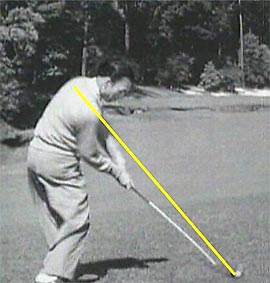
Here's a couple of looks at Ben Hogan.
As you can see Hogan has a very bent right arm at impact and then it stays bent (but to a lesser degree, but still more than your average golfer) well past impact.
One of the things experienced golfers have guarded against over the years is casting the golf club. But I think what has happened is that because of that fear of casting the club, they wind up throwing (thrusting) the right arm and try to keep the right wrist with it's maximum bend at impact.
Instead, I think a better and more efficient way is pivot on the downswing, unbend the right wrist and keep the right arm bent in and thru impact.
On the downswing, everybody's main objective is to get the clubhead to the ball. I think there's different ways golfers do it.
'Casters' = No or little pivot on the downswing causing them to throw the right arm and unbend the right wrist to get to the ball. The also usually do not have much axis tilt.
'Thrusters' = Frozen right wrist, some pivot, axis tilt varies, and they thrust the right arm to get the clubhead to the ball. The right arm is usually bent at impact, but not nearly as much as Hogan and they usually use a CF release (releasing out to the right).
Here's a good pic demonstrating a CP release (releasing left, left pic) and CF release (releasing out to the right, right pic).
John Erickson calls the CP release (hitting) and CF release (swinging), but that can be confusing for golfers who understand TGM. So I will tentatively call the CF release (thrusters) unless I see somebody that I think thrusts and uses a CP release.
Thrusters are not all bad. Moe Norman was certainly a thruster in my book. I think in order for him to hit it dead straight like he did he had fabulous face control and a shallow attack angle.
'Savers' - Right Wrist unbends, plenty of pivot action to and thru the ball, arms are very inactive thru the impact interval. They more or less:
1. Drop the arms on the startdown a bit while pivoting. 2. Get plenty of axis tilt. 3. 'Cast' the club by unbending the right wrist and keep pivoting. 4. Have a lot of right arm bend at impact.
Very tough to 'flip' with a lot of right arm bend at impact. I call them 'savers' because when a golfer has a straight right arm at impact or close to a straight arm, it's often referred to as 'running out of right arm.' If they have plenty of right arm bend and keep it thru impact, then they have 'saved the right arm.'
I've received some questions about what type of vintage irons that golfers should go after, so I wanted to put this in a blog so people can refer to it for help. First, I suggest that if you're going after some vintage irons, make sure that they are forged irons. Cast irons probably became popular in the mid-80s and most of them had a tremendous amount of offset and you can only bend cast so much. Clubfitters are usually averse to bending irons much either way, but the reality is that you can bend the forged irons a ton and not every worry about them snapping.
Also, check to see what type of shafts are in the vintage irons. You'll probably want to change your shafts if you become serious about using vintage irons outside of practice. But I would stay away from the aluminum shafts which were prevalent back then because they are very light and have a poor feel to them.
I've also been asked about shafts that were 'pinned' in some vintage irons. Back in the 60's and earlier, Hogan company would put a 'pin' in the hosel of the shafts to keep the shafts from falling out. Some golfers think that it made Hogan's irons 'special' but the reality is that back then the epoxy was not very good at keeping the shafts in place, so Hogan went a step further and just pinned them so the shafts wouldn't fall out. I spoke to Jim Kronus at the Iron Factory about the process of re-shafting pinned irons and he said it's quite easy as they just re-shaft like they normally do with modern epoxy and weld the pin hole shut and all he charges is $1 extra per club to do that.
I highly recommend the Iron Factory for their work. Not only do they do tremendous work (Shawn Clement recommends them as well), but their chroming process is such that they can add weight or take off weight with their re-chroming. Almost any other re-chroming process takes some weight off the clubhead.
Lastly, I will only be recommending blade, muscle back irons. Although the forged cavity back design hasn't been around that long, I think for the purposes of trying to improve your swing, motor skills and hand-eye coordination...it's best to go with blade style irons.
In Part I, we will look at the Hogan company irons.
As you may already know, I currently carry a set of 1963 Hogan IPT (Improved Power Thrust) blades that I like quite a bit. I think the Hogan forgings are excellent and better than most of the other forgings of other OEM clubs outside of probably Mizuno. I believe that Hogan designed the irons personally until the '63 IPT's cam out. I am pretty certain that the last line of irons that Hogan personally designed were the 1962 Power Thrusts.
As I've explained before with the line of Hogan irons from the 60's, you'll find that they look somewhat like today's blades and then from the 8-PW the clubhead becomes very round. But I actually like the way those short irons perform. They also have very sharp leading edges, longer hosels and are about 1/2" shorter than today's irons.
I really dig most of the Hogan irons from the 60's, but my favorites are probably the Bounce Sole 1+ irons.
The 70's was an excellent decade of clubmaking for Hogan's company. Just some real gems here. You should also see some slightly longer shafted irons as well, about +1/4" longer which is about the length of today's standard length muscleback irons.
It's tough for me to choose a best one from this decade, but I really like the 1972 Hogan Apex. You can tell those are the 1972 as the back stamping has 'Apex' on top.
I get a lot of questions on the Apex II line, which is an excellent line. I've spoken to a few Hogan irons afficianados and they believe that the Apex II irons are the softest of all Hogan forgings. There's a 'white cameo' and a 'black cameo' and from what I've been told is that the 'white cameo' was, at the time, meant for the higher skilled golfer. Why that was I have no idea.
Hogan irons in the 80's tried to be more 'user friendly' and it was probably the downfall of the company as 'user friendly' irons were mastered by Ping until Callaway came along. However, they made some gems in the Hogan Apex 'Redline' irons.
I vividly recall the Redlines being the skilled golfer's club of choice when it came to blade style irons. There's also the Hogan Apex PC, which is supposed to be a very difficult club to hit.
I get some questions about the 'Medallion' line of irons. I have hit both the '78 and '82 Medallion irons, but I preferred the '82 Medallions.
Then there's always the 1983 Hogan Personal irons. Those were a re-make of the 1958 Precision irons.
The Personal irons design was a precursor to the Mizuno MP-29's which were wildly popular. The problem with the Personal irons is that a used set goes for about $750 and you can find some new sets, but they go for about $1,200.
In the 90's Hogan still went the Game Improvement irons path, but still the company was able to produce a few more good muscleback irons.
The Hogan company I believe moved their forging house from Ft. Worth to Virginia and then moved back to Ft. Worth and then back to Virginia. The general consensus is you want the Ft. Worth made clubs. Hogan made an FT model which looks very similar to the '88 Redlines, but it will say 'FORGED' on the back stamping and say 'Fort Worth' on the hosel.
I would say that the best of the 90's musclebacks are:
Some noticeably differences here besides clubhead speed and ball speed. Particularly the Attack angle where the LPGA is much more shallow on the Attack Ange. The average AoA for the PGA Tour with the driver is -1.3 compared to the LPGA's +3.0. With a 7-iron it's -4.3 on the PGA and -2.3 on the LPGA.
This creates a higher vertical launch angle for the LPGA, but a lower maximum height (due to a much lower clubhead speed). I'd be curious to see if the higher clubhead speed LPGA Tour members also have a steeper attack angle.
I have heard of the theory that every club is supposed to reach the same maximum height, but these stats show that to be untrue.
My #3 golf swing of all time belongs to the golfer that I believe was the greatest pure ballstriker ever, Moe Norman.
Many misintrepret my statement and then throw up the question of 'if Moe was such a great ballstriker, then why did he never make it on the PGA Tour?'
The main reason being was that Moe had a severe anxiety about being in public at the time. Furthermore, he was a horrendous putter. In fact, he was a golfer who didn't read the green and look at his putts. He just got up there and hit the putt as he liked to say 'miss 'em quick.' In fact, in a Golf Magazine article Moe stated that he and George Knudson would often play rounds of golf for money where no putting was involved. They'd give out say $20 for a fairway, $20 for a green then $100 for a 'poley' and then they would pick the ball up off the green and go to the next hole.
Tough to make it on the PGA Tour in any era when your putting is like that.
Also, people don't realize that back before the Nationwide Tour and the Hooters Tour (and the Hooters Tour is not a way to make money as a touring professional), golfers either had to be beyond phenomenal with shooting low scores or they had to be really good, but get some good financial backing. Otherwise, they would find themselves on the Canadian Tour.
But as far as ballstriking goes, Moe's ballstriking in his prime was ever bit as good as Hogan's and Snead's and Trevino's, but I don't think anybody could ever hit it as dead straight on command as often as Moe could. Moe could also work the ball on command and when he wasn't an overweight golfer in his 60's, he hit the ball quite far, particularly for his age.
So, what can we learn from Moe?
Certainly there are many things, but for starters it's amazing to think how many people view Moe's swing as 'unorthodox', but outside of the setup the swing looks pretty much normal. So just a look at a swing in normal motion really doesn't show what the swing is actually made of.
But another thing we can learn from is something we had discussed on the message board. There's been a bit of discussion on my thoughts of the backswing and working on the backswing in practice. I actually don't have a problem with working on the backswing if it calls for it, but I think most golfers almost exclusively work on the backswing and neglect the downswing when they are on the range.
However, if you're going to work on the backswing, most golfers are more concerned about the swing plane on the backswing and not the clubface. I also find that most golfers, outside of beginners, struggle with a very closed clubface in the backswing. But in Moe's swing at P4, it's dead square.
I still believe that the game is mostly about who can consistently control the clubface the best at impact and Moe had that in spades.
Part of my blog is to discover new things, admit when I was wrong on things in the past and to come up with new ways to explain things that I've been working on.
One term we have been working constantly with is 'swinging left' and why is it important and such. We've also been working on Trackman definitions and how to get the optimal numbers for hitting it dead straight. Along with understanding the differences between 'swinging left' properly and making that dreaded, cutting across 'over the top' move. I think that lately I have come up with ways to better decipher what all of this means and why it is important. And a special thanks goes to NYC Lagster and Brian Manzella for helping me understand this better.
Why is swinging left important?
Because it allows the golfer to stay on plane 'past impact.' Here's a great video of NYC Lagster on a swing plane. Notice at the end he purposedly throws the club and even though he's swinging his hands to the left, his club goes right down at the target.
But take a look at the swing plane training aid. In order to stay on that plane post impact, the golfer HAS to swing to the left quite a bit.
Here's a photo sequence of mine before I started on working on 'swinging left.' (click the pic to enlarge)
If you look at the last photo of me from the DTL view in the upper right hand corner, you can see the clubshaft 'exiting' almost to the right of my left shoulder. If we were to photoshop a swing plane training aid, my clubshaft would be WELL off and above the swing plane training aid.
In fact if you ever get a chance to get on one of these swing plane training aids or the Explanar training aid, take a swing with it and chances are it will feel very odd in the follow thru as to how far left you have to swing to stay on plane. And here's the key thing...the 'swing left' is really a POST IMPACT FEELING & MOVE.
Here's a Manzella video showing what 'swinging left' looks like.
I think that's where most people get confused with 'swinging left', it's a POST impact move. Lag Erickson (www.advanced ballstriking.com) refers to it as 'releasing left' which I think is a better description.
Also, note that in Trackman, when they measure 'horizontal swing plane', that is measuring where the clubhead's direction POST impact. In other words, it's measuring if the golfer moved the clubhead to the left, right or square to the target POST impact.
Now, there is no definitive right or wrong when it comes to how a golfer releases a clubhead, but it certainly has a major effect on impact. But I will get to that in a bit.
Of course, with this information the question some of you are probably asking is:
'WHY do we care about 'swinging left' or measuring the horizontal swing plane or 'staying on plane post impact' when the ball has already been struck?'
The reason being is that the CORRELATION between the horizontal swing (the direction of the club post impact) is direct with the club path PRE impact and INTO impact.
Note: There are some other factors that determine the club path pre-impact and into impact, but I will get those in a bit.
In other words, if that clubhead is going out to the right POST impact, then it will certainly be going out to the right just before impact. If you swing the clubhead to the left the *proper* amount POST impact, you can create a square path right before impact. And of course, if you go too far left post impact, then you will create a clubhead that will be going left PRE impact.
In Trackman terms this is called 'Club Path' or sometimes called 'True Path' or 'Dynamic Path.'
So in the terms of Trackman it would look like this:
Horizontal Swing Plane = Direction of the clubhead post impact.
Club Path = Direction of the clubhead just into impact.
Here's another thing. Club Path (clubhead direction into impact) is what matters when it comes to the ball flight. But we can improve our Club Path or get it where we want by controlling our horizontal swing plane.
THIS is what Manzella is talking about. He wants you to 'swing left' POST impact a proper amount in order to create a Club Path of 0* coming INTO impact.
SliceFixer wants you to have the hands moving 'low and left' in order to create a proper amount of horizontal swing plane so you can create a 0* club path coming INTO impact (SliceFixer isn't that scientific, but that's basically what he's doing...which is good).
Lag Erickson is doing the same.
But like I've said, it's *how* they get their students to do is a whole different story.
So, what is the difference between that ugly, dreaded over the top move and properly 'swinging left.'
On Trackman you would see a HSP (horizontal swing plane) going so far left that the Club path coming INTO the ball would be going dead left as well when the dreaded over the top move is made. Conversely, with properly swinging left, you would see something like a -3* HSP (swinging clubhead 3* LEFT POST impact), but a club path of around 0* (square club path INTO impact).
I believe what seperates the dreaded over the top golfers and the properly swinging left is usually the pivot. The dreaded OTT golfers throw their arms and hands at the ball with little or no pivot and that causes them to get that club going too far left. Proper 'swing left' golfers start pivoting early on in the downswing and use their hands properly and don't get too 'armsy' in their swing.
OTHER FACTORS IN DETERMINING 'PROPER' HSP
IF you are trying to hit it dead straight and at the target, you need to have clubhead going in a proper direction POST impact in order get a 0* clubpath going INTO impact.
But how much and what direction the clubhead moves POST impact in order to 'zero out' the path INTO impact is dependent upon:
1. Attack Angle 2. Vertical Swing Plane
Attack Angle is measured from the FACE ON view. This is the angle that the clubhead goes to the ball, be it downward or upward. On Trackman, the number will likely range from anywhere to -6 (downward) to +5 (upward). Very few golfers hit upward and those who do, almost exclusively do it with the driver. You *can* hit up with irons, but you will not be compressing the ball properly.
The PGA Tour Averages for attack angle are as follows:
Driver = -1* 3-iron = -3* 7-iron = -4* PW = -5*
The steeper downward the attack angle, the more the golfer will have to 'swing left' in order to 'stay on plane post impact' and create a 0* club path INTO impact.
The shallower the plane, or with an upward hit, the golfer needs to swing more to the RIGHT post impact to 'stay on plane post impact' and create a 0* club path into impact.
Why do you swing more left on a steeper attack angle and more right on a shallower attack angle? Because the 'low point' is being moved around.
If you have a shallower attack angle the low point moves further BACK in your stance. That also changes your plane. A good way to see how that is would be to get on one of those swing plane training aids. Now, move our body a bit up further to the left and swing the club on the plane. You will see that in order to 'stay on plane POST impact' you don't need to swing as far left as you used to.
THE GENERAL RULE OF THUMB is that *if* you want a path INTO impact of 0* with an IRON, the HSP has to be about 1/2 of the Attack Angle.
So, if you hit an 8-iron with a -5* attack angle. The GENERAL rule of thumb is that you'll need to have a HSP of about -2.5* in order to create a club path of 0*.
With a DRIVER, the GENERAL rule of thumb is that the HSP needs to about *match* the Attack angle. So if you have a -1* attack angle with the driver, then in order to 'stay on plane post impact' and 'zero out your club path", you will also need an HSP of -1*.
VERTICAL SWING PLANE
VSP (Vertical Swing Plane) is measured from the DTL view. This is pretty much what the golfer swinging down on the 'elbow plane' or the 'turned shoulder plane' is being measured. A golfer swing on the elbow plane on the downswing will have a flatter VSP angle than a golfer swinging down on the turned shoulder plane.
The flatter the VSP, the more to the left the golfer will need to swing post impact.
The more upright the VSP, the more right the golfer will need to swing post impact.
Since you cannot usually move those swing plane aids, just imagine if you flattened out the angle of the swing plane aid. That would mean you would need to swing the club left (to swing it flatter) to stay on plane post impact. Conversely, if you made the swing plane aid more upright, you would need to swing more right (to swing more upright) to stay on plane post impact.
While the 'general rule of thumb' is that you need to have an HSP that is 1/2 of the Attack Angle in order to 'zero out' the club path, that is based on a VSP of 60*. Most VSP's are in the range of 55-65*.
So, if you have an attack angle of -5* with a 6-iron and you have a VSP of 60*, in order to create a Club Path of 0*, then your HSP must be -2.5*.
However, if your attack angle is -5* with a 6-iron and you have a VSP of 55* (flatter than 60*), you need to have an HSP of something less than -2.5* (more left of 2.5* left) in order to create a club path of 0*.
Let's say the same thing, except the VSP is 65*. Then you need to create an HSP of -2.5 (more right of 2.5* left) in order to create a 0* club path.
Here's a couple of sample Trackman numbers, both with 6-irons:
Attack angle = -0.8 Vert swing plane = 62.7
So the VSP is a little more upright of 60* and the Attack Angle is -0.8*. That means the golfer needs to release th club POST impact about -0.4 or more toward 0.0* in order to create a club path of 0*
Horiz swing plane = 2.9
This golfer actually released the clubhead 2.9* to the right of the target.
Club Path = 3.3
This created a clubhead that was going out to the right 3.3* as it came INTO the ball.
Face angle = 2.0
Face angle is 2.0* to the right of the target (Open Face) but the clubpath is more inside-to-out of the face angle, so a slight push draw.
Spin axis = -3.4
Negative Spin Axis means ball's spin axis is to the left or a draw/hook spin. Which is what we expected.
Side yards = 0.1 R
Ball wound up 0.1 yards to the right of the target. Just like expected...slight push draw that goes back to the targe
***************** Attack angle = -4.7 Vert swing plane = 54.2
The VSP is flatter than 60* and the Attack Angle is -4.7*. So in order to 'zero out the path', the golfer needs to swing somewhat more left than -2.35* POST impact.
Horiz swing plane = 2.0
This golfer actually swung the clubhead 2* POST impact. This will move the Club Path out to the right.
Club Path = 5.4
Like we expected. Coming INTO the ball, the clubhead was going in a direction of 5.4* to the right.
Face angle = 2.4
Face angle is open by 2.4* and Club path is more out to the right (5.4*) than the face angle. Should be another push draw, but probably with more draw spin.
Spin axis = -2.0
Draw spin of 2*, but not as much as suspected. May have caught the ball slightly off the heel, reducing the draw spin a tad.
Side yards = 2.5 R
Ball wound up 2.5 yards right of the target. It started out slightly more out to the right and drew back slightly, which was more or less expected.
WHY DO WE WANT TO ZERO OUT THE PATH?
You don't HAVE TO zero out the path. If you can hit the ball consistently with a draw (or a fade), go for it. The problem I think teachers like Manzella and Rob Noel are seeing is that golfers are swinging very far out to the right. Like a golfer may have -4* attack angle and a VSP of 60*, but then wind up having a HSP of +5* (5* out to the right) or a plethora of other numbers that are hardly optimal.
Plus, as I've noticed...it's much easier to retain a FLW at impact when you start to learn how to properly 'swing left' and my cranium does not move so much back and away from the target on the downswing.
I've been asked a few times by different blog readers about my thoughts on the USGA's groove rule.
I think it's one of the most ridiculous, haphazard rulings in the history of all sports.
First, I believe that the rule is in place due to the influence of golfers like Arnold Palmer and Jack Nicklaus who have been outspoken about the grooves. Let me get this straight, I have a tremendous amount of respect for both of these great men, but I do not agree with their sentiments on the rules. I can understand their line of thinking, but the grooves are not the problem.
In fact, as far as scores and handicaps actually being lowered, equipment isn't an issue. Why? Because the average golfer's handicap really hasn't reduced in the last 80 years!
Again, don't get me wrong. I think there needs to be regulations on certain things like the golf ball and the drivers because they are making good courses either obsolete or having to re-design and they lose their beautry often times when they are ridiculously stretched to odd lengths.
Secondly, the PGA Tour and other tours have been set up to become a game of bomber vs. bomber which I find much less interesting than a bomber vs. short but accurate player vs. jack of all trades, master of none, etc.
And I can see where the frustration of many of the older golfers sits in as they see the winner of a tournament hit less than half their fairways and just badly miss on too many drives. But because they are so long they are often left with such a short iron into the green it really doesn't matter if they missed badly or even worse...they miss so badly but are so long that they 'over-shoot' the trouble. Johnny Miller once made a great observation that Tiger plays great on courses where opposing fairways run parallel to each other because he can miss the fairway so bad and find himself on a fairway for a different hole and all he needs to do is hit the ball a little higher over some trees.
These problems can be solved by thickening the rough, creating more OB stakes so a golfer can't come in from another fairway and making sure that driver technology and golf ball technology doesn't get the ball flying any further than it is today.
Not getting rid of square grooves.
And the entire Mickelson v McCarron issue is just as ridiculous. Mickelson thinks he's getting an advantage by hitting a 20 year old, poorly designed wedge and McCarron, who seemingly is the only person on Tour who cannot go on eBay, thinks the same thing as well.
Oh yeah, what Phil is doing is perfectly legal as well.
But to me, this signifies a bit why the handicaps of golfers have not dropped in the past 80 years. The Secret In The Dirt crew of Sevam1 and Steve Elkington hope to figure why the handicaps have not dropped this year.
The SITD's thought is to go back in time and hit equipment that those golfers had to hit and basically see what golfers like Henry Cotton had to go thru in order to figure out how to hit the golf ball well.
I think it's a pretty sharp idea.
My current feelings on why the handicap hasn't improved over the past 80 years follows this type of logic.
A. Golf and Driver = Longer in distance
B. To Counter, Courses Became Longer
This is important to note because if we were to just say that we are not any better than we were 80 years ago, it would be erroneous because you can bet that if we were playing 6,000 yard courses with modern equipment, it would be a cakewalk for us. Instead, the courses are entirely longer and that helps offset the extra length we've gained with the drivers and the ball.
C. Irons Designed to hit the ball longer
Irons have much stronger lofts, lower COG, bigger sweetspots so they are more forgiving, upright lie angles to take away the slice move.
However, I THINK THIS IS A BIG PART OF THE PROBLEM. I can't knock the modern driver because research shows that you will put yourself in a much better position to score lower with today's modern driver vs. the vintage persimmon or even the metal drivers.
However, we have gotten into the mode of making irons so easy to hit and so easy to hit them far, golfer's are not properly testing their motor skills as well as they should and they become very sloppy with their precision in their swing.
Can't generate clubhead speed? Throw in an ultra-light club.
Can't keep the ball flight from ballooning? Go with stronger lofts.
Can't stop mis-hitting the irons? Go with a bigger clubface.
Can't stop slicing? More upright lies and more offset will do the trick.
I had a teacher ask me more about this and he thought that the modern irons were 'playing for your misses instead of playing for your good strikes.'
My response is that usually good teachers in their lessons try to 'take away the reward' when a student makes a compensatory move in their swing that is in place because of a flaw they have mechanically.
The modern day, over-sized, offset, lighter, more upright lie irons just reward golfers for their compensations and flaws that they have in their swing. If you're in a competitive round of golf, I probably wouldn't suggest anything easier than a 'players' cavity back set of irons. But if you're practicing, you should really buy some vintage blades cheap off of eBay so you can stop rewarding yourself for flaws and compensations in your swing. I think it's very difficult for teachers to stop letting their students 'reward' themselves when the equipment is trying to accomplish the exact opposite goal.
D. 'Target Golf' aka 'Carry Golf'
'Target Golf' is a name given to Pete Dye's course designs that are prevalent today. I think it's a poor way to describe it because every golf course is 'target golf' in one form or another. But Dye's designs are more what I call 'carry golf.' It wants you to hit the target almost exclusively thru the carry of the golf ball. This is in stark contrast to even 30 years ago when courses were designed to allow for more roll, particularly landing shots short of the green and then seeing them land onto the green. I was estimating this, but the old school type of courses would have about 12 holes on average that allowed golfers to roll the ball onto the green. Today's courses probably average about 8 holes where the ball can roll onto the green.
This has meant things like island greens. It used to be a novel concept back in the 80's, now probably 1/3rd of the courses have either an island green or a green that is almost entirely surrounded by water.
A lot of this is done to make courses more pretty and believe it or not, I really don't have a problem with 'carry golf.' However, I think it makes the game harder for the general golfing public.
E. Greens are far better
David Orr (www.orrgolf.com) did a study on putting and one of the many things he found out was that golfers, ranging from PGA Tour pros to the 30 handicapper, improved their putting on average 20% going from a muni type green to a Tour quality green (Pinehurst).
Simply put, smoother greens are easier to putt on, even if they are much faster. In fact, Mark Sweeney of AimPoint Golf states this clearly. You will make more putts on faster greens, period.
So, what's the synopsis of why handicaps have stayed the same in the past 80 years?
1. Ball traveled further 2. Caused courses to expand to offset that, which kept handicaps the same. 3. Iron designs became worse, causing golfers to be longer, but more inaccurate and inconsistent with their irons. 4. Courses became more 'carry golf' oriented, making them harder for golfers in general. 5. Greens became easier to putt on.
And all of that pretty much evened out.
But, it's my belief that if golfers can get back into hitting much better designed irons, at least when they practice, the scores would improve.
And while putting has improved because greens are much better today...I believe putting should be MUCH better than it already is.
Unfortunately, we have golfers who think that they wil putt better by spending $300 on the latest Scotty Cameron while they still do not know how to read greens or they do not aim that new $300 putter very accurately.
The entire groove rule fiasco symbolizes the handicaps not lowering over the past 80 years because golfers have often gone after simple 'quick fixes' from an equipment standpoint that actually hurt their game and all of these changes the game has scene over the years has been due to the driver and the golf ball.