You'll love this
3JACK
Tuesday, February 3, 2009


Improving Ballstriking
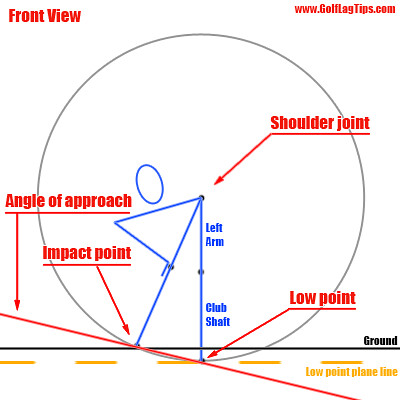
I get a lot of PM's and see a lot of posts basically asking how somebody can improve their ballstriking. Lots of questions from beginners, avid golfers trying to take it to the next level and golfers looking to 'overhaul' their golf swing. I've been in all of those positions and have done that. I'll try to give a Reader's Digest version in regards to these questions.
Here's how I would attack the issue:
1) Make sure you have a pretty good grip. It's not the most important part of the golf swing and there's plenty of acceptable variations. But if the variation doesn't work for you, it can throw you off just enough to make good ballstriking very difficult to accomplish. It's not so much as to how many knuckles you're showing on your left hand (although it can be important), but more of where the club is gripped in the hand. Too much in the palm of the lead hand is usually the problem with most golfers.
2) Make sure that you understand what happens with the clubhead and it's relation to the ball when it is properly struck with an *iron*. The driver is a little different now since Trackman technology has made some new discoveries, but the fix isn't too hard with a driver, IMO.
Here's how I would attack the issue:
1) Make sure you have a pretty good grip. It's not the most important part of the golf swing and there's plenty of acceptable variations. But if the variation doesn't work for you, it can throw you off just enough to make good ballstriking very difficult to accomplish. It's not so much as to how many knuckles you're showing on your left hand (although it can be important), but more of where the club is gripped in the hand. Too much in the palm of the lead hand is usually the problem with most golfers.
2) Make sure that you understand what happens with the clubhead and it's relation to the ball when it is properly struck with an *iron*. The driver is a little different now since Trackman technology has made some new discoveries, but the fix isn't too hard with a driver, IMO.
3) Make sure you understand the importance of a flat lead wrist at impact, what it looks like and what the trail wrist is doing at impact.
4) Make sure you understand the *new ball flight laws.* For now, the *new ball flight laws* will help you understand what your were doing when you hit a shot poorly. Once you start to get better and better and more consistent, you can then start using the *new ball flight laws* to work the ball. Most PGA Tour players can work the ball quite a bit. Somebody like Anthony Kim doesn't really work the ball in both directions (he usually hits it left-to-right), but he can use the new ball flight laws to hit a small fade or a big fade depending on the shot. And even he has some idea of how to work it right-to-left if he absolutely has to.
5) Finally, understand that pivot is the lifeblood of the golf swing. Steps 2-4 are not going to happen with success without an effective pivot. So understand what a good pivot is and understand how to execute an effective pivot. And here's the best I can do right now at explaining pivot (http://3jack.blogspot.com/2009/01/explaining-pivot.html)
After that, I would practice A LOT of chip, pitch and punch shots. I've changed my mind from talking to a lot of teachers who keep telling me that I'm on the right track, but golfers don't learn unless they incorporate some full swings in their practice sessions. But 1-5 are very prevalent in chip, pitch and punch shots.
So, I would start off the practice session with some chips, pitches and punches, then take some full swings. If you don't feel the difference or you start to lose it a little, go back to chips/pitches/punches and then some more full swings. In fact, when I play golf I usually take a pitch shot practice swing and then a full practice swing...then hit the ball.
All of the rest is more or less icing on the cake. Things like swing plane, address position, etc. are important, but get 1-5 down first and then make those swing plane changes if you deem fit.
3JACK
Monday, February 2, 2009
Manzella Explains D-Plane
'D-Plane' is something I've struggled with learning...but I had it right without even really knowing it. D-Plane was created by Theodore Jorgenson, a University of Nebraska physics professor who wrote the book 'The Physics of Golf.' The big part that confused me was I just didn't understand where the name D-plane came from. Here's a great thread on the subject (http://www.brianmanzella.com/forum/golfing-discussions/11013-finally-d-plane-pic-manzella.html)
The old PGA standard of ball flight says that the direction a ball starts at is almost exclusively due to the path of the club. And the curvature of the ball is due to the angle of the clubface. Here's a pic Manzella uses for that:

The old PGA standard of ball flight says that the direction a ball starts at is almost exclusively due to the path of the club. And the curvature of the ball is due to the angle of the clubface. Here's a pic Manzella uses for that:
The new D-plane rules (the correct rules) tell us something different. It says that Snead's shot would not start out to the right and draw to the middle of the green because the ball starts out mostly to where the face is angled. I've heard clubface angle has anywhere from 70-90% influence on the direction the ball flies to, but the common percentage I hear is that the influence is 87%.
So to make it easy, the ball starts out where the clubface is angle (for the most part) and then curves due to the club path. Let's say that Snead's clubface is 1 degree open and the club path is 10 degrees in-to-out. The D-plane laws say that the ball will actually travel like this:

Once you understand the D-plane rules, you can immensely improve your game. Not only can you figure out how to work the ball, but when you hit poor shots, you have a decent idea of what happened at impact.
Just another reason why http://www.brianmanzella.com/ is one of the best golf forums on the 'net.
3JACK
Johnny Miller Swing Sequence - Down The Line View
Here's the DTL Sequence:
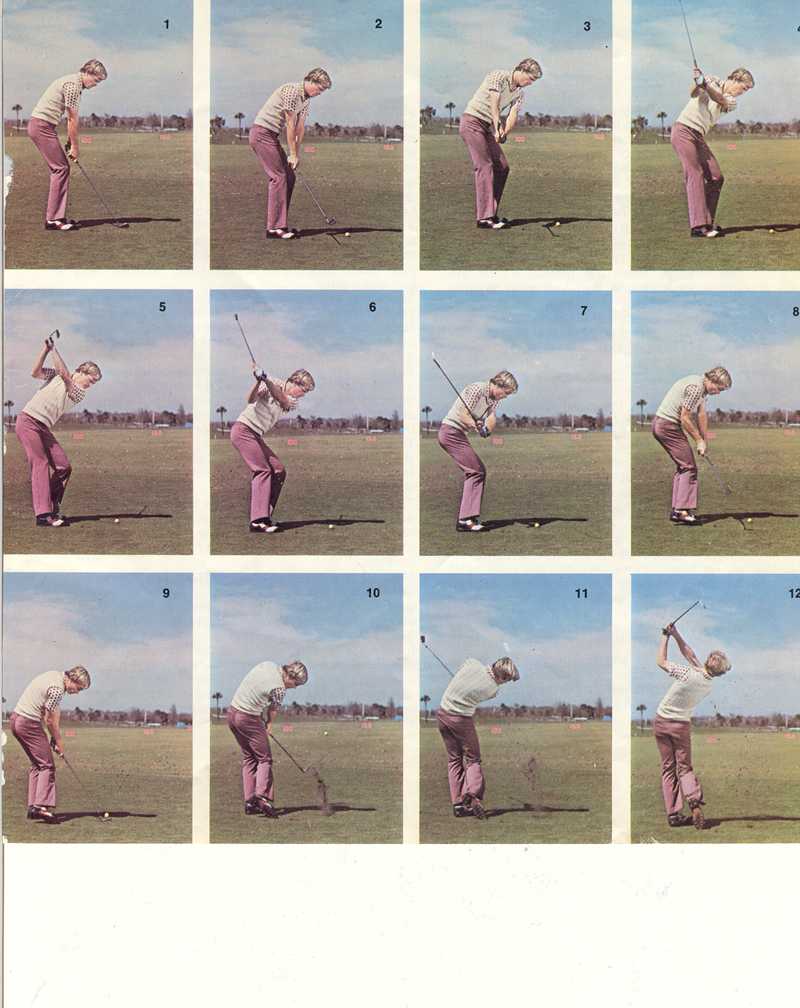
Brian Manzella notes that this is from 1971 and that his 1974 swing sequence is even better. Hopefully I can post that up soon.
3JACK
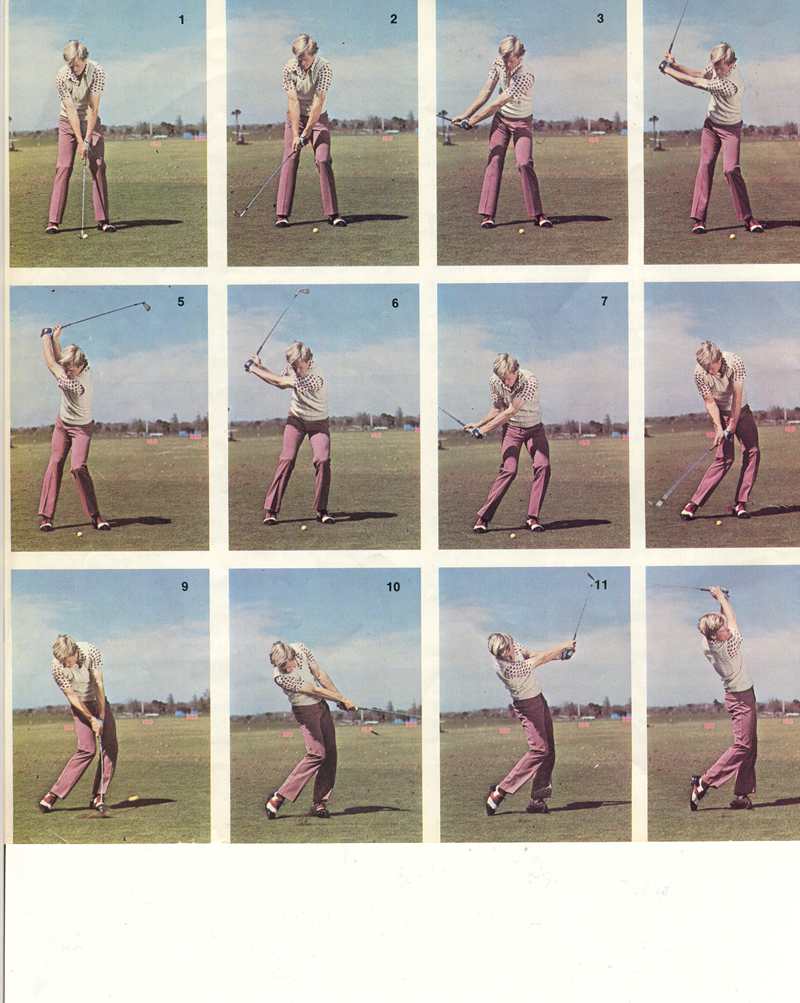
Johnny Miller Swing Sequence - Face On View
Here's one of the all time great ballstriker's swing sequence. Oddly, it's very hard to find any pictures or videos on his swing.
Strangest Swings in All of Golf
Neat video on strangest golf swings in golf. I will say that we may have a great player with a flawed/poor pivot...Eamonn Darcy. Darcy still has a nice backswing pivot and does a decent job from the top of the swing to right about impact, but right after impact it gets a little goofy.
3JACK
3JACK
Harold Swash Putting Drills
Here's another Harold Swash (European Putting Guru) video...this time on putting drills.
Swash has his students use an almost 'robotic' type of putting motion. But it's very effective. His star pupil is Paddy Harrington, an unbelievable putter. And I'm quite certain that Justin Rose is going to him after watching Rose putt at Dubai this weekend.
Swash has his students use an almost 'robotic' type of putting motion. But it's very effective. His star pupil is Paddy Harrington, an unbelievable putter. And I'm quite certain that Justin Rose is going to him after watching Rose putt at Dubai this weekend.
Subscribe to:
Posts (Atom)