Here’s
a table showing the make percentage on Tour between birdie and non-birdie
putts:
The point being is that in order to make birdies, you have to get birdie
shots closer to the cup and give yourself more opportunities inside the cup. The
‘cut-off’ point seems to be 20 feet and in.
Here’s a look at Mickelson’s
main metrics:
60 (-11) 11 birdies 0 Bogeys 8/14 fairways
hit 16/18 GIR -13 G.I.R.O. Score
Phil had 12 birdie putts inside 20
feet. He made 10 of those birdie putts.
His other birdie came on a putt
on the par-4 1st hole where he made a 22-footer.
I’m sure some will say
‘well, he’s a bomb-n-gouger and that’s why he went low.’ Well, not
quite.
His average drive went 296 yards.
Like he typically has
done, he has driven the ball ineffectively by Tour standards.
He found
deep rough on #2 from a wayward tee shot, flew it over the green and then had to
make a nice up-and-down to save par.
He found the fairway bunker on the
par-5 3rd hole which cost him being able to go for the green in two shots. He
laid up, then stiff a wedge to a less than 2 feet and made birdie.
Phil
found the deep rough off the tee on #6 and missed the green and had to get
up-and-down for par.
He found the deep rough on #11 and stiffed one from
178 yards to 8-feet and made the birdie.
He found the fairway bunker
again on #13 and could only hit his next shot about 90 yards, then stiffed his
next shot from 165 yards to 3 feet and made birdie.
Outside of those very
bad drives, Phil was able to get another 9 approach shots inside 20 feet for
birdie. Of course, there was the 15th and 17th holes where he was not taking
full approach shots into the hole, but that is still 7 full approach shots that
Lefty was able to stick inside 20-feet from the cup. And he made a whopping
83.3% of them.
For this day, Mickelson used his fantastic iron play and
putting to get him to -11 under par.
Woods returns to the winner circle winning the Farmers Insurance Open at Torrey Pines.
I did not pick Tiger for the Farmers since he was a 6/1 odds to win. However, I had ranked him #1 player to win the Farmers based off of last year's metrics and how his game fits the course.
Here's how my Farmers picks did:
Dustin Johnson 14/1 (t-51st)
Brandt Snedeker 14/1 (2nd)
Bubba Watson 18/1 (DNP)
Keegan Bradley 25/1 (MC)
Rickie Fowler 33/1 (t-6th)
Bo Van Pelt 35/1 (t-78th)
Jason Day 50/1 (t-9th)
Geoff Ogilvy 50/1 (MC)
Seung-Yul Noh 80/1 (t-27th)
Value Pick: Roberto Castro 200/1 (t-44th)
And here are my picks for TPC Scottsdale:
Jason Dufner: 14/1
Rickie Fowler: 14/1
Bubba Watson: 16/1
Keegan Bradley: 33/1
Ryan Palmer: 50/1
John Huh: 66/1
Kyle Stanley: 100/1
Roberto Castro: 150/1
Kevin Streelman: 150/1
Value Pick: Brad Fristch: 250/1
I plan on posting up the rankings for each of the main categories in 2-weeks, after the Northern Trust Open at Riviera.
For now, here's the top-50 in Driving Effectiveness so far in the season.
1. Trahan, D.J.
2. Stadler, Kevin
3. Weekley, Boo
4. Thompson, Nicholas
5. Streelman, Kevin
6. Pride, Dicky
7. Glover, Lucas
8. Palmer, Ryan
9. Bryant, Bart
10. Duke, Ken
11. Cantlay, Patrick
12. Maggert, Jeff
13. Yang, Y.E.
14. de Jonge, Brendon
15. Campbell, Chad
16. Points, D.A.
17. Kirk, Chris
18. Henley, Russell
19. Wilson, Mark
20. Fisher, Ross
21. Lee, Richard
22. Short, Jr., Wes
23. Kokrak, Jason
24. Hoffman, Charley
25. Clark, Tim
26. Horschel, Billy
27. Fritsch, Brad
28. Ogilvie, Joe
29. Adams, Blake
30. Park, Jin
31. Hicks, Justin
32. Rollins, John
33. Gardiner, Scott
34. Allenby, Robert
35. Ames, Stephen
36. Lingmerth, David
37. Singh, Vijay
38. Love III, Davis
39. Stefani, Shawn
40. Norlander, Henrik
41. Overton, Jeff
42. Haas, Bill
43. Jones, Matt
44. Karlsson, Robert
45. Gay, Brian
46. Snedeker, Brandt
47. Ogilvy, Geoff
48. Gomez, Fabian
49. Stallings, Scott
50. Garrigus, Robert
After the Demo Day on Wednesday, about 200 instructors got together for an Open Forum discussing golf instruction at Metrowest. This was being hosted by Nick Chertock (Golf Progress) and Chris Como (ChrisComoGolf.com).
This didn't go that well as the scope was too wide and you had too many instructors that showed up with interests in differing things. Some wanted to talk about Trackman, some wanted to talk about biomechanics, some wanted to talk about TGM, others wanted to talk about very basic teaching principles like drills and shooting the camera.
In the crowd were people like Rob Neal, Ben Shear, Joe Curtis, Mario Bevilacqua, John Dochety, David Graham, Lynn Blake, Joe Mayo, Brian Manzella, Fredrik Tuxen, Mike Adams, Mike McManus, Sasho MacKenzie, etc.
I don't want to discourage Chris Como and Nick Chertock from doing it again, particularly since this was the first time attempting this. I believe they can come up with a better plan and if they have one, I will attend it next year.
Thursday night was the Tweet Up 3.0, which had another great turnout with many of the same people that attended the Open Forum the previous night. However, Tour Striker inventor Martin Chuck was there. The Tour Striker was not at this year's demo day, but Martin told me they would be there next year they just wanted to take a year off and observe the show from the outside. There was also people like TJ Yeaton, Nick Starchuk, Wayne Yamaguchi, Sara Dickson, AimPoint founder Mark Sweeney, Rob McGill and many others there. I had a great time discussing the game, golf instruction, equipment and 2012 Pro Golf Synopsis.
Unfortunately, I accidentally deleted all of my pictures and videos from the Saturday show. This was my first time attending the Saturday show and it has a completely different feel to it as so many people in the industry leave on Saturday.
Overall, the show was a bit disappointing as there was a noticeable lack of innovation and differentiation in products. The big thing in equipment now is utility irons. But, everybody has these utility irons and it's hard to differentiate itself. To make matters worse, Titleist didn't have their Utility iron on display. I had been told by some who have hit it that it's a great club. Too bad we couldn't get to see it.
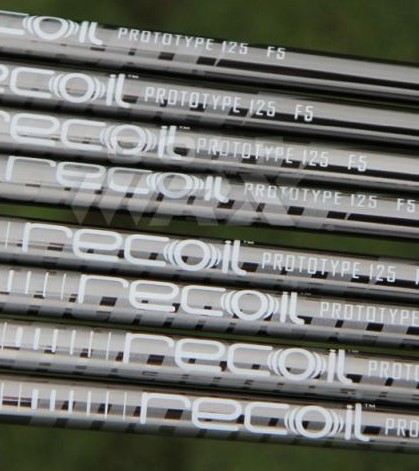
I was impressed with the new UST Mamiya Recoil shafts.
The recoil shafts are a carbon fiber shaft much along the lines of Aerotech's Steel Fiber shafts. However, the UST Mamiya Recoil shafts have weights as light as 68 grams and as heavy as 125 grams. They almost look like a stepless steel shaft at first with the silver paint. The butt section is designed to be be thinner so the butt section is not too stiff. They have 3 different models, from the 600, 800 and Prototype series. I think I may try one out this year.
As I mentioned at the Demo Day, the Edel irons were fantastic:
The Edel irons have numerous customiziation options from the offset, top line, bounce angle, toe design, etc.
What's interesting about the Edel irons is that they can make the head weight for each iron to your exact specifications. If you're into MOI matching like I am, you get a better headweight without having to use lead tape.
I thought the new ES12 ball and clubhead monitor was pretty neat for $250.
Lastly, I was quite impressed with what the Swing Catalyst has to offer. Here's the integration model which incorporates launch monitor and force plates into swing instruction and analysis.
Hopefully come 2014 we'll see some more advances in equipment. Otherwise, it was another great experience.
A few weeks ago somebody asked the question of ‘how would you fit Steve Stricker?’ over on the Wishon golf forum (www.wishongolf.com). While proper clubfitting takes trial and error and making adjustments to the equipment and is not always a precise art from, I thought I would give it a shot.
Currently, here are the shafts that Stricker uses:
Driver: UST Mamiya ProForce V2 86 gram shaft
3-wood: UST Mamiya ProForce V2 95 gram shaft
Hybrid: UST Mamiya ProForce V2 104 gram shaft
Irons: KBS Tour C-Taper (stiff)
However, let’s look at Stricker’s swing:
When looking at shaft fitting, we generally try to look at few things:
1. Shaft Weight
2. Bend Profile – Tip Section
3. Bend Profile – Butt Section
4. Hand/Wrist/Finger Strength
I won’t worry about shaft length because we don’t know much in the way of Stricker’s body dimensions.
But as far as the swing goes, we generally want to look at:
A. Clubhead Speed
B. The Startdown (transition)
C. When they release the #2 Power Accumulator (lead wrist uncocking) in the downswing.
***
The startdown is generally a little harder to define as to whether the golfer has what I call a ‘hard’, ‘soft’ or ‘average’ stardown.
Generally, I like to look at the ‘soft’ startdowns, first. Generally, the softer startdowns are more of a float loading action where the golfer adds more wristcock in the transition. Lucas Glover is a good example of a ‘float load.’
Converserly, a very hard startdown has more of a ‘cranking down’ motion like a Jamie Sadlowski.
I would consider Sadlowski’s to be the hardest of transitions because he has cocked his wrists at the top of the swing and much as he can and retains that wristcock well into the downswing.
Now, Stricker’s swing…
Stricker is obviously not a ‘float loader.’ He does not add extra wrist cock in transition. However, unlike Sadlowski he does not have a lot of wristcock at the top of the swing. He’s not casting the club, but he’s not lagging it much either.
The general concept is that harder transitions require the butt section to be a little stiffer. If you’re a float loader and you go with a very stiff butt section to the shaft, it will feel like those shafts you feel you ‘can’t get around on’ or ‘can’t release the club.’ Although part of this is dependent upon hand strength and clubhead speed. Two players with the same type of transition, but one with much stronger hands and generates much more clubhead speed will likely need a stiffer butt section to the shaft.
***
The release of the #2 power accumulator has a lot to do with how the golfer generates their clubhead speed. The later the #2 PA is released, the more last second acceleration they have in their swing.
When looking at Stricker’s swing
He has a fairly early #2 PA release for a PGA Tour pro.
The earlier the release, the shafts should generally be lighter. And the tip section should be softer. This will get the launch a little higher and increase the spin rate a little, which is needed when there is less acceleration.
***
Here’s a look at Stricker’s radar metrics from 2012:
These are pretty solid numbers. And looking at his rankings in carry distance, clubhead speed, max height and hang time…they are all in line with each other.
With that, it’s safe to say that Mr. Stricker is fit fairly well to begin with. The only potential problem, is that the shafts he is carry are quite heavy.
Each of the shafts are heavy with what I would label as S+ butt sections with X-Stiff Tip Sections. Stricker also uses an 8.5° lofted driver and still gets a good amount of height on the ball despite a fairly average clubhead speed.
My thinking is that Stricker hits up on the ball with his driver and generally has a shallower attack angle. Thus, he needs a shaft that is more tip stiff than the average golfer who releases the #2 Power Accumulator as early as he does.
However, the potential issue is that his current shafts are a bit too heavy for him and that *might* cause him to lose some clubhead speed. Probably 1-2 mph worth. That does not sound like much, but all of the metrics since they started tracking clubhead speed on Tour in 2008 indicate differently.
I looked up comparable shafts on Wishon Golf’s Shaft Bend Profile software. I found many similar shafts in bend profile to shafts that Stricker currently uses. But, I could only find 2 shafts that had similar profiles and were much lighter:
These shafts are a little softer in the tip section than Stricker’s current shafts. This could theoretically help him improve some performance.
But the problem is that it is difficult to argue against the way Stricker’s current clubs perform. With the lighter shafts, he would have to add more weight to the clubheads in order to get his total club MOI where he would need it. And while MOI matching is a revolutionary process, we still have to remember that the distribution of the weight of the main components of the club (grip, shaft and clubhead) are important in the producing the optimal clubfitting for the golfer.
For instance, my irons are fitted at a MOI of 2,725 kg/cm^2.
I can hit any iron much better at 2,725 kg/cm^2. But, I hit it best with a 50 gram grip, a 110-118 gram shaft, and a moderately heavier clubhead. A heavier shaft with a lighter clubhead does not function as well for me. Or a super light shaft with an extra heavy clubhead.
For Stricker, with the fairly hard transition and earlier than average release, he could very well hit it best with a 50 gram grip, heavy shafts, and average clubhead weight.
These are just the many factors one has to consider with clubfitting optimization. And one cannot just go with what should work in theory. But, there is always the possibility that even Tour players are not quite optimized with clubfitting. However, I think Stricker is either optimized with his fitting or darn close to it.
I got to the Orange County Convention Center at 8:30 Wednesday morning. I was going to drive over to OCN after I got my badge, but decided against it since I paid $14 for parking. I'm glad I didn't as traffic to OCN was outrageous.
So far, I was a bit disappointed to the point where I only made 1 trip around the range.
Not really much in the way of innovation or really exciting products out there.
There was a thing called 'The Golf Robot' that was very cool. It was a golf club hooked up to a machine.
Rumor has it that the golf robot will shut down the power of an entire city block when trying to replicate Jim Thorpe's swing.
Fourteen Golf has some new blades coming out that look really nice. I like their new driver as well. I also liked the new Yonex E-Zone driver.
I experimented with a bunch of different utility irons. I liked Fourteen Golf's quite a bit. However, Titleist did not have their new U-model utility iron which was mind boggling and disappointing.
PURE Grips has a new grip out that is supposed to be their answer to the cord grip. It felt very different. Kinda like a putting a car tire on a golf grip. I think you're either going to love it or hate it.
And then there was Edel Golf...
I tried their regular model and the Faldo model.
The Faldo model has a higher CoG. I hit it pretty decent. But, I was loving the regular model cavity back irons. They look great, little offset and they feel great.
They moved the CoG away from the heel a bit more, but didn't move the scorelines away from the heel as much as they did with the wedges.
It's a different looking face. It's not exactly some modern/new wave craze, but it's not exactly old school in looks either.
But, I loved the way these irons feel and how they played. They have that nice 'thump' to them without the thump being the divot and so much shaft deflection.
They also will be providing a various amount of customized options like the type of toe design, top line, etc. Very interesting and just a great set of irons.
You're going to like the Torque Balanced Faldo Putters. These are more like a 'heel hang', directly opposite of the toe hang putters. Leaving the putter face open isn't an issue with these putters.
My initial impression was there wasn't much to get overly excited about at the Demo Day outside of Edel.
The rest of the manufacturers were not creating anything that was eye popping or innovative, but made sense type of product. I think a lot of the publics needs are not being addressed by these bigger manufacturers.
OCN also did not have professional caterers and that was a problem. I've found OCN's staff to be great each time I've been there, but they simply weren't suited for the food service in this environment. The line was a good 20 minutes just to get your food. You had 5 people working, 3 others doing nothing but talking. Problems with getting cash change, etc.
Overall a bit disappointing.
Tomorrow is Tweet-Up 3.0 at the Brick House Tavern. And then Saturday I will hit up the show again and hopefully see some better products I didn't see at Demo Day.
![[image]](http://www.libertynews.com/wp-content/uploads/2013/01/Phil-Mickelson-Wallpaper-2.jpg "[image]")
![[image]](http://www.golfwrx.com/wp-content/uploads/2013/01/Capture1-600x162.jpg "[image]")