Here's a video from blog follower and friend Sevam1 with match between Sevam and Steve Elkington, using hickory shafted clubs.
3JACK
Wednesday, March 31, 2010


Tuesday, March 30, 2010
How Those Guys Did It
A new blog reader e-mailed me yesterday and asked me a very general question. 'How did those guys do it despite having vastly different golf swings?'
I thought about it for a second and wanted to break it down and then analyze it from there.
For starters, we know that impact is objective. For example, if the clubface is open 2* and the path is inside-to-out by 2* and you hit it square with 90 mph clubhead speed and a certain dynamic loft at impact, the ball will go the same way regardless if Tiger Woods is swinging the club or Richie3Jack is swinging the club.
But while impact is objective, that doesn't mean great players had the same exact impact as can be seen by their ball flight.
However, IMO the key is their consistency and control of 'the big 3':
- Clubface Control
- Clubpath Control
- Low Point Control
Looking at Trackman reports, you will see that better golfers are very consistent with the 'Big 3.' Their clubface control will not only be close to square to the target, but it won't deviate much. For instance, if a sub-scratch golfer has his clubface on average 1* open at impact, chances are that almost every shot they will hit will have a very slightly open clubface at impact. Same with path, if it's slightly outside-to-in on average, they will almost never have a swing where the path is inside-to-out. And if their average attack angle is at -4* with a 7-iron, it probably will not deviate more than +1 or -1* degrees.
So IMO, the great golfers were supremely consistent with the 'Big 3' and had great pivots to make them impact conditions very dynamic. But, they also may have had very different impact conditions (but still good impact conditions) and went about getting those impact conditions in different ways.
Let's take a look at some of them.
LEE TREVINO
What do we know about Trevino?
- he took gigantic divots
- he tend to hit the ball low
- he favored a fade (although he could hit any shot he wanted)
- He lived by the mantra 'aim left, swing right, walk straight'
I believe that while Trevino claimed he swung the club out to the right, he actually aimed so far left at address that his club still wound up swinging to the left.
Trevino used to have problems with a snap hook before he became a touring professional and my guess is the aiming left came about from him trying to prevent the hook. Trevino also talked about 'hanging on for dear life' with his left hand after seeing Ben Hogan do a clinic and that got rid of his hook. I believe like Hogan, Trevino had problems with the snap hook because his clubface would get occasionally too closed.
But because of that, my guess is that Trevino's clubface in his prime was probably slightly closed.
I also believe he had very steep attack angles, so his plane line was quite a bit out to the left than Trevino ever imagined. I also bet that his greatest consistency came with the attack angle because he never seemed to catch anything fat or thin. And once he learned how to stop getting that clubface too shut, he became one of the greatest ballstrikers of all time.
MOE NORMAN
What do we know about Moe?
- He hit the ball probably straighter on command than anybody in history.
- He took very shallow divots if any at all.
My guess with Moe is that his attack angle was probably shallower than -2* even with the steepest of irons. Because of that, his horizontal swing plane was probably very close to square to the target and even more amazingly, his path was square.
Moe's greatest attribute had to be his square clubface. If there's one thing I would preach to learn from Moe's swing is to look at how square his clubface is, particularly at the top of the swing. From there, it's easy to keep it dead square throughout the downswing.
BEN HOGAN
What do we know about Hogan?
- Released the club very much to the left.
- Fought a hook early on in his career.
- Leaned towards hitting a fade after 'The Secret.'
- Moderate sized divots.
I think Hogan's Attack Angle was *slightly* shallower than the PGA Tour averages of today. I don't think it was anywhere near as shallow as Moe Norman's. He probably had a path that wound up being outside-to-in by 0.5 to 1.5*, but probably very close to 1.0*. I think his clubface was very square, almost uncanny square. And depending on the path, that would create the size of the fade or the straight shot.
We also know Hogan's stance diagram from '5 Lessons.'
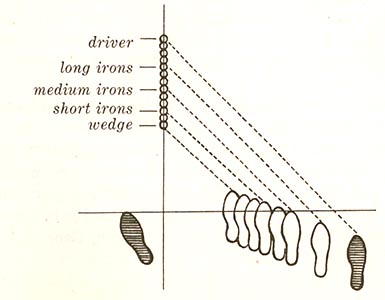
While Hogan was known for a power fade, he probably hit a lot of straight shots and I believe the stance diagram is a secret as to why. I believe Hogan figured out that a square stance with a driver would lead to a large fade which he didn't want. And a square stance with a 9-iron would lead to a ball flight he didn't want.
Many of today's golfers would use a 'CF Release' with the woods and a 'CP Release' with the irons so they wouldn't have to fool around with their stance. But I believe Hogan would never consider fooling around with the release actions (had he known about the different ones) because of his fear of hooking the ball.
KENNY PERRY
I used Perry because he's a known for his hook spin on the golf ball and the others were all straight/faders of the golf ball. Nonetheless, he's an excellent ball striker.
What do we know about Perry?
- He hits a big draw, rarely tries to hit a fade on command
- He hits the ball high
- He hits it very long
This indicates that Perry's path is inside-to-out and probably quite a bit.
His plane line is probably a bit inside to out as well.
Attack angles and paths are not mutually exclusive, but golfers who do swing out to the right usually see a shallower attack angle as well. I wouldn't be surprised, given Perry's length off the tee and his ball flight, if he had an upward attack angle with the driver.
Now, the dynamics of those swings, like clubhead speed, will be different. But all of these players controlled and were consistent with the 'Big 3', had great pivots to power those swings and knew how to play the shots that they hit.
3JACK
I thought about it for a second and wanted to break it down and then analyze it from there.
For starters, we know that impact is objective. For example, if the clubface is open 2* and the path is inside-to-out by 2* and you hit it square with 90 mph clubhead speed and a certain dynamic loft at impact, the ball will go the same way regardless if Tiger Woods is swinging the club or Richie3Jack is swinging the club.
But while impact is objective, that doesn't mean great players had the same exact impact as can be seen by their ball flight.
However, IMO the key is their consistency and control of 'the big 3':
- Clubface Control
- Clubpath Control
- Low Point Control
Looking at Trackman reports, you will see that better golfers are very consistent with the 'Big 3.' Their clubface control will not only be close to square to the target, but it won't deviate much. For instance, if a sub-scratch golfer has his clubface on average 1* open at impact, chances are that almost every shot they will hit will have a very slightly open clubface at impact. Same with path, if it's slightly outside-to-in on average, they will almost never have a swing where the path is inside-to-out. And if their average attack angle is at -4* with a 7-iron, it probably will not deviate more than +1 or -1* degrees.
So IMO, the great golfers were supremely consistent with the 'Big 3' and had great pivots to make them impact conditions very dynamic. But, they also may have had very different impact conditions (but still good impact conditions) and went about getting those impact conditions in different ways.
Let's take a look at some of them.
LEE TREVINO
What do we know about Trevino?
- he took gigantic divots
- he tend to hit the ball low
- he favored a fade (although he could hit any shot he wanted)
- He lived by the mantra 'aim left, swing right, walk straight'
I believe that while Trevino claimed he swung the club out to the right, he actually aimed so far left at address that his club still wound up swinging to the left.
Trevino used to have problems with a snap hook before he became a touring professional and my guess is the aiming left came about from him trying to prevent the hook. Trevino also talked about 'hanging on for dear life' with his left hand after seeing Ben Hogan do a clinic and that got rid of his hook. I believe like Hogan, Trevino had problems with the snap hook because his clubface would get occasionally too closed.
But because of that, my guess is that Trevino's clubface in his prime was probably slightly closed.
I also believe he had very steep attack angles, so his plane line was quite a bit out to the left than Trevino ever imagined. I also bet that his greatest consistency came with the attack angle because he never seemed to catch anything fat or thin. And once he learned how to stop getting that clubface too shut, he became one of the greatest ballstrikers of all time.
MOE NORMAN
What do we know about Moe?
- He hit the ball probably straighter on command than anybody in history.
- He took very shallow divots if any at all.
My guess with Moe is that his attack angle was probably shallower than -2* even with the steepest of irons. Because of that, his horizontal swing plane was probably very close to square to the target and even more amazingly, his path was square.
Moe's greatest attribute had to be his square clubface. If there's one thing I would preach to learn from Moe's swing is to look at how square his clubface is, particularly at the top of the swing. From there, it's easy to keep it dead square throughout the downswing.
BEN HOGAN
What do we know about Hogan?
- Released the club very much to the left.
- Fought a hook early on in his career.
- Leaned towards hitting a fade after 'The Secret.'
- Moderate sized divots.
I think Hogan's Attack Angle was *slightly* shallower than the PGA Tour averages of today. I don't think it was anywhere near as shallow as Moe Norman's. He probably had a path that wound up being outside-to-in by 0.5 to 1.5*, but probably very close to 1.0*. I think his clubface was very square, almost uncanny square. And depending on the path, that would create the size of the fade or the straight shot.
We also know Hogan's stance diagram from '5 Lessons.'
While Hogan was known for a power fade, he probably hit a lot of straight shots and I believe the stance diagram is a secret as to why. I believe Hogan figured out that a square stance with a driver would lead to a large fade which he didn't want. And a square stance with a 9-iron would lead to a ball flight he didn't want.
Many of today's golfers would use a 'CF Release' with the woods and a 'CP Release' with the irons so they wouldn't have to fool around with their stance. But I believe Hogan would never consider fooling around with the release actions (had he known about the different ones) because of his fear of hooking the ball.
KENNY PERRY
I used Perry because he's a known for his hook spin on the golf ball and the others were all straight/faders of the golf ball. Nonetheless, he's an excellent ball striker.
What do we know about Perry?
- He hits a big draw, rarely tries to hit a fade on command
- He hits the ball high
- He hits it very long
This indicates that Perry's path is inside-to-out and probably quite a bit.
His plane line is probably a bit inside to out as well.
Attack angles and paths are not mutually exclusive, but golfers who do swing out to the right usually see a shallower attack angle as well. I wouldn't be surprised, given Perry's length off the tee and his ball flight, if he had an upward attack angle with the driver.
Now, the dynamics of those swings, like clubhead speed, will be different. But all of these players controlled and were consistent with the 'Big 3', had great pivots to power those swings and knew how to play the shots that they hit.
3JACK
Monday, March 29, 2010
A Look At The Unorthodox Swings - Part 8
In this edition of the unorthodox swings, I look at Chi Chi Rodriguez.
Chi Chi was an 8-time PGA Tour winner and a 22-time Champions Tour winner. He was considered to be a very good ballstriker and shotmaker, who won in spite of his putting.

One thing I would like to go over is the terminology of 'tipping out' in the golf swing.
To begin with, 'tipping out' occurs at the P6 position of the golf swing. P6 is in the downswing, when the clubshaft is parallel to the ground.

Of course, this is what P6 looks like from the DTL view.

In the photo above, Mac O'Grady is in about as good of a P6 position as a golfer can get. The clubshaft from this view is parallel to the target line. The toe of the club is pointing straight up at the sky, which is a square clubface.
Now look at Chi Chi from the DTL view at P6 (last picture on the right of the middle row). As you can see, his clubshaft is pointing a little bit left of parallel to the target line.
When the clubshaft is left of parallel at P6, that's called 'tipping out.'
Chi Chi is tipping out very slightly here, but his clubface is dead square and it's something he's done for so long that he can repeat good impact conditions over and over again.
The problem most golfers have with 'tipping out' is the clubface is actually closed for them when they do it, and that combined with the tipping out action causes them to suddenly open the clubface wide open and hit a shank. I should know because last year I suffered with bouts of 'tipping out.'
The unorthodox parts for Chi Chi's swing to me start off with the address position. He stands very far away and almost address the ball like Moe Norman from the DTL perspective.

Other than that, his backswing looks pretty normal. He then 'swings left' quite noticeably with a very flat shoulder turn past impact and then has a bit of a funky finish. But other than that, his swing looks very orthodox.
I think Chi had excellent footwork and kept his clubface very square throughout the golf swing. He also mastered the 'CP release' (aka swinging left), so if he was measure on Trackman, he probably had a lot of 0* path and 0* clubface readings.
3JACK
Chi Chi was an 8-time PGA Tour winner and a 22-time Champions Tour winner. He was considered to be a very good ballstriker and shotmaker, who won in spite of his putting.
One thing I would like to go over is the terminology of 'tipping out' in the golf swing.
To begin with, 'tipping out' occurs at the P6 position of the golf swing. P6 is in the downswing, when the clubshaft is parallel to the ground.
Of course, this is what P6 looks like from the DTL view.
In the photo above, Mac O'Grady is in about as good of a P6 position as a golfer can get. The clubshaft from this view is parallel to the target line. The toe of the club is pointing straight up at the sky, which is a square clubface.
Now look at Chi Chi from the DTL view at P6 (last picture on the right of the middle row). As you can see, his clubshaft is pointing a little bit left of parallel to the target line.
When the clubshaft is left of parallel at P6, that's called 'tipping out.'
Chi Chi is tipping out very slightly here, but his clubface is dead square and it's something he's done for so long that he can repeat good impact conditions over and over again.
The problem most golfers have with 'tipping out' is the clubface is actually closed for them when they do it, and that combined with the tipping out action causes them to suddenly open the clubface wide open and hit a shank. I should know because last year I suffered with bouts of 'tipping out.'
The unorthodox parts for Chi Chi's swing to me start off with the address position. He stands very far away and almost address the ball like Moe Norman from the DTL perspective.
Other than that, his backswing looks pretty normal. He then 'swings left' quite noticeably with a very flat shoulder turn past impact and then has a bit of a funky finish. But other than that, his swing looks very orthodox.
I think Chi had excellent footwork and kept his clubface very square throughout the golf swing. He also mastered the 'CP release' (aka swinging left), so if he was measure on Trackman, he probably had a lot of 0* path and 0* clubface readings.
3JACK
Sunday, March 28, 2010
Fooling Around with More Statistics
In a previous post I talked about the PGA Tour's new 'Putts Gained' statistic. I started fooling around with other statistical ideas.
The first was combining the Putts Gained and the Putts per GIR rankings. I think this gives a good indication of how good of a putter somebody is and probably a good indication of their ability to score (hitting approach shots in the right spots and/or just being able to make putts). Here's what I got:

1. Luke Donald
2. Greg Chalmers
3. Brian Gay
4. Aaron Baddeley
5. Joe Ogilvie
6. Tiger Woods
7. Jim Furyk
8. Charlie Wi
9. Bob Heintz
10. Kevin Na
11. Matt Kuchar
12. Brandt Snedeker
13. Jason Day
14. Webb Simpson
15. Geoff Ogilvy
16. Brad Faxon
17. Corey Pavin
18. Vaughn Taylor
19. Zach Johnson
20. Pat Perez
21. Harrison Frazar
22. Stephen Ames
23. Anthony Kim
24. Tim Clark
25. Parker McLachlin
26. Mike Weir
27. Daniel Chopra
28. Bryce Molder
29. Steve Stricker
30. Fredrik Jacobson
31. Ben Crane
32. Dean Wilson
33. Ryuji Imada
34. Jerry Kelly
35. Bo Van Pelt
36. Hunter Mahan
37. Chris Riley
38. George McNeill
39. Retief Goosen
40. Bob Estes
41. Scott McCarron
42. Jeff Quinney
43. Justin Leonard
44. Mark Wilson
45. James Nitties
46. Ryan Moore
47. Paul Goydos
48. Stewart Cink
49. Ben Curtis
50. Dustin Johnson
51. Lucas Glover
52. David Toms
53. Scott Verplank
54. Charley Hoffman
55. Jeff Klauk
56. Padraig Harrington
57. Tim Petrovic
58. Lee Janzen
59. Michael Letzig
60. James Driscoll
61. Steve Marino
62. Bubba Watson
63. Eric Axley
64. Jeff Overton
65. Ryan Palmer
66. Kenny Perry
67. John Mallinger
68. Kevin Sutherland
69. Brian Davis
70. Richard S. Johnson
71. David Mathis
72. David Duval
73. Ian Poulter
74. Spencer Levin
75. Jeev M. Singh
76. Scott Piercy
77. Matt Jones
78. Angel Cabrera
79. Nick Watney
80. Nathan Green
81. Marc Leishman
82. Carl Pettersson
83. Bill Haas
84. Woody Austin
85. Rod Pampling
86. Justin Rose
87. Michael Allen
88. Colt Knost
89. John Merrick
90. Phil Mickelson
91. Chad Campbell
92. Steve Lowery
93. Jason Dufner
94. Ted Purdy
95. Martin Laird
96. Matt Weibring
97. Kevin Streelman
98. Kris Blanks
99. Cliff Kresge
100. John Rollins
101. Fred Couples
102. Matt Bettencourt
103. D.A. Points
104. Tim Herron
105. John Senden
106. Charles Howell III
107. Johnson Wagner
108. Nick O'Hern
109. Cameron Beckman
110. Brett Quigley
111. Todd Hamilton
112. Andres Romero
113. Brian Bateman
114. Rory Sabbatini
115. Troy Matteson
116. Tommy Armour III
117. Aron Price
118. Tag Ridings
119. Jonathan Byrd
120. Y.E. Yang
121. Sean O'Hair
122. Sergio Garcia
123. J.J. Henry
124. Chris Stroud
125. Jimmy Walker
126. Brendon de Jonge
127. Jason Bohn
128. Brad Adamonis
129. Tom Pernice, Jr.
130. Chris DiMarco
131. Steve Elkington
132. Scott Sterling
133. Alex Cejka
134. Rich Beem
135. Bart Bryant
136. Bill Lunde
137. Mark Brooks
138. Camilo Villegas
139. K.J. Choi
140. Marc Turnesa
141. Derek Fathauer
142. Chez Reavie
143. Patrick Sheehan
144. Mark Calcavecchia
145. Leif Olson
146. Davis Love III
147. Mathew Goggin
148. Briny Baird
149. Robert Garrigus
150. Kent Jones
151. Steve Flesch
152. Ernie Els
153. Kevin Stadler
154. Heath Slocum
155. Brendon Todd
156. Charles Warren
157. Jarrod Lyle
158. Shaun Micheel
159. D.J. Trahan
160. Ken Duke
161. Tommy Gainey
162. Jonathan Kaye
163. Jeff Maggert
164. Joe Durant
165. Nicholas Thompson
166. Casey Wittenberg
167. Glen Day
168. Peter Lonard
169. Greg Owen
170. Darron Stiles
171. Rick Price
172. Greg Kraft
173. Gary Woodland
174. Boo Weekley
175. Rocco Mediate
176. Vijay Singh
177. Tom Lehman
178. Jason Gore
179. J.B. Holmes
180. Stuart Appleby
181. Matthew Borchert
182. Robert Allenby
183. Peter Tomasulo
184. Kirk Triplett
185. Adam Scott
186. Billy Mayfair
187. Will MacKenzie
188. Jay Williamson
189. Ricky Barnes
Again, that top 10 of players sounds right with guys like Luke Donald, Baddeley, Gay, Tiger and Wi all in that top. Congrats to friend of the 3Jack blog, David Orr, for his pupil Charlie Wi making the top 10.
Anyway, I then wanted to see what the DIFFERENCE in Putts Gained and Putts per GIR was and how golfers stacked up. I think these rankings help give an indication of a golfer's SCORING capability versus their putting skills. If a golfer does really well in putts per GIR versus Putts Gained, it shows to me that they at least have an ability to score well, be it by placing their approach shots in a good position or their mentality to get the birdie when they need it.

1. Jonathan Byrd
2. David Duval
3. Kris Blanks
4. Fred Couples
5. Phil Mickelson
6. Rory Sabbatini
7. Alex Cejka
8. Jason Bohn
9. Scott Verplank
10. Brian Davis
11. Matt Weibring
12. Tag Ridings
13. Joe Durant
14. Derek Fathauer
15. Dustin Johnson
16. Justin Leonard
17. Brendon de Jonge
18. Steve Stricker
19. Michael Allen
20. Heath Slocum
21. Darron Stiles
22. Rick Price
23. Anthony Kim
24. Tommy Armour III
25. Tommy Gainey
26. Brett Quigley
27. David Toms
28. Tim Herron
29. Daniel Chopra
30. J.B. Holmes
31. Jason Dufner
32. Ken Duke
33. Harrison Frazar
34. Robert Garrigus
35. Nicholas Thompson
36. Peter Lonard
37. Bill Haas
38. Charley Hoffman
39. Kirk Triplett
40. Bo Van Pelt
41. D.J. Trahan
42. Dean Wilson
43. John Mallinger
44. John Merrick
45. Vijay Singh
46. Will MacKenzie
47. Paul Goydos
48. Bubba Watson
49. Camilo Villegas
50. Adam Scott
51. Colt Knost
52. Briny Baird
53. Ernie Els
54. Billy Mayfair
55. Martin Laird
56. Shaun Micheel
57. Vaughn Taylor
58. Jeff Quinney
59. Mark Calcavecchia
60. Leif Olson
61. Ricky Barnes
62. Jimmy Walker
63. Stuart Appleby
64. Woody Austin
65. Jason Gore
66. Rocco Mediate
67. Jay Williamson
68. Charles Howell III
69. Chris DiMarco
70. Jarrod Lyle
71. Scott Piercy
72. Mathew Goggin
73. John Rollins
74. Ian Poulter
75. Michael Letzig
76. Sean O'Hair
77. Chris Stroud
78. Casey Wittenberg
79. Boo Weekley
80. Corey Pavin
81. Lucas Glover
82. Tim Clark
83. D.A. Points
84. Peter Tomasulo
85. Jerry Kelly
86. Steve Marino
87. Y.E. Yang
88. Bart Bryant
89. Charlie Wi
90. Andres Romero
Note, I didn't put in golfers whose difference in putts gained ranking and putts per GIR were somewhat miniscule. I considered 'miniscule' as any difference between -20 and +20 in ranking points.
148. Tiger Woods
149. Tim Petrovic
150. Eric Axley
151. Steve Lowery
152. Rod Pampling
153. Patrick Sheehan
154. John Senden
155. Brandt Snedeker
156. George McNeill
157. Angel Cabrera
158. Marc Leishman
159. Ryan Moore
160. Kenny Perry
161. Brian Bateman
162. Ted Purdy
163. Fredrik Jacobson
164. Brad Faxon
165. Brendon Todd
166. Nick Watney
167. Kevin Streelman
168. Parker McLachlin
169. Troy Matteson
170. David Mathis
171. Stewart Cink
172. Scott McCarron
173. Scott Sterling
174. Mark Brooks
175. Brad Adamonis
176. Bill Lunde
177. Richard S. Johnson
178. Aron Price
179. Bryce Molder
180. Padraig Harrington
181. Todd Hamilton
182. Carl Pettersson
183. Jeff Klauk
184. J.J. Henry
185. Nathan Green
186. Marc Turnesa
187. Spencer Levin
188. Ben Curtis
189. Matt Jones
Problem with this stat is there really is no trend here. If you finish high, you're probably doing a little better stroke average wise than if you finish poorly, but nothing that really stands out.
Next, I put together the following rankings:
Total Ballstriking Ranking
Putts Gained Ranking
Putts Per GIR Ranking
I think I would call this 'Total Game' statistic. Here this measures the golfer's ballstriking skills, their putting skills and their 'scoring' skills.
Not bad for a guy coming off a serious knee injury last year.

1. Tiger Woods
2. Zach Johnson
3. Jim Furyk
4. Tim Clark
5. Steve Stricker
6. Hunter Mahan
7. Stephen Ames
8. Bob Heintz
9. Brian Gay
10. Bo Van Pelt
11. Bryce Molder
12. Charlie Wi
13. Justin Leonard
14. Brandt Snedeker
15. David Toms
16. Ben Crane
17. Harrison Frazar
18. Matt Kuchar
19. Luke Donald
20. Vaughn Taylor
21. Kenny Perry
22. Kevin Na
23. Lucas Glover
24. Scott Verplank
25. Mark Wilson
26. Jason Day
27. Steve Marino
28. Greg Chalmers
29. Jerry Kelly
30. Chris Riley
31. Dean Wilson
32. Bob Estes
33. Corey Pavin
34. Ryan Moore
35. Joe Ogilvie
36. Scott McCarron
37. Dustin Johnson
38. Charley Hoffman
39. Michael Allen
40. Aaron Baddeley
41. Webb Simpson
42. Geoff Ogilvy
43. Mike Weir
44. Pat Perez
45. Jeff Klauk
46. Chad Campbell
47. Marc Leishman
48. Jason Dufner
49. Daniel Chopra
50. Kris Blanks
51. Jeff Quinney
52. Anthony Kim
53. Brad Faxon
54. Retief Goosen
55. Bill Haas
56. Fredrik Jacobson
57. John Senden
58. George McNeill
59. Ted Purdy
60. Paul Goydos
61. Stewart Cink
62. Ryan Palmer
63. Kevin Sutherland
64. Michael Letzig
65. Colt Knost
66. Matt Weibring
67. Parker McLachlin
68. Nick Watney
69. John Mallinger
70. Ryuji Imada
71. Justin Rose
72. Rod Pampling
73. John Merrick
74. Tommy Armour III
75. Jason Bohn
76. Lee Janzen
77. Brian Davis
78. Fred Couples
79. Tim Petrovic
80. James Nitties
81. Matt Jones
82. Kevin Streelman
83. Bubba Watson
84. Troy Matteson
85. Chris Stroud
86. Scott Piercy
87. Woody Austin
88. Spencer Levin
89. Martin Laird
90. Sean O'Hair
91. Angel Cabrera
92. Jonathan Byrd
93. Richard S. Johnson
94. Sergio Garcia
95. Ben Curtis
96. Nick O'Hern
97. Steve Elkington
98. Alex Cejka
99. Padraig Harrington
100. Scott Sterling
101. D.A. Points
102. J.J. Henry
103. Patrick Sheehan
104. Ian Poulter
105. Steve Lowery
106. Jeff Overton
107. Eric Axley
108. Heath Slocum
109. John Rollins
110. David Mathis
111. Y.E. Yang
112. David Duval
113. Tag Ridings
114. Bill Lunde
115. Cameron Beckman
116. Robert Garrigus
117. Charles Howell III
118. Rich Beem
119. Phil Mickelson
120. Briny Baird
121. Nathan Green
122. Carl Pettersson
123. Johnson Wagner
124. D.J. Trahan
125. Chez Reavie
126. Camilo Villegas
127. Cliff Kresge
128. Joe Durant
129. Todd Hamilton
130. Bart Bryant
131. Charles Warren
132. Ernie Els
133. Chris DiMarco
134. Davis Love III
135. Greg Owen
136. Brett Quigley
137. Kevin Stadler
138. K.J. Choi
139. Jeff Maggert
140. Brendon de Jonge
141. Rory Sabbatini
142. Aron Price
143. Matt Bettencourt
144. Tim Herron
145. Mathew Goggin
146. Andres Romero
147. Robert Allenby
148. Kent Jones
149. Boo Weekley
150. Mark Brooks
151. Darron Stiles
152. Brian Bateman
153. Nicholas Thompson
154. Tom Pernice, Jr.
155. Tom Lehman
156. Steve Flesch
157. Jimmy Walker
158. Kirk Triplett
159. Jay Williamson
160. Glen Day
161. Brad Adamonis
162. Casey Wittenberg
163. Mark Calcavecchia
164. Vijay Singh
165. Will MacKenzie
166. Marc Turnesa
167. Jason Gore
168. Billy Mayfair
169. Leif Olson
170. Derek Fathauer
171. Jarrod Lyle
172. Rocco Mediate
173. Ken Duke
174. Rick Price
175. Ricky Barnes
176. Peter Tomasulo
177. Peter Lonard
178. Brendon Todd
179. Gary Woodland
180. Greg Kraft
181. Adam Scott
182. Stuart Appleby
183. J.B. Holmes
3JACK
The first was combining the Putts Gained and the Putts per GIR rankings. I think this gives a good indication of how good of a putter somebody is and probably a good indication of their ability to score (hitting approach shots in the right spots and/or just being able to make putts). Here's what I got:
1. Luke Donald
2. Greg Chalmers
3. Brian Gay
4. Aaron Baddeley
5. Joe Ogilvie
6. Tiger Woods
7. Jim Furyk
8. Charlie Wi
9. Bob Heintz
10. Kevin Na
11. Matt Kuchar
12. Brandt Snedeker
13. Jason Day
14. Webb Simpson
15. Geoff Ogilvy
16. Brad Faxon
17. Corey Pavin
18. Vaughn Taylor
19. Zach Johnson
20. Pat Perez
21. Harrison Frazar
22. Stephen Ames
23. Anthony Kim
24. Tim Clark
25. Parker McLachlin
26. Mike Weir
27. Daniel Chopra
28. Bryce Molder
29. Steve Stricker
30. Fredrik Jacobson
31. Ben Crane
32. Dean Wilson
33. Ryuji Imada
34. Jerry Kelly
35. Bo Van Pelt
36. Hunter Mahan
37. Chris Riley
38. George McNeill
39. Retief Goosen
40. Bob Estes
41. Scott McCarron
42. Jeff Quinney
43. Justin Leonard
44. Mark Wilson
45. James Nitties
46. Ryan Moore
47. Paul Goydos
48. Stewart Cink
49. Ben Curtis
50. Dustin Johnson
51. Lucas Glover
52. David Toms
53. Scott Verplank
54. Charley Hoffman
55. Jeff Klauk
56. Padraig Harrington
57. Tim Petrovic
58. Lee Janzen
59. Michael Letzig
60. James Driscoll
61. Steve Marino
62. Bubba Watson
63. Eric Axley
64. Jeff Overton
65. Ryan Palmer
66. Kenny Perry
67. John Mallinger
68. Kevin Sutherland
69. Brian Davis
70. Richard S. Johnson
71. David Mathis
72. David Duval
73. Ian Poulter
74. Spencer Levin
75. Jeev M. Singh
76. Scott Piercy
77. Matt Jones
78. Angel Cabrera
79. Nick Watney
80. Nathan Green
81. Marc Leishman
82. Carl Pettersson
83. Bill Haas
84. Woody Austin
85. Rod Pampling
86. Justin Rose
87. Michael Allen
88. Colt Knost
89. John Merrick
90. Phil Mickelson
91. Chad Campbell
92. Steve Lowery
93. Jason Dufner
94. Ted Purdy
95. Martin Laird
96. Matt Weibring
97. Kevin Streelman
98. Kris Blanks
99. Cliff Kresge
100. John Rollins
101. Fred Couples
102. Matt Bettencourt
103. D.A. Points
104. Tim Herron
105. John Senden
106. Charles Howell III
107. Johnson Wagner
108. Nick O'Hern
109. Cameron Beckman
110. Brett Quigley
111. Todd Hamilton
112. Andres Romero
113. Brian Bateman
114. Rory Sabbatini
115. Troy Matteson
116. Tommy Armour III
117. Aron Price
118. Tag Ridings
119. Jonathan Byrd
120. Y.E. Yang
121. Sean O'Hair
122. Sergio Garcia
123. J.J. Henry
124. Chris Stroud
125. Jimmy Walker
126. Brendon de Jonge
127. Jason Bohn
128. Brad Adamonis
129. Tom Pernice, Jr.
130. Chris DiMarco
131. Steve Elkington
132. Scott Sterling
133. Alex Cejka
134. Rich Beem
135. Bart Bryant
136. Bill Lunde
137. Mark Brooks
138. Camilo Villegas
139. K.J. Choi
140. Marc Turnesa
141. Derek Fathauer
142. Chez Reavie
143. Patrick Sheehan
144. Mark Calcavecchia
145. Leif Olson
146. Davis Love III
147. Mathew Goggin
148. Briny Baird
149. Robert Garrigus
150. Kent Jones
151. Steve Flesch
152. Ernie Els
153. Kevin Stadler
154. Heath Slocum
155. Brendon Todd
156. Charles Warren
157. Jarrod Lyle
158. Shaun Micheel
159. D.J. Trahan
160. Ken Duke
161. Tommy Gainey
162. Jonathan Kaye
163. Jeff Maggert
164. Joe Durant
165. Nicholas Thompson
166. Casey Wittenberg
167. Glen Day
168. Peter Lonard
169. Greg Owen
170. Darron Stiles
171. Rick Price
172. Greg Kraft
173. Gary Woodland
174. Boo Weekley
175. Rocco Mediate
176. Vijay Singh
177. Tom Lehman
178. Jason Gore
179. J.B. Holmes
180. Stuart Appleby
181. Matthew Borchert
182. Robert Allenby
183. Peter Tomasulo
184. Kirk Triplett
185. Adam Scott
186. Billy Mayfair
187. Will MacKenzie
188. Jay Williamson
189. Ricky Barnes
Again, that top 10 of players sounds right with guys like Luke Donald, Baddeley, Gay, Tiger and Wi all in that top. Congrats to friend of the 3Jack blog, David Orr, for his pupil Charlie Wi making the top 10.
Anyway, I then wanted to see what the DIFFERENCE in Putts Gained and Putts per GIR was and how golfers stacked up. I think these rankings help give an indication of a golfer's SCORING capability versus their putting skills. If a golfer does really well in putts per GIR versus Putts Gained, it shows to me that they at least have an ability to score well, be it by placing their approach shots in a good position or their mentality to get the birdie when they need it.
1. Jonathan Byrd
2. David Duval
3. Kris Blanks
4. Fred Couples
5. Phil Mickelson
6. Rory Sabbatini
7. Alex Cejka
8. Jason Bohn
9. Scott Verplank
10. Brian Davis
11. Matt Weibring
12. Tag Ridings
13. Joe Durant
14. Derek Fathauer
15. Dustin Johnson
16. Justin Leonard
17. Brendon de Jonge
18. Steve Stricker
19. Michael Allen
20. Heath Slocum
21. Darron Stiles
22. Rick Price
23. Anthony Kim
24. Tommy Armour III
25. Tommy Gainey
26. Brett Quigley
27. David Toms
28. Tim Herron
29. Daniel Chopra
30. J.B. Holmes
31. Jason Dufner
32. Ken Duke
33. Harrison Frazar
34. Robert Garrigus
35. Nicholas Thompson
36. Peter Lonard
37. Bill Haas
38. Charley Hoffman
39. Kirk Triplett
40. Bo Van Pelt
41. D.J. Trahan
42. Dean Wilson
43. John Mallinger
44. John Merrick
45. Vijay Singh
46. Will MacKenzie
47. Paul Goydos
48. Bubba Watson
49. Camilo Villegas
50. Adam Scott
51. Colt Knost
52. Briny Baird
53. Ernie Els
54. Billy Mayfair
55. Martin Laird
56. Shaun Micheel
57. Vaughn Taylor
58. Jeff Quinney
59. Mark Calcavecchia
60. Leif Olson
61. Ricky Barnes
62. Jimmy Walker
63. Stuart Appleby
64. Woody Austin
65. Jason Gore
66. Rocco Mediate
67. Jay Williamson
68. Charles Howell III
69. Chris DiMarco
70. Jarrod Lyle
71. Scott Piercy
72. Mathew Goggin
73. John Rollins
74. Ian Poulter
75. Michael Letzig
76. Sean O'Hair
77. Chris Stroud
78. Casey Wittenberg
79. Boo Weekley
80. Corey Pavin
81. Lucas Glover
82. Tim Clark
83. D.A. Points
84. Peter Tomasulo
85. Jerry Kelly
86. Steve Marino
87. Y.E. Yang
88. Bart Bryant
89. Charlie Wi
90. Andres Romero
Note, I didn't put in golfers whose difference in putts gained ranking and putts per GIR were somewhat miniscule. I considered 'miniscule' as any difference between -20 and +20 in ranking points.
148. Tiger Woods
149. Tim Petrovic
150. Eric Axley
151. Steve Lowery
152. Rod Pampling
153. Patrick Sheehan
154. John Senden
155. Brandt Snedeker
156. George McNeill
157. Angel Cabrera
158. Marc Leishman
159. Ryan Moore
160. Kenny Perry
161. Brian Bateman
162. Ted Purdy
163. Fredrik Jacobson
164. Brad Faxon
165. Brendon Todd
166. Nick Watney
167. Kevin Streelman
168. Parker McLachlin
169. Troy Matteson
170. David Mathis
171. Stewart Cink
172. Scott McCarron
173. Scott Sterling
174. Mark Brooks
175. Brad Adamonis
176. Bill Lunde
177. Richard S. Johnson
178. Aron Price
179. Bryce Molder
180. Padraig Harrington
181. Todd Hamilton
182. Carl Pettersson
183. Jeff Klauk
184. J.J. Henry
185. Nathan Green
186. Marc Turnesa
187. Spencer Levin
188. Ben Curtis
189. Matt Jones
Problem with this stat is there really is no trend here. If you finish high, you're probably doing a little better stroke average wise than if you finish poorly, but nothing that really stands out.
Next, I put together the following rankings:
Total Ballstriking Ranking
Putts Gained Ranking
Putts Per GIR Ranking
I think I would call this 'Total Game' statistic. Here this measures the golfer's ballstriking skills, their putting skills and their 'scoring' skills.
Not bad for a guy coming off a serious knee injury last year.
1. Tiger Woods
2. Zach Johnson
3. Jim Furyk
4. Tim Clark
5. Steve Stricker
6. Hunter Mahan
7. Stephen Ames
8. Bob Heintz
9. Brian Gay
10. Bo Van Pelt
11. Bryce Molder
12. Charlie Wi
13. Justin Leonard
14. Brandt Snedeker
15. David Toms
16. Ben Crane
17. Harrison Frazar
18. Matt Kuchar
19. Luke Donald
20. Vaughn Taylor
21. Kenny Perry
22. Kevin Na
23. Lucas Glover
24. Scott Verplank
25. Mark Wilson
26. Jason Day
27. Steve Marino
28. Greg Chalmers
29. Jerry Kelly
30. Chris Riley
31. Dean Wilson
32. Bob Estes
33. Corey Pavin
34. Ryan Moore
35. Joe Ogilvie
36. Scott McCarron
37. Dustin Johnson
38. Charley Hoffman
39. Michael Allen
40. Aaron Baddeley
41. Webb Simpson
42. Geoff Ogilvy
43. Mike Weir
44. Pat Perez
45. Jeff Klauk
46. Chad Campbell
47. Marc Leishman
48. Jason Dufner
49. Daniel Chopra
50. Kris Blanks
51. Jeff Quinney
52. Anthony Kim
53. Brad Faxon
54. Retief Goosen
55. Bill Haas
56. Fredrik Jacobson
57. John Senden
58. George McNeill
59. Ted Purdy
60. Paul Goydos
61. Stewart Cink
62. Ryan Palmer
63. Kevin Sutherland
64. Michael Letzig
65. Colt Knost
66. Matt Weibring
67. Parker McLachlin
68. Nick Watney
69. John Mallinger
70. Ryuji Imada
71. Justin Rose
72. Rod Pampling
73. John Merrick
74. Tommy Armour III
75. Jason Bohn
76. Lee Janzen
77. Brian Davis
78. Fred Couples
79. Tim Petrovic
80. James Nitties
81. Matt Jones
82. Kevin Streelman
83. Bubba Watson
84. Troy Matteson
85. Chris Stroud
86. Scott Piercy
87. Woody Austin
88. Spencer Levin
89. Martin Laird
90. Sean O'Hair
91. Angel Cabrera
92. Jonathan Byrd
93. Richard S. Johnson
94. Sergio Garcia
95. Ben Curtis
96. Nick O'Hern
97. Steve Elkington
98. Alex Cejka
99. Padraig Harrington
100. Scott Sterling
101. D.A. Points
102. J.J. Henry
103. Patrick Sheehan
104. Ian Poulter
105. Steve Lowery
106. Jeff Overton
107. Eric Axley
108. Heath Slocum
109. John Rollins
110. David Mathis
111. Y.E. Yang
112. David Duval
113. Tag Ridings
114. Bill Lunde
115. Cameron Beckman
116. Robert Garrigus
117. Charles Howell III
118. Rich Beem
119. Phil Mickelson
120. Briny Baird
121. Nathan Green
122. Carl Pettersson
123. Johnson Wagner
124. D.J. Trahan
125. Chez Reavie
126. Camilo Villegas
127. Cliff Kresge
128. Joe Durant
129. Todd Hamilton
130. Bart Bryant
131. Charles Warren
132. Ernie Els
133. Chris DiMarco
134. Davis Love III
135. Greg Owen
136. Brett Quigley
137. Kevin Stadler
138. K.J. Choi
139. Jeff Maggert
140. Brendon de Jonge
141. Rory Sabbatini
142. Aron Price
143. Matt Bettencourt
144. Tim Herron
145. Mathew Goggin
146. Andres Romero
147. Robert Allenby
148. Kent Jones
149. Boo Weekley
150. Mark Brooks
151. Darron Stiles
152. Brian Bateman
153. Nicholas Thompson
154. Tom Pernice, Jr.
155. Tom Lehman
156. Steve Flesch
157. Jimmy Walker
158. Kirk Triplett
159. Jay Williamson
160. Glen Day
161. Brad Adamonis
162. Casey Wittenberg
163. Mark Calcavecchia
164. Vijay Singh
165. Will MacKenzie
166. Marc Turnesa
167. Jason Gore
168. Billy Mayfair
169. Leif Olson
170. Derek Fathauer
171. Jarrod Lyle
172. Rocco Mediate
173. Ken Duke
174. Rick Price
175. Ricky Barnes
176. Peter Tomasulo
177. Peter Lonard
178. Brendon Todd
179. Gary Woodland
180. Greg Kraft
181. Adam Scott
182. Stuart Appleby
183. J.B. Holmes
3JACK
Saturday, March 27, 2010
Thinking About Scoring
Lately, I’ve been thinking about the term ‘scoring’ and what it is and how to go about it.
I think the general feeling I have on scoring is that it’s not really one particular part of the game, it’s more or less shooting a better score than your actual ballstriking (and even putting and short game) deserve.
It seems to me that ‘scoring’ CAN be good putting or a good short game and usually consists of that, but is not mandatory. And a lot of it seems to be ‘hitting the right shot at the right time.’
For instance, my lowest rounds ever have been two rounds of 64. On the first 64 I shot, I can honestly say that I didn’t strike the ball great and didn’t hit it great. I probably hit about 12-13 greens that day. But even more amazing about that 64 was it came with a FOUR PUTT.
For instance, on the first hole I hit a so-so driver in the left hole, then hit a 7-iron to about 12 feet and made the putt. But on the 8th hole I pull hooked a 3-iron into the opposite fairway, then hit a flop shot that was basically a prayer that went THRU a big pine tree, missed the entire tree and lipped out for birdie (and kicked in for par). And in between there I had some times where I hit a good driver, a nice approach and 2-putted from 10-15 feet. So, it wasn’t like I struck the ball exceptionally well or I putted great, I just scored well.
I’ve been starting to think a bit more about scoring lately, particularly from taking the Lag Erickson Advanced Ballstriking modules. One of the protocols is to flatten out your downswing plane quite a bit and to flatten your lie angles on some old, forged irons. I currently have 2 sets of old Hogan irons (’63 IPT’s and ’83 Apex PC’s) that are bent 5* flat from standard. Lag Erickson brought up the point that because you really won’t miss shots left and long of the green with this flatter downswing plane and flatter iron lie angles. And because of that, you won’t put yourself in a tough position to get up and down because missing a green left and long usually puts the golfer in jail.
If you think about it for a second, it does make a lot of sense since most greens are sloped uphill for the golfer. So if they miss long (and left), they’ll have a downhill chip instead of an uphill putt if they missed right (and short or pin-high). And I think it’s little things like this that usually typify ‘scoring’ and what makes a good ‘scorer’ versus a poor ‘scorer.’
Of course, there’s some other things that I think make a good ‘scorer’ and here are some of my thoughts on that.
ONE WAY MISSES
I think this is extremely important and a big advantage that the ABS modules provide for their students. With that flat downswing plane and flat lie angles, you’re simply not going to come over the top or hook shots well left. Your misses will be pushes out to the right.
Whether or not you miss right or left, I think it’s an ENORMOUS advantage to miss shots one way. Even Tiger Woods and Anthony Kim talked about this in their clinic.
The one way miss is a CONFIDENCE builder. If you know where your misses are going (and they are going in one direction), you can play for that and fire at flags and break down your swing thoughts in a simpler fashion.
That’s a big reason why I’m not interested in hitting a ‘soft draw’ or a ‘power fade’ as my stock shot. My experience hitting both of those is that when you ‘double cross’ the shot (hitting a fade when you play for a draw or vice versa), the misses are too big. However, if your stock shot is a dead straight shot, the double cross is really taken out of the equation. You may hit a fade or a draw when playing for a straight shot and still wind up in decent shape.
GOOD DRIVING AND GOOD PUTTING = GOOD SCORING
The title is quite simple. If you drive the ball well and you putt well, you normally score well. IMO, this is because the iron shots are much easier with the good drives putting you in good position and if you miss an iron shot, your putting saves you. Also, you can chew up those par-5’s as most of them are designed where a good driver and a decent second shot gets you near the green on the approach.
MISSING DISASTER
The PGA Tour golfers usually avoid O.B and hazards and just as importantly, spots where you cannot get up and down from.
If there were signs on the golf course that told golfers the percentage of getting up and down, we would certainly treat the 5% or 10% ‘signs’ almost like a hazard. Not only is your chance of getting up and down is anemic, but you’re likely to take 4 or 5 shots instead of 3.
The PGA Tour golfers pretty much map out where they want to avoid missing shots, even in non-hazard or non-O.B. areas. They find the places where if they miss they can get the best chance of getting up and down. The problem with amateurs is that they often don’t take any of this into consideration.
KNOWING WHERE TO LEAVE IT
One of the things that caught my eye and got me thinking was the ‘Putts Gained’ statistical article that I wrote a post about earlier this month.
The key point I thought was made here:
The best putter in 2009 by this measure was Luke Donald, who gained an average of 0.905 strokes on the field by virtue of his putting skill alone. Mr. Stricker, who finished No. 1 in putting average last year largely because of his proficiency with approach shots, ranked a surprising 69th in putts gained per round. (Deeper analysis by MIT showed that Mr. Stricker's ranking was also negatively affected because he happened to play on the "easiest" greens of all 166 players sampled.)While Stricker was the #1 putter on Tour last year in the Putts per GIR stat, he was ranked 69th in the Putts Gained statistic. That doesn’t mean Stricker is a bad putter, in reality he’s still a very above average putter.
However, his ballstriking was phenomenal and he was probably very good at getting his approach shots into makeable positions.
Somebody like Luke Donald who was #1 in putts gained, didn’t fare as well in putts per GIR because Stricker was leaving himself in a much better position to make putts.
But, I also do not believe it’s all about hitting shots closer, but also leaving yourself with makeable putts.
David Orr did a study of nearly 700 golfers, from the 50 PGA Tour pros to the extremely high handicapper, and found that the putt made the most was at the 5 o’clock position of the fall line (an uphill putt that breaks slightly right to left).
I sort of put this information on hold for awhile. But recently the course I play has aerated the greens and the one thing I noticed is that once you get outside of 10 feet, you simply won’t make a downhill put on aerated greens unless you are plain lucky.
The downhill putts are hit softer and thus the ball rolls at a slower velocity. Because of this, the ball tends to ‘grab’ the green more and the aeration holes knock the ball off line. However, with uphill putts the ball has to be hit harder and has more velocity and is not effected by the aeration hole as much.
Even when you are not playing on aerated greens, the same can apply with soft spike indentations, ball marks, etc.
So, golfers can really start making more putts if they can find a way to leave themselves with more makeable putts. If you have a 30 foot putt that bends sidehill, you may want to make sure that you don’t miss it on the high side. Or if you are using the Rule of 12 and you are in between clubs, you may want to use the club that will leave you with an uphill putt.
The same applies with approach shots. Knocking a shot in from 150 yards is almost impossible. Hitting one so close that you have a kick in putt is pretty slim. However, if you can start thinking about leaving yourself with an uphill putt, your chance of making a 20 foot uphill putt should be greater than making a 20 foot downhill putt.
A lot of this reminds me a bit of football strategy. Many times coaches see their defense is struggling and giving up points and blame it on a lack of talent on defense. However, the problem may be more along the lines of the offense throwing the ball too much and not chewing up the clock and the time of possession and putting the defense in a better position to succeed.
I think it’s important to recognize that somebody like Steve Stricker isn’t the best ‘pure’ putter on Tour last year, but he may have been the best ‘scorer’ on Tour last year and did it a lot with his ballstriking.
3JACK
Friday, March 26, 2010
A Look At the Unorthodox Swings - Part 7
Here I look at Paul Azingers swing.
Azinger was one of the world's best players back in the late 80's and early 90's. He was known for having a very well rounded game of ballstriking and short game.
As you will see in the sequences below, he has a very strong grip and mostly hit a punch type of shot with every swing.
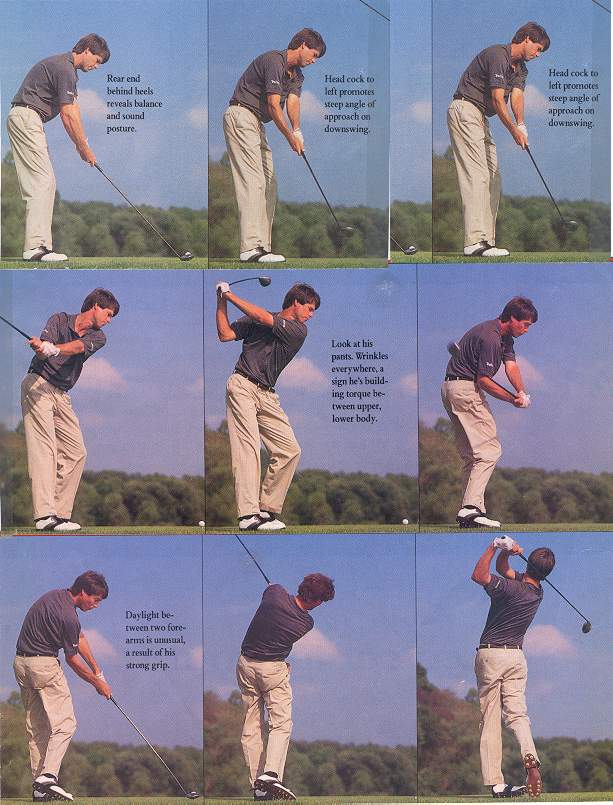
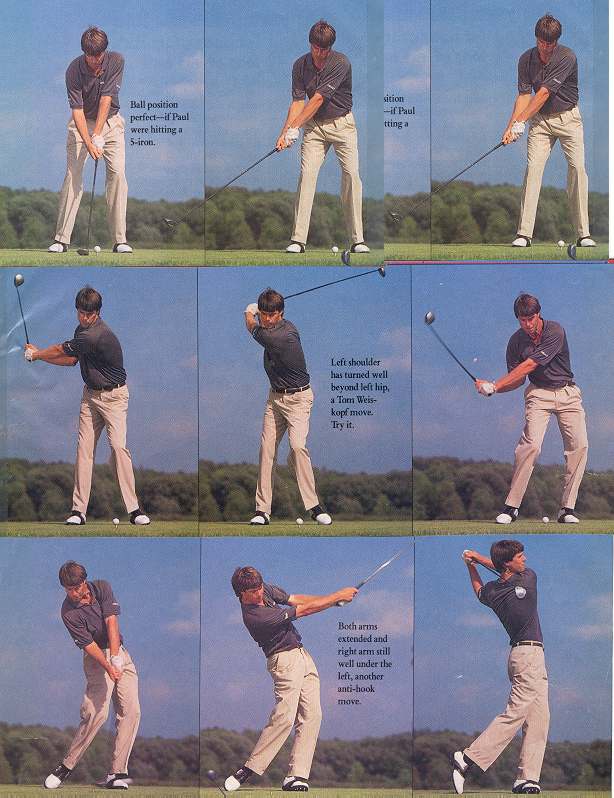
In the Advanced Ballstriking curriculum, there are some things that would be looked upon favorably. Azinger's downswing is on the "4:30 line' or the 'elbow plane.' He also had very good footwork as he was considered one of the more athletic golfers on the PGA Tour in his prime.
The big key to me is looking at the DTL sequence. Particularly looking at his swing at the top and then at the 1/2 way point of the downswing. His clubface is dead shut at the top of the swing, but at the 1/2 down point his swing is dead square.
One of the things we see from these good ballstrikers with unorthodox swings is that most of them have very orthodox downswings and do those important things like keeping the face square.
That being said, I think it's rare for a golfer with a very shut face at the top of the swing to get it square at the 1/2 down point. Usually I find that even good golfers with that shut of a face don't get the face square until right before impact. Then it becomes a question of whether or not they can square it up on time.
3JACK
Azinger was one of the world's best players back in the late 80's and early 90's. He was known for having a very well rounded game of ballstriking and short game.
As you will see in the sequences below, he has a very strong grip and mostly hit a punch type of shot with every swing.
In the Advanced Ballstriking curriculum, there are some things that would be looked upon favorably. Azinger's downswing is on the "4:30 line' or the 'elbow plane.' He also had very good footwork as he was considered one of the more athletic golfers on the PGA Tour in his prime.
The big key to me is looking at the DTL sequence. Particularly looking at his swing at the top and then at the 1/2 way point of the downswing. His clubface is dead shut at the top of the swing, but at the 1/2 down point his swing is dead square.
One of the things we see from these good ballstrikers with unorthodox swings is that most of them have very orthodox downswings and do those important things like keeping the face square.
That being said, I think it's rare for a golfer with a very shut face at the top of the swing to get it square at the 1/2 down point. Usually I find that even good golfers with that shut of a face don't get the face square until right before impact. Then it becomes a question of whether or not they can square it up on time.
3JACK
Thursday, March 25, 2010
Knudson Swing from 'Swing Motion' Tape
Here's a good video of George Knudson's swing in his latter days. Knudson is a guy I like to find things about and study his swing because he was one of the all-time great ballstrikers and was pretty tall. He may have had the best footwork of any golfer to have ever played the game.
3JACK
3JACK
Subscribe to:
Posts (Atom)