Wednesday, October 7, 2009

3Jack's Translation of TGM: Part 8F


7-16 (Knee Action)

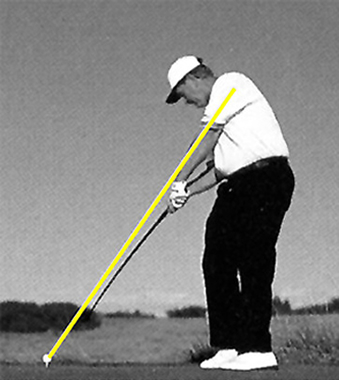
Knee Action is classified based on the combinations of bent and straight knee conditions. Knee bend and knee straightening determines hip slant which is the 'slant' angle between the right and left hip.

If you straighten the right knee at the top of the swing, you will have more hip slant than if you have the right knee more flexed. Sam Snead straightened the right knee out (straightened, not LOCKED) and had more hip slant than a golfer who would keep the right knee flexed.
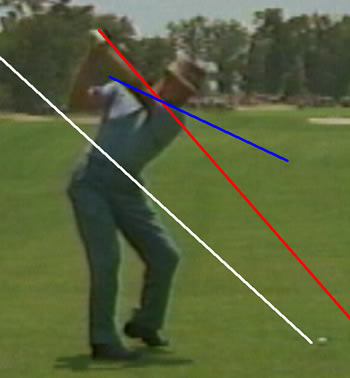


The hip slant effects the hip turn. More hip slant = more backswing hip turn. Less Hip Slant = less backswing hip turn.

Actually, the primary function of Knee Action -- as with Waist Bend -- is to maintain a motionless Head during the Stroke.
Less knee bend will restrict the Pivot and Hip Slide and the more upright the plane tends to be. So if you're looking to flatten out your swing, more knee bend may be the answer. The S&T guys teach a straightened (not locked) right knee at the top of the swing. This allows more of an upright shoulder turn. To combat that, the S&T guys teach to take the hands much more inside than most other swings.

If the knee actually locks on the backswing, it will HAVE TO unlock on the downswing and Homer states that subsequent unlocking is disruptive.

Homer then talks about 'anchor' designs where the right and/or the left knees can be bent so it acts as an anchor throughout the entire stroke. We'll go over these knee anchors later on.


7-17 (Foot Action)

I think 7-17 is so important and so overlooked that I want to post the entire 3 paragraph section.

Foot Action accomodated the Knee Action resulting from the motion of the Weight Shift, and accepts the changes in the loading of the Feet. The loading can shift between the inner and the outer edge of the Foot but shouldn't roll the Foot over on its edge. The majority of the weight should be on the heel and its better to turn on one's heel than to roll excessively. Address Position loading of the Feet is even distribution between both Feet but with enough on the heels to allow the toes to be lifted up momentarily without altering the distribution between the toe and heel.

The heel should not be lifted off the ground, but pulled off -- and then no more than necessary. Merely lifting the heel accomplishes nothing.

Halting the Backstroke motion with the Feet and letting this same tension pull the Downstroke through Impact is 'swinging from the Feet' and gives the Stroke Maximum Swing Radius.
The feet accomodates the knees which helps accomodate the PIVOT. The weight should move anywhere from the inner edge of the foot to the outer edge, but should not roll over on the outer edge. Furthermore, you should be able to lift the toes upward momentarily. Keep the weight off the toes if you can because it can cause some serious flaws in the Geometry of your swing. If anything, I try to keep the weight in the middle of the arches of the feet, sort of like feeling as though the arches in your feet are 'suction cups' to the ground.

Homer talks about 'swinging from the feet' which is very similar to what Sevam1 has discussed in his e-book 'The Secret Is In The Dirt.' Homer basically states that this is a good thing because it maximizes the swing radius (more extension in the swing) which helps create more power.

Here's a couple of videos I did on 7-17.


3JACK

Monday, October 5, 2009

3Jack's Translation of TGM: Part 8E


7-13 (Shoulder Turn)

Shoulder turn is established the planes the Right Shoulder rotates on. And when we've talked about getting the Right Shoulder on plane on the downswing so far in these translations, the key component has been tilting the axis properly via a hip slide. The Stack & Tilt guys talk a lot about 'axis tilt' and on the downswing they want to see a hip slide instead of just rotating the hips. This tilts the axis away from the target and gets the right shoulder on plane.

The Shoulder is the fastest and farthest moving component of the Pivot and actually transmits the Pivot motion to the Arms.
So out of all of the components of the pivot, the shoulders move the fastest (remember, the hands are not part of the pivot). The shoulders rotating takes the energy from the pivot and transmits it to the Arms.

When the Shoulder moves on the same Downstroke Plane as the Hands, it provides its greatest support and its best guidance to the Stroke.
Homer also talks about the right shoulder going off plane and the compensations that would need to be made. Homer notes that you want to keep that Right Shoulder 'back' and 'down' so you can keep the Right Shoulder on plane and that will preven the golfer from 'running out of right arm' (the right arm should still be bent at impact, if it is straightened, you are 'running out of right arm'). When you 'run out of right arm', that causes clubhead throwaway (flipping).


7-14 (Hip Turn)

Hip Turn is a product of Knee Bend and Waist Bend. Without the hip turn, the weight could not shift, the shoulder turn axis be tilted without moving the head. Remember, Homer believed in a stationary head in the swing or the 'Tripod Centered Head.'

Homer talks about a 'Hula-Hula' flexibility, basically the hips moving in a gyrating motion like somebody using a hula hoop. It's not just a pure rotation of the hips, but some slide and some rotation, just like somebody trying to use the hula hoop.

The hip turn permits effects, actions and motions of the Pivot. 'Weight Shift is strictly a HIP MOTION.' Substituting a Head Motion and/or a Knee Motion will may Swaying inevitable.


7-15 (Hip Action)

Hip Action differs from Hip Turn. Hip Actions main duty is to lead and pull the Shoulders back and down in varying combinations.

Hitters start their downswing with a noticeable hip slide. So Homer states that if the hitter forgets to weight shift, that can cause an issue because of that hip slide. For the swinger though, they can 'throw' the right shoulders via the hip action.

Homer talks about 'clearing the right hip', but that means that the right hip is properly turned on the backswing. TGM likes to get the hitters in particular to have a slightly open right hip at address so the hands can deliver the club to impact more easily.

Homer then talks about the importance of hip action and how it cannot be haphazard. The S&T guys teach a noticeable hip slide on the downswing as they don't want the hips to rotate and 'get fast' on the downswing.

This video by Lynn Blake talks about some other differences in hitters vs. swingers and pay attention to the hip action difference between the two.


3JACK

Sunday, October 4, 2009

3Jack's Translation of TGM: Part 8D


7-11 (Pressure Point Combinations)

'Fundamentally, Power must flow from its source (the Accumulators) and must be exerted againt something (Presure Points) that will directly and/or indirectly drive the Club thru Impact.' - Homer Kelley pg. 104
I can't tell you how important I think this statement is to making a swing that produces precise results.

The power comes from the Power Accumulators and those Accumulators are exerted by the Pressure points. One thing that has improved my swing tremendously is that I now have proper 'extension' after impact. Here's a pic of Zach Johnson with proper extension in the follow thru.


In TGM terms this is known as proper Extensor Action, where the right arm has straightened in the follow thru and that stretches the left arm which has already been straight throughout the downswing.

As this was one of my problems, I erroneously thought that I had work on actively extending my arms in the follow thru. But what I really needed to do was to have the proper lag pressure at impact which was exerted by the #1 Pressure Point in my right hand. That exertion thru my pressure points would, in my case, feel like it would push my arms 'into extension.' Without the pressure points exerting the lag pressure, the flip would come into play and I didn't have enough 'umph' to extend both arms into the follow thru.

That is what the quote above represents to me.

A golfer can use one or any combination of pressure points. This produces 15 different combinations.

Each Power Accumulator normally actuates its 'same numbered' Pressure Point.
Meaning that the number PP and numbered PA are 'connected' to each other.

#1 PP = Lifeline of the Right hand where it touches the left thumb. The #1 PA is the folding and straightening of the right arm which is 'triggered' by using the #1 PP.

#2 PP = Last 3 fingers of the left hand. The golfer will use the #2 PP if they are trying to use the #2 PA, which is the vertical uncocking of the left wrist.

#3 PP = BASE JOINT of the right index finger. The #3 PA is 'transfer power' which is actuated thru use of the #3 PP.

#4 PP = Where the upper left arm and left side of the body meet. Using the #4 PA by 'blasting the arm off the chest' requires some 'snug' left side connection.

So, if you're a hitter you need to focus on the #1 and/or #3 PP's and their role with the #1 and/or #3 PA's. If you're a swinger, you should focus on the #2 and/or #4 PP's and their role with the #2 and/or #4 PP's. Obviously, you can use any combination of PP's, but if you're trying to develop your Stroke, you should try to get your focus on those PP's depending on whether you are a hitter or swinger.

That's a big reason why I feel you want maximum pressure of whatever pressure point you choose at impact, because it produces maximum power accumulator activation and maximum lag pressure.


7-12 (Swing Center Tripod)

Swing Center Tripod has to do with the pivot action and the 'stationary' head. Homer believes that the golfer should have a 'centered' and stationary head. Sort of imagine the golfer from the Face On view as a trip with their feet being the tripod legs and in the middle of tripod is the golfer's head.

Here's a 2-frame pic from Justin Tang showing an 'incorrect' moving head on the left and a 'swing center tripod' on the right.


3JACK

3Jack's Translation of TGM: Part 8C


7-10 (Hinge Actions)

There are 3 hinge actions...Horizontal, Angled and Vertical Hinge Actions. These can be used with all motions and all clubs, except for the Horizontal Hinge Action with the Putter. In the putter, the golfer should either use either Angled Hinge Action (Arced Putting Stroke) or the Vertical Hinge Action (Straight Back - Straight Thru Stroke).

'Hinge Actions' describe and control the manipulation of the Hands through the Impact Interval. The Hand manipulation in turn controls the Clubface MOTIONS.' - Homer Kelley pg. 102
All of the Hinge Actions in the normal swing are still executed on an Inclined plane. You may rotate the plane line left (or right), but they still require a straight plane and executing on an inclined plane.

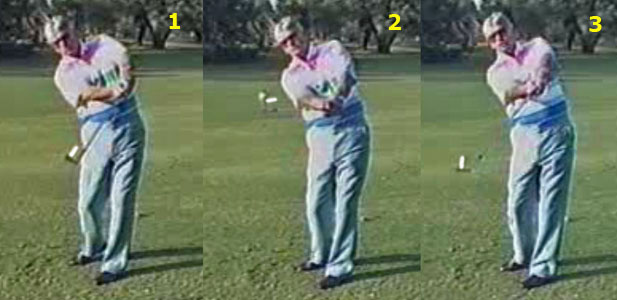
Homer Kelley states that it's good to practice all of the hinge motions with just the left arm only. I agree. Always good to understand them all and be able to execute them all so you can get a good feel and sense for each action and then be able to use that knowledge and FEEL in order to operate your preferred hinge action time and time again. For instance, I can execute horizontal hinging, but I used Angled Hinging in my normal swing. While I'm not as consistent at executing horizontal hinging, just understanding and sensing that hinge action has helped me with my angled and vertical hinge action. Here again is the pics of Tommy Tomasello displaying the different Hinge Actions from Jeff Mann's Web site.


#1 Pic = Angled Hinge = No Roll FEEL
#2 Pic = Horizontal Hinge = Full Roll FEEL
#3 Pic = Vertical Hinge = Reverse Roll FEEL

Chronic Fades and Pushes can mean insufficient Roll. Chronic Draws and Pulls can mean excessive Roll.
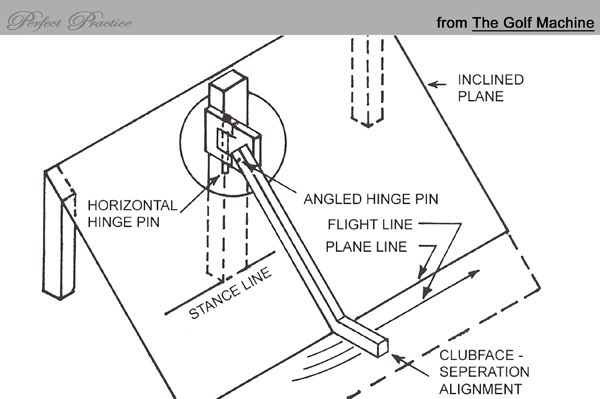
It's important to note that the 'machine' has a 'hinge pin' attached to it. Here's a diagram of the 'machine.'


Homer states:

The 'Hinges' are actually mounted at the Left Shoulder but the real control comes with moving or holding the Left Wrist in the positions called for by the respective Hinge arrangements.
Here's a couple of Lynn Blake videos talking about the hinge action and the 'hinge pin.'


So the hinge action deals a lot with the the left arm hinging from the left shoulder joint. The problem a lot of golfers have is that they:

1. Use the wrong Hinge Action for their swing

This occurs when a 'hitter' uses a horizontal hinge action. Or even worse, when a hitter or a swinger uses a vertical hinge action on a full swing. I used to have a problem with the latter. My grip was so strong and my clubface was so closed at the top, I started to open the clubface on the downswing as a means to square the clubface at impact, but that would lead to a vertical hinge action.

2. Don't execute any of the hinge actions correctly.

Usually this comes from flipping at impact or the golfer just 'crossing over' the arms and swiveling the hands way too early. Thru the impact interval the golfer should make their hinge action first, then swivel the hands to finish.


3JACK

Friday, October 2, 2009

3Jack's Translation of TGM: Part 8B


7-8 (The Fix)

7-8 talks about impact fix which is about feeling and sensing the correct impact alignments at impact.

Homer notes:

Impact conditions are not the same as in the Address except for Clubshaft angle. The most important single differences is that the Left Wrist is bent at Address, but not at impact. Therefore, precision alignment of the Grip can be taken only in the Impact position. Secondly, the Left Shoulder is higher at Impact so the player must be positioned accordingly for proper Shoulder-to-Ball distance.
As I talked about in the Results to the Latest Poll Question, there's still a top 10 teacher talking golfers should try and emulate their address position at impact. As you can see, that couldn't be further from the truth.


Even Homer's mention that the clubshaft angle is the same doesn't apply to everybody. The clubshaft angle CAN be the same, but usually it's not. The pics above of Mac O'Grady show a golfer very close to having the same shaft angle, but they are clearly not the same angles.

Homer also notes 'They (the hands) must appear to be near or covering, the Left Toe -- nowhere near the ball.'

This talking about the 'Visual Equivalents' and at impact the hands should APPEAR to be near or covering the left toe. For instance, take a club and address the ball. Now, just forward press your hands until they are 'covering' the left toe. That's what your hands at impact should look like. That's why Homer talks about the hands looking like they cover your left toe from the golfer's perspective. Homer also suggests just switching back and forth between address hands (the butt of the club pointing at the belt buckle) and impact hands (covering the left toe) so you can really sense what the different between address and impact is really like. Furthermore, that's what seperates the Pro and the Hacker.


7-9 (The Address)

Where impact fix has the golfer feeling and sensing the alignments at impact before they start the swing, the Address Position is simply the position the golfer is in before they start the backstroke. So a lot of time it is the golfer stepping to the ball and aligning their body and clubface to the target. Then they go to impact fix (sensing and feeling what the impact alignments will be like), this will have their hands at 'impact hands'. Then once they sense and feel the proper impact alignments (impact fix), they go their regular address position (usually 'mid-body' hands).


3JACK

Thursday, October 1, 2009

3Jack's Translation of TGM: Part 8A


7-5 (Plane Line)


The above pic shows what the 'machine' at its base form looks like. The principles of this machine are the same as somebody properly swinging along a plane board.


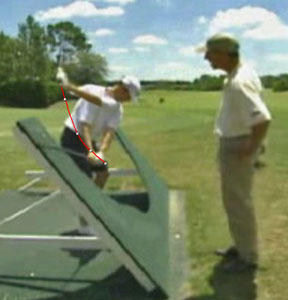
If you look at the top diagram, it shows where the plane line is. It is the line at the bottom of the plane board. The club should point at the plane line throughout the swing (except when the clubshaft is parallel to the ground). This Martin Hall video basically explains having a 'straight plane line' with the SmartStick Training Aid.


We talk about 'swinging left' here in accordance to D-Plane, but all that means is keeping the face square to the target at impact and just 'moving the plane board' only a couple of degrees or so to the left and swinging along that 'imaginary plane board.'

But the thing to remember here is that the plane line and the line of flight of the ball are not always the same. 'Swinging Left' in accordance to D-Plane shows that. The same could be said if the golfer wants to hit a draw or a fade. The plane line has to be left of the clubface angle at impact for a fade and right of the clubface angle at impact for a draw. How you move the plane line will be discussed when I translate Chapter 10.


7-6 (Basic Plane Angles)

Basic Plane Angles are essentially the 'flatness' or the 'steepness' of the backswing.


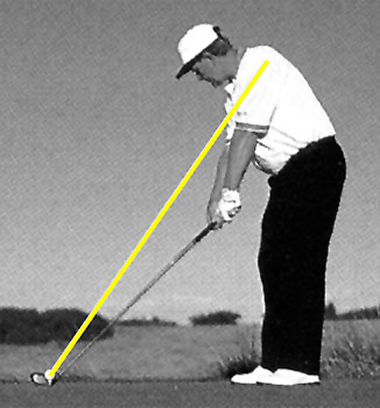
As you can see, Mr. Hogan and Mr. Nicklaus have different looking backswings because they swing on different plane angles. But obviously neither is 'wrong' or 'better', just better for their bodies, abilities, and skills.

No Plane is technically too flat or too steep unless it allows the Heel or Toe of the Club to touch the ground before Seperation or without compensating. Ball location and Plane Angle are closely associated. As the Plane Angle steepens, the Ball must moved forward to control Divot depth. Never TRY to 'take' -- or 'not take' -- a Divot. It must be the automatic result of Ball Placement AND Plane Angle.

7-7 (Plane Angle Variations)

Plane Angle Variations is sort of like Jim Hardy's 'one plane' and 'two plane' swing, although I'm not a fan of the way Hardy simplifies it, nor the amount of importance he places upon it. In TGM, plane angle variations can be things like a 'zero shift', a 'single shift', a 'double shift', etc. Very few golfers can swing right along a large plane board. Instead, they usually will naturally 'lift' their hands and arm above the imaginary plane board and then they might drop them back on the imaginary plane board on the downswing.


3JACK

A Look Into The Latest Poll Results


In the latest poll question 'What Do You Think Is The Biggest Problem Facing the Game of Golf Right Now?', the results were as follows:

Slow Pace of Play: 19 votes (31%)

Lack of Quality Instruction: 18 votes (29%)

Memberships Too Expensive: 16 votes (26%)

Equipment Too Expensive: 3 votes (4%)

Overestimation of 'Tiger-Mania': 3 votes (4%)

Not Enough Exciting Players On Tour: 2 votes (3%)


Interesting results. Slow Pace of Play is probably more annoying to other people as I'm not married nor do I have children. I can't stand slow play, but it's not as big of a factor in my golfing life as it is for most people. The people have spoken when it comes to the lack of quality instruction. It's really a situation where you guess if some top teacher will work out for you and when they don't or their instruction only brings small improvement in your game, you wonder how these guys get top 100 teacher credentials. I'd really like to take a poll of Golf Digest's Top 50 instructors and ask them what causes the initial direction and curvature of ball flight. I'm willing to guess that less than 10% get it right. In fact, in the latest edition of Golf Digest, Jim Flick (ranked #5 instructor in the world), claimed that at impact you should emulate your address position. Not only do we know this to be horrendously incorrect, but here's a look at Nicklaus' address and impact positions, a guy that Flick used to teach.


(Thanks to Somax Sports for the pics)

The others are pretty self-explanatory for the most part. I thought the expense of equipment would've been a problem, but the major OEM's have done a good job of reducing their prices in order to suit the golfer in this company.

I put in the 'Overestimation of Tiger-Mania.' What basically happened is that corporations thought 'Tiger Mania' would cause the golf market to boom. This generated more equipment companies, jacked up the price of equipment, more courses were built, prices of golf went up and all that happened was more people would watch golf, if and only if Tiger was in contention on Sunday (believe me, I did a study on this during college). My golf membership is such where I get to be a member at 23 courses in the Atlanta area. Basically the corporation that owns these companies came up with a smart business model where they bought up all these distressed properties that were built in the late 90's.

And having gone to college in the Myrtle Beach area, I've seen up close and personal how destructive the overestimation of 'Tiger Mania' can help kill a city's economy.

Anyway, I'll have a new poll up. I'd appreciate it if you can give your feedback.


3JACK